
Incall or Outcall are common service terms that many people see online. These words often appear in beauty, wellness, repair, consulting, and personal service industries. Many users get confused because both terms relate to appointments and customer visits.
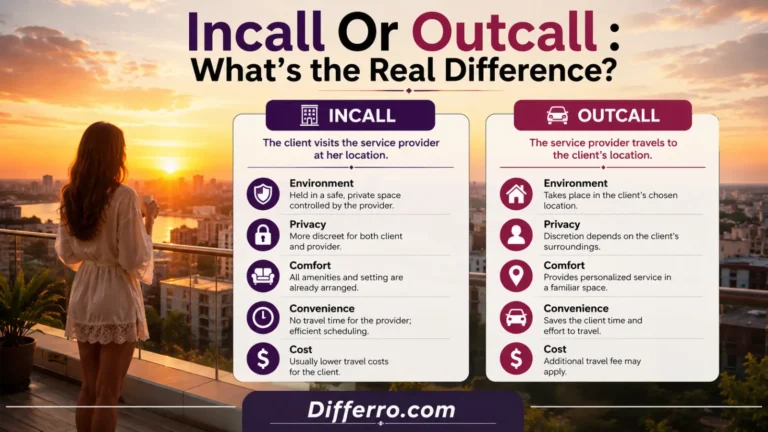
The difference is simple. “Incall” means the customer goes to the service provider’s location. “Outcall” means the service provider travels to the customer’s location.
Understanding these terms helps you book services correctly. It also prevents confusion during appointments. Both words are widely used in business listings, advertisements, and booking platforms.
In this guide, you will learn the meaning of each word, the key differences, usage tips, common mistakes, and search trends across different countries.
⭐ Quick Answer
Incall means the client visits the provider’s location for a service.
Outcall means the provider travels to the client’s location.
Example:
- Incall: “The client visited the office for the meeting.”
- Outcall: “The technician came to the customer’s home.”
📘 Meaning of Incall
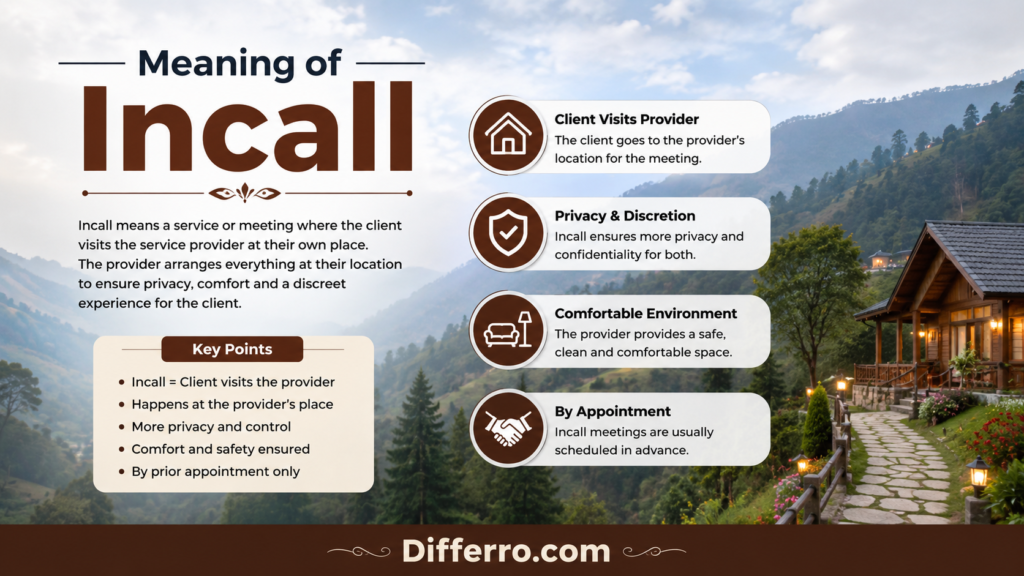
Incall refers to a service where the customer travels to the provider’s place.
This location could be:
- An office
- A studio
- A clinic
- A salon
- A business location
Examples:
- “She booked an incall appointment at the spa.”
- “The consultant only accepts incall meetings.”
📘 Meaning of Outcall
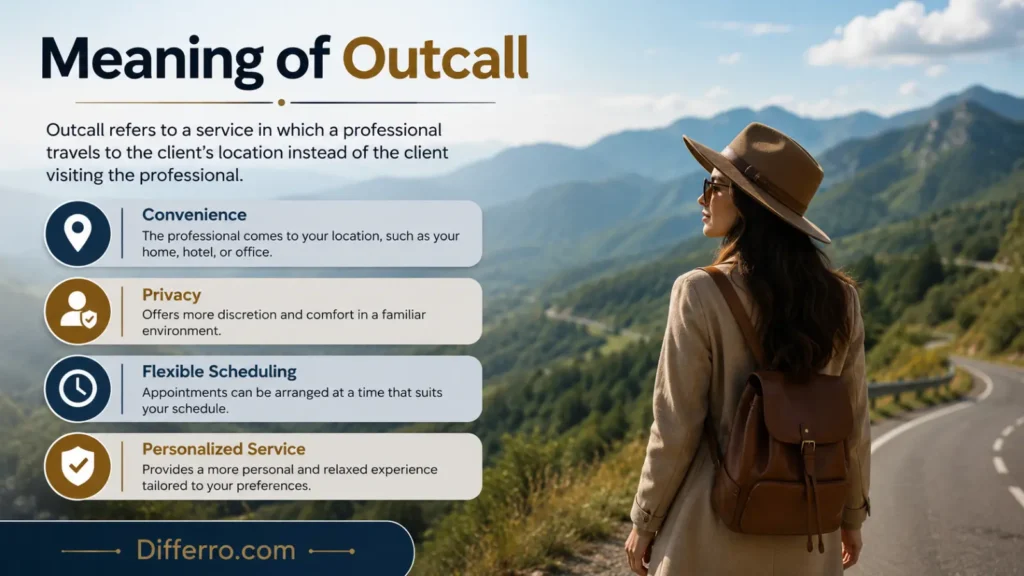
Outcall refers to a service where the provider visits the customer’s location.
This is common in:
- Home repair
- Beauty services
- Consulting
- Mobile services
Examples:
- “The plumber offers outcall services.”
- “He requested an outcall massage session.”
📊 Key Differences Between Incall and Outcall
| Feature | Incall | Outcall |
|---|---|---|
| Meaning | Customer visits provider | Provider visits customer |
| Travel | Client travels | Service provider travels |
| Usage | Offices, clinics, salons | Home services, mobile services |
| Tone | Professional and location-based | Flexible and convenient |
| Popularity | Common in fixed businesses | Popular in mobile services |
🕰️ Origin & History
The words incall and outcall developed from customer service industries. Businesses needed simple terms to explain where appointments would happen.
- “In” refers to coming into a location.
- “Out” refers to going outward to another location.
These terms became popular with:
- Hospitality businesses
- Mobile services
- Repair companies
- Wellness industries
Similar Word Examples
- Check-in / Check-out
- Walk-in / Drive-out
- Login / Logout
🇬🇧 British English vs American English Spelling
Both incall and outcall are used in British and American English. The spelling usually stays the same in both versions.
American English often uses these terms in business marketing. British English uses them more in service-based industries.
There is no major spelling difference between the two regions.
📋 British vs American English Comparison Table
| Feature | British English | American English |
|---|---|---|
| Incall | Common in service ads | Common in business listings |
| Outcall | Used in mobile services | Frequently used in customer services |
| Spelling Difference | None | None |
| Usage Style | Formal and business-focused | Marketing-focused |
✅ When to Use Incall
Use incall when:
- The customer visits the provider
- The service happens at a fixed location
- The business has an office or studio
Examples:
- “The lawyer offers incall consultations.”
- “Incall appointments are available from Monday to Friday.”
✅ When to Use Outcall
Use outcall when:
- The provider travels to the customer
- The service is mobile
- Convenience is important
Examples:
- “The makeup artist provides outcall services.”
- “Outcall repairs cost extra because of travel.”
❌ Common Mistakes
| Incorrect Usage | Correct Usage |
|---|---|
| “I booked an outcall at the clinic.” | “I booked an incall at the clinic.” |
| “The client traveled for the outcall.” | “The client traveled for the incall.” |
| “Incall means home service.” | “Outcall means home service.” |
| “Outcall always costs less.” | “Outcall may cost more due to travel.” |
🧠 Easy Trick to Remember
- Incall = INside the provider’s place
- Outcall = OUTside visit to the customer
This simple memory trick helps avoid confusion.
✨ Write 5 Examples
1. Beauty Services Example
“The salon only accepts incall bookings during weekends.”
2. Home Repair Example
“The electrician provides outcall services for nearby areas.”
3. Business Meeting Example
“The company arranged an incall meeting at the office.”
4. Healthcare Example
“The nurse offers outcall visits for elderly patients.”
5. Fitness Training Example
“The trainer charges extra for outcall sessions.”
🔍 Related Keywords
- incall meaning
- outcall meaning
- incall vs outcall
- difference between incall and outcall
- outcall services
- incall appointment
- mobile service terms
📈 Google Trends & Usage Data
In the USA, “outcall” gets strong searches because mobile services are popular.
Meanwhile, both terms appear in professional service listings and wellness industries across the UK.
Australian users search both keywords equally for booking-related services.
In India and Pakistan, many people look up these terms to understand business service meanings.
Overall, “outcall” often receives slightly more searches because home services continue to grow worldwide.
📊 Comparison Table: Keyword Variations
| Keyword Variation | Search Intent |
|---|---|
| incall meaning | Definition |
| outcall meaning | Definition |
| incall vs outcall | Comparison |
| outcall services | Service search |
| incall appointment | Booking-related |
| mobile outcall service | Local service |
| professional incall | Business usage |
FAQs ,
Is “incall” a correct word?
Yes. “Incall” is a valid business and service term.
What is the difference between incall and outcall?
Incall means the customer visits the provider. Outcall means the provider visits the customer.
Which is more common?
Outcall is becoming more common because mobile services are increasing.
Are these words formal?
Yes. They are commonly used in professional service industries.
Why does confusion exist?
People confuse the travel direction between the client and the provider.
🏁 Final Verdict
Both incall and outcall are correct words. The right choice depends on who travels for the service.
Use incall when the customer visits the business location.
Use outcall when the service provider travels to the customer.
Understanding this difference helps businesses explain services clearly and helps customers book correctly.
📝 Conclusion
Incall or Outcall may seem confusing at first, but the difference is easy to understand. Incall means the customer goes to the provider’s location. Outcall means the provider travels to the customer.
These terms are widely used in service industries, business listings, and appointment systems. Knowing the correct meaning improves communication and prevents booking mistakes.
Both words are correct and professional. The best choice depends on where the service takes place. If the service happens at a business location, use incall. If the provider travels to the client, use outcall.
Learning these terms also helps you understand online service listings more confidently.
Discover More Post ,
Knick Or Nick : Which Word Should You Use?
Carrys Or Carries : Which Spelling Is Correct?
Honour Or Honor : Which Spelling Is Correct?

Sara Taylor is a passionate writer and language enthusiast. She specializes in creating simple and easy-to-understand articles about English grammar, spelling differences, and commonly confused words. Her writing style focuses on helping students, writers, and English learners improve their language skills with confidence. Through informative guides and practical examples, Sara makes complex grammar topics easier for everyday readers.