
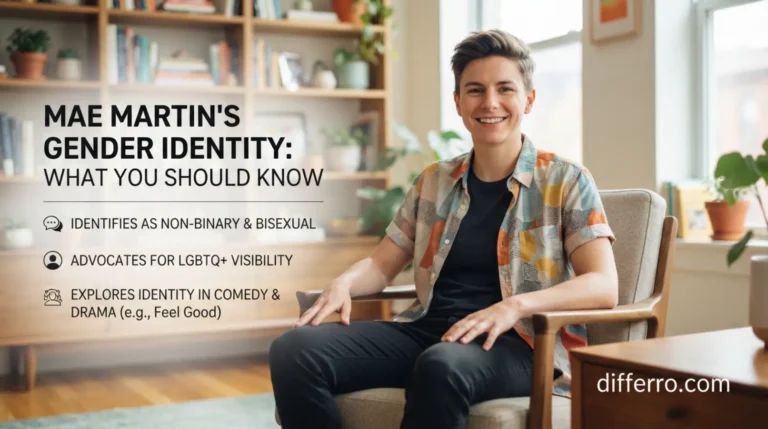
Mae Martin male or female is a common search query about the Canadian comedian, actor, and writer. Many people want to understand Mae Martin’s gender identity and the pronouns they use. Mae Martin is known for stand-up comedy, television appearances, and the Netflix series Feel Good. Their work often explores identity, relationships, and personal experiences.
Mae Martin identifies as non-binary, meaning they do not identify exclusively as male or female. They use they/them pronouns, although their pronoun preferences and public descriptions should always be understood in context. Non-binary people may have different identities and pronoun preferences. Therefore, it is important to respect how each person describes themselves.
This article explains Mae Martin’s gender identity, the meaning of non-binary, and the correct pronouns to use. It also addresses common misconceptions and answers frequently asked questions. The goal is to provide clear, respectful information without confusing gender identity with biological sex or appearance.
⭐ Quick Answer
Mae Martin identifies as non-binary, rather than exclusively male or female. They are a Canadian comedian, actor, and writer who uses they/them pronouns.
Example: Instead of saying, “He is a comedian” or “She is a comedian,” you can say, “They are a comedian.”
Meaning of Mae Martin’s Gender Identity
What Does Non-Binary Mean?
Non-binary describes a gender identity that does not fit exclusively into the categories of man or woman. Some non-binary people feel their gender falls between these categories, while others experience gender differently.
Non-binary is an umbrella term. It can include several gender identities, and every person’s experience may differ.
Examples:
- Example 1: A person identifies as neither exclusively male nor exclusively female and describes themselves as non-binary.
- Example 2: Someone identifies outside the traditional male-female categories and prefers they/them pronouns.
These examples illustrate the term generally. They do not describe every non-binary person’s experience.
What Does Male or Female Mean?
Male and female can refer to biological sex categories, which involve characteristics such as reproductive anatomy, hormones, and chromosomes. People commonly use these terms in medical or biological contexts.
Gender identity is different. It refers to a person’s internal understanding of their gender.
Examples:
- Example 1: A person may identify as a man and use he/him pronouns.
- Example 2: A person may identify as a woman and use she/her pronouns.
Some people identify outside these categories. Mae Martin identifies as non-binary.
🔍 Mae Martin Male or Female: Key Differences Explained
Mae Martin’s gender identity differs from the traditional male-or-female classification. Understanding the following terms helps explain the distinction.
| Feature | Male | Female | Non-Binary |
|---|---|---|---|
| General meaning | A sex or gender category, depending on context | A sex or gender category, depending on context | A gender identity outside exclusively male or female categories |
| Gender identity | May describe someone who identifies as a man | May describe someone who identifies as a woman | Describes someone whose gender does not fit exclusively into either category |
| Pronouns | Often he/him | Often she/her | May include they/them, she/her, he/him, or other pronouns |
| Usage | Everyday, social, and biological contexts | Everyday, social, and biological contexts | Gender identity discussions and personal descriptions |
| Application to Mae Martin | Not an accurate exclusive gender label | Not an accurate exclusive gender label | Matches Martin’s publicly stated identity |
Important: Mae Martin publicly identified as non-binary in 2021. At that time, Martin stated that they used both they/them and she/her pronouns.
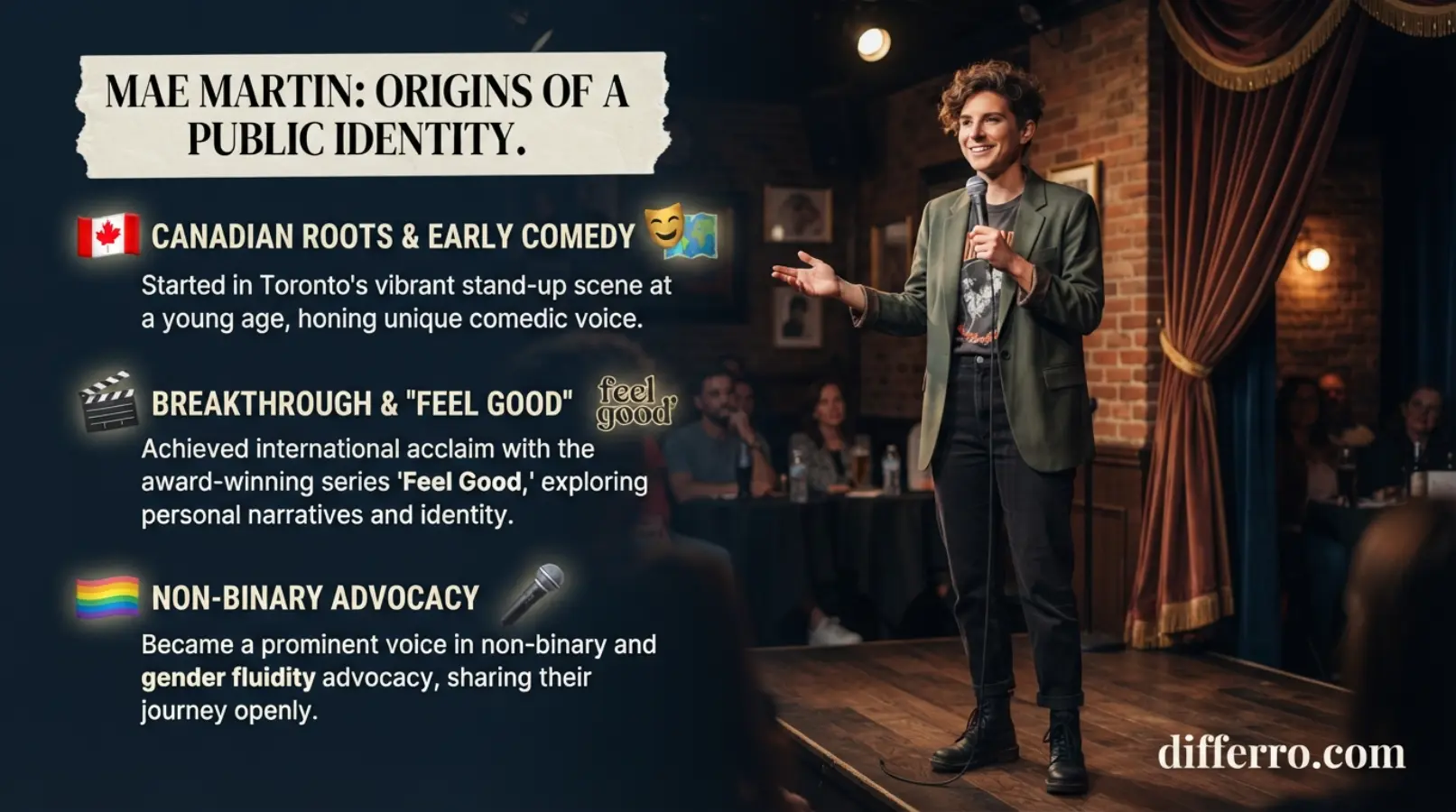
🕰️ Origin and History of Mae Martin’s Public Identity
Mae Martin built a career in stand-up comedy before gaining wider recognition through television. Their semi-autobiographical Netflix series, Feel Good, explores relationships, sexuality, addiction, and gender identity.
In April 2021, Martin publicly discussed their non-binary identity. They explained their pronoun preferences and described their understanding of gender as personal and evolving.
Martin’s public discussion helped more viewers understand non-binary identities. Their career also shows how comedy can explore personal experiences and social expectations.
Similar Gender Identity Terms
- Non-binary: An umbrella term for gender identities outside exclusively male or female categories.
- Transgender: A term for people whose gender identity differs from the sex assigned to them at birth.
- Cisgender: A term for people whose gender identity aligns with their sex assigned at birth.
- Gender identity: A person’s internal understanding of their gender.
- Pronouns: Words people use to refer to someone, such as they, she, or he.
These terms have different meanings. They should not be used interchangeably.
🇬🇧 British English vs American English
The terms male, female, and non-binary have the same standard spelling in British and American English.
Both countries use non-binary when discussing gender identities outside exclusively male or female categories.
The spelling remains the same, although individual publications may follow different style guides.
British vs American English Comparison
| Term | British English | American English |
|---|---|---|
| Male | Male | Male |
| Female | Female | Female |
| Non-binary | Non-binary | Non-binary |
| Gender identity | Gender identity | Gender identity |
| Pronouns | Pronouns | Pronouns |
👤 When to Use Each Term
When to Use Male
Use male when discussing biological sex or a person’s gender, where that description accurately reflects the context and individual.
However, do not assume someone identifies as a man simply because of their appearance.
Example: “The study examined health outcomes among male participants.”
For Mae Martin, describing them simply as male would not accurately communicate their publicly stated non-binary identity.
When to Use Female
Use female when the term fits the biological, medical, or gender context.
Avoid automatically describing a person as a female comedian when they have publicly explained that this label does not reflect their identity.
Example: “The report examined health outcomes among female participants.”
Martin previously expressed concern about being inaccurately labelled a female comedian.
When to Use Non-Binary
Use non-binary when describing someone whose gender identity does not fit exclusively into male or female categories.
Example: “Mae Martin is a non-binary comedian and actor.”
This description reflects Martin’s publicly stated identity.
Which Pronouns Should You Use for Mae Martin?
Martin has publicly used they/them and she/her pronouns. Recent profiles commonly use they/them when referring to Martin.
Here are examples of respectful usage:
- They: “Mae Martin is a comedian. They perform stand-up.”
- She: “Mae Martin is a comedian. She performs stand-up.”
- Name repetition: “Mae Martin is a comedian. Martin performs stand-up.”
When discussing a public figure, follow their stated preferences and reliable, current biographical information.
⚠️ Common Mistakes About Mae Martin’s Gender Identity
Mistake 1: Assuming Mae Martin Is Exclusively Male or Female
Incorrect: “Mae Martin must be either a man or a woman.”
Correct: “Mae Martin identifies as non-binary.”
Mistake 2: Confusing Gender Identity With Sexual Orientation
Incorrect: “Mae Martin’s sexuality determines their gender.”
Correct: “Gender identity and sexual orientation describe different aspects of a person.”
Martin has publicly described themself as bisexual and non-binary.
Mistake 3: Assuming Pronouns From Appearance
Incorrect: “Mae Martin looks masculine, so only he/him pronouns must apply.”
Correct: “Use pronouns that reflect the person’s stated preferences.”
Appearance alone does not establish someone’s gender identity or pronouns.
Mistake 4: Treating Non-Binary as Another Word for Male or Female
Incorrect: “Non-binary simply means male or female.”
Correct: “Non-binary describes gender identities that do not fit exclusively into the categories of man or woman.”
Mistake 5: Assuming Every Non-Binary Person Uses They/Them
Incorrect: “All non-binary people use they/them pronouns.”
Correct: “Non-binary people use different pronouns according to their individual preferences.”
Martin publicly stated that they used both they/them and she/her pronouns.
🧠 Easy Trick to Remember
Use this simple memory tip:
- Male: A sex or gender category, depending on context.
- Female: A sex or gender category, depending on context.
- Non-binary: A gender identity that is not exclusively male or female.
- Pronouns: Words used to refer to someone.
Remember: Mae Martin identifies as non-binary. Their public pronoun preferences have included they/them and she/her.
🌟 Everyday-Life Examples: Mae Martin Male or Female
1. Someone Searches for Mae Martin’s Gender
A viewer watches Feel Good and wonders whether Mae Martin is male or female.
Answer: Mae Martin identifies as non-binary, rather than exclusively male or female.
2. A Viewer Discusses Mae Martin’s Comedy
A fan wants to describe Martin to a friend.
Example: “Mae Martin is a talented comedian and actor. They also created Feel Good.”
This sentence uses they/them pronouns naturally.
3. Someone Confuses Gender With Sexuality
A viewer learns that Martin is bisexual and assumes this explains their gender identity.
Correction: Bisexuality describes sexual orientation, while non-binary describes gender identity.
4. A Writer Creates a Biography
A blogger wants to introduce Mae Martin in an entertainment article.
Example: “Mae Martin is a Canadian comedian, actor, and writer who identifies as non-binary.”
This wording is clear, informative, and respectful.
5. Someone Asks About Mae Martin’s Pronouns
A reader wants to know whether to use they/them or she/her.
Answer: Martin publicly stated that both sets of pronouns were acceptable to them. Recent coverage commonly uses they/them.
🌍 Google Trends and Search Interest: Five Countries
Google Trends reports relative search interest rather than exact search volumes. The following observations are general expectations, not verified country rankings.
- USA: Searchers may look for Mae Martin’s gender identity, pronouns, and television career.
- UK: Interest may relate to Feel Good, British television appearances, and Martin’s comedy.
- Australia: Users may search for Martin’s identity, stand-up performances, and Netflix shows.
- India: Searchers may seek straightforward explanations of Martin’s gender identity and pronouns.
- Pakistan: Searches may focus on whether Martin is male or female and what non-binary means.
SEO insight: Compare the exact keyword with related phrases in Google Trends for each country. Use the same date range and search category to make a fair comparison. Do not claim one country has the highest interest without checking current data.
Comparison Table: Keyword Variations
| Keyword variation | Search intent | Recommended content placement |
|---|---|---|
| Mae Martin male or female | Gender identity question | Title and introduction |
| Is Mae Martin non-binary? | Identity clarification | Quick Answer |
| Mae Martin gender identity | Informational | Main explanation |
| Mae Martin pronouns | Pronoun information | Pronouns section |
| Mae Martin sexuality | Sexual orientation | Related explanation |
| Mae Martin biography | General information | Introduction or biography |
| Mae Martin they/them pronouns | Pronoun clarification | FAQ section |
❓ Frequently Asked Questions
1. Is Mae Martin male or female?
Mae Martin identifies as non-binary, meaning they do not identify exclusively as male or female. They publicly discussed their gender identity in 2021.
2. What is the difference between male, female, and non-binary?
Male and female can describe biological sex or gender, depending on context. Non-binary describes a gender identity that does not fit exclusively into the categories of man or woman.
3. Which pronouns does Mae Martin use?
Martin publicly stated that they use they/them and she/her pronouns. Many recent profiles use they/them when referring to Martin.
4. How should writers describe Mae Martin formally?
Writers can describe Martin as a Canadian comedian, actor, and writer who identifies as non-binary. They should use respectful language and accurate pronouns.
5. Why are people confused about Mae Martin’s gender?
People may be unfamiliar with non-binary identities or may assume gender from appearance. Martin has also discussed receiving inaccurate labels in media coverage. Their public explanation helped clarify their identity.
🏆 Final Verdict: Is Mae Martin Male or Female?
Mae Martin identifies as non-binary, rather than exclusively male or female. They are a Canadian comedian, actor, and writer known for projects including Feel Good.
Martin publicly stated that they use they/them and she/her pronouns. Many current profiles use they/them. Writers should respect Martin’s stated identity and avoid assumptions based on appearance.
The key distinction is simple: gender identity describes how someone understands their gender, while sexual orientation describes patterns of attraction. These concepts are different, and one does not determine the other.
If you searched “Mae Martin male or female,” the clearest answer is that Martin identifies as non-binary. This description reflects their public statements and provides a respectful way to understand their identity.
Conclusion
The question “Mae Martin male or female” reflects curiosity about the comedian’s gender identity. Mae Martin identifies as non-binary, meaning they do not identify exclusively as male or female.
Martin publicly discussed their identity in 2021 and stated that they use they/them and she/her pronouns. Recent biographical coverage commonly uses they/them.
Understanding these terms helps readers discuss public figures accurately and respectfully. Male, female, and non-binary do not mean the same thing. Gender identity also differs from sexual orientation, which describes attraction.
When writing about Mae Martin, use their name, respect their stated identity, and choose pronouns supported by reliable information. This approach keeps entertainment articles clear, accurate, and inclusive.

Imran Lodhra is a comparison-focused content writer at Differro.com.
He specializes in creating clear, simple, and informative comparison articles.
His work helps readers understand key differences, pros and cons, and important details.
Imran focuses on accurate, practical, and easy-to-read content for everyday readers.