
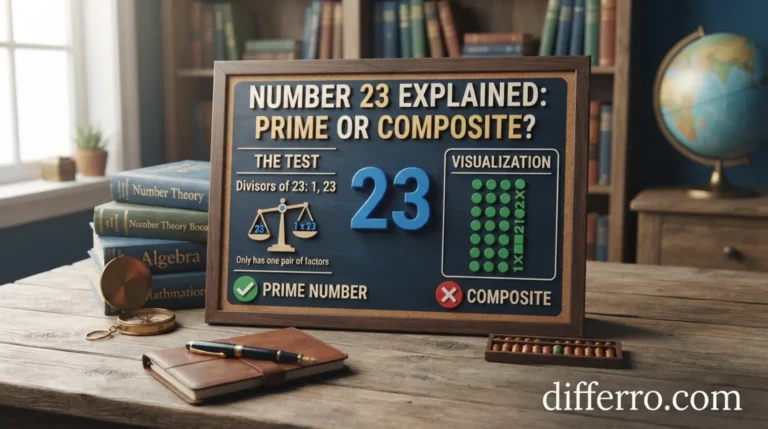
Number 23 Explained: Prime or Composite? This question helps students understand an important concept in mathematics. The number 23 may look simple, but knowing its classification builds strong number theory skills.
A prime number has exactly two positive factors: 1 and itself. A composite number has more than two positive factors. Understanding this difference makes it easier to classify whole numbers correctly.
So, is 23 a prime number or a composite number? The answer becomes clear when we examine its factors. We can divide 23 evenly by 1 and 23, but no other positive whole numbers divide it without a remainder.
This article explains why 23 is prime, how prime numbers differ from composite numbers, and how to identify them. You will also find simple examples, common mistakes, and practical tips. These explanations make the topic easier for students, parents, and anyone learning basic mathematics.
⭐ Quick Answer
The number 23 is a prime number because it has exactly two positive factors: 1 and 23. No other positive whole number divides 23 evenly.
Example: 23 ÷ 1 = 23, and 23 ÷ 23 = 1. Therefore, 23 is prime, not composite.
📘 Meaning of a Prime Number
A prime number is a whole number greater than 1 with exactly two positive factors: 1 and itself.
These numbers cannot be divided evenly by other positive whole numbers.
Examples of Prime Numbers
Example 1: Number 7
The positive factors of 7 are 1 and 7. Therefore, 7 is prime.
Example 2: Number 13
The positive factors of 13 are 1 and 13. Therefore, 13 is also prime.
Why Is 23 a Prime Number?
The number 23 follows the same rule.
Its positive factors are:
- 1
- 23
Only these two positive whole numbers divide 23 without leaving a remainder.
Therefore, 23 is a prime number.
📗 Meaning of a Composite Number
A composite number is a whole number greater than 1 that has more than two positive factors.
Unlike prime numbers, composite numbers can divide evenly by numbers other than 1 and themselves.
Examples of Composite Numbers
Example 1: Number 12
The positive factors of 12 are 1, 2, 3, 4, 6, and 12.
Since 12 has six positive factors, it is composite.
Example 2: Number 15
The positive factors of 15 are 1, 3, 5, and 15.
Since 15 has four positive factors, it is composite.
Why Is 23 Not Composite?
The number 23 has only two positive factors: 1 and 23.
No other positive whole number divides it evenly.
Therefore, 23 does not meet the definition of a composite number.
🔍 Prime vs Composite Numbers: Key Differences
Prime and composite numbers differ mainly in their number of positive factors.
| Feature | Prime Number | Composite Number |
|---|---|---|
| Meaning | Has exactly two positive factors | Has more than two positive factors |
| Mathematical classification | Prime | Composite |
| Factors | Only 1 and itself | More than 1 and itself |
| Smallest example | 2 | 4 |
| Example numbers | 2, 3, 5, 7, 11, 23 | 4, 6, 8, 9, 12, 15 |
| Divisibility | No other positive whole number divides it evenly | At least one other positive whole number divides it evenly |
| Number 23 | Prime | Not composite |
Remember: The number 1 is neither prime nor composite because it has only one positive factor.
📚 Origin and History of Prime Numbers
Prime numbers have fascinated mathematicians for thousands of years. Ancient Greek mathematicians studied their properties and developed methods to identify them.
The Greek mathematician Euclid made important contributions to number theory. His work established fundamental results about prime numbers, including the fact that infinitely many primes exist.
Another important method is the Sieve of Eratosthenes. This method identifies prime numbers by removing multiples of smaller prime numbers.
Similar Mathematical Terms
- Prime number: A number with exactly two positive factors.
- Composite number: A number with more than two positive factors.
- Factor: A whole number that divides another number without a remainder.
- Multiple: A number obtained by multiplying a number by an integer.
- Divisibility: The ability of one number to divide another without a remainder.
These terms help students understand why 23 belongs to the prime number category.
🇬🇧 British English vs American English Spelling
The terms prime number and composite number have the same spelling in British and American English.
Both countries use the same mathematical definitions and symbols for these concepts.
Only some related mathematical vocabulary or teaching preferences may vary between educational settings.
British vs American English Comparison
| Feature | British English | American English |
|---|---|---|
| Prime number | Prime number | Prime number |
| Composite number | Composite number | Composite number |
| Factor | Factor | Factor |
| Mathematical meaning | Same | Same |
| Number 23 classification | Prime | Prime |
🧮 When to Identify a Number as Prime
A number is prime when it has exactly two positive factors: 1 and itself.
You can check a number by testing whether smaller prime numbers divide it evenly.
Example: Is 23 Prime?
Let’s test the number 23.
- 23 ÷ 2 leaves a remainder.
- 23 ÷ 3 leaves a remainder.
- 23 ÷ 5 leaves a remainder.
We only need to test prime divisors up to the square root of 23. Its square root is approximately 4.8.
Therefore, checking 2 and 3 is sufficient because these are the only prime numbers below 4.8.
Neither divides 23 evenly.
Conclusion: 23 is prime.
🧩 When to Identify a Number as Composite
A number is composite when it has more than two positive factors.
You can identify a composite number by finding a divisor other than 1 and itself.
Example: Is 24 Composite?
Let’s examine the number 24.
- 24 ÷ 2 = 12
- 24 ÷ 3 = 8
- 24 ÷ 4 = 6
These divisions leave no remainder.
The positive factors of 24 include 1, 2, 3, 4, 6, 8, 12, and 24.
Therefore, 24 is a composite number.

⚠️ Common Mistakes When Classifying Number 23
Mistake 1: Calling 23 a Composite Number
Incorrect: 23 is composite because it is greater than 10.
Correct: 23 is prime because it has exactly two positive factors.
A number’s size does not determine whether it is prime or composite.
Mistake 2: Forgetting That 1 Is a Factor
Incorrect: The only factor of 23 is 23.
Correct: The positive factors of 23 are 1 and 23.
Every positive integer has 1 as a positive factor.
Mistake 3: Thinking Every Odd Number Is Prime
Incorrect: Every odd number is prime.
Correct: Some odd numbers are composite. For example, 9 has factors 1, 3, and 9.
Being odd does not automatically make a number prime.
Mistake 4: Confusing Factors With Multiples
Incorrect: 46 is a factor of 23.
Correct: 46 is a multiple of 23 because 23 × 2 = 46.
A factor divides a number evenly, while a multiple results from multiplication.
Mistake 5: Calling 1 a Prime Number
Incorrect: 1 is prime because only 1 divides it.
Correct: 1 is neither prime nor composite because it has only one positive factor.
Prime numbers must have exactly two distinct positive factors.
Mistake 6: Assuming a Remainder Means Composite
Incorrect: 23 is composite because 23 ÷ 2 leaves a remainder.
Correct: A remainder shows that 2 is not a factor of 23.
To establish that 23 is prime, we must rule out all possible prime divisors up to its square root.
🧠 Easy Trick to Remember
Use this simple rule:
Prime = exactly two positive factors.
Composite = more than two positive factors.
Now apply the rule to 23.
- 1 divides 23 evenly.
- 23 divides itself evenly.
- No other positive whole number divides it evenly.
Therefore, 23 is prime.
A Quick Memory Tip
Think of prime numbers as numbers with only two factor partners: 1 and themselves.
Composite numbers have additional factor partners.
For example, 23 has only 1 and 23. However, 12 has 1, 2, 3, 4, 6, and 12.
This makes the difference easier to remember.
🌟 Everyday-Life Examples: Number 23 Explained
1. Dividing 23 Apples Among Children
Suppose you have 23 apples and want to divide them equally among several children.
You can give all 23 apples to one child or give one apple to each of 23 children.
However, you cannot divide the apples equally among two or three children without leaving some apples over.
This example illustrates why 23 is prime.
2. Arranging 23 Chairs in Equal Rows
Imagine arranging 23 chairs into equal rows with the same number of chairs in each row.
You can arrange them in one row of 23 chairs or 23 rows of one chair.
You cannot create a rectangular arrangement with more than one row and more than one column using all 23 chairs.
This happens because 23 is prime.
3. Sharing 23 Chocolates Equally
Suppose a teacher has 23 chocolates for students.
The teacher can give all chocolates to one student or distribute one chocolate to each of 23 students.
However, the teacher cannot share all 23 chocolates equally among two, three, or four students.
These examples demonstrate the factor properties of a prime number.
4. Comparing 23 With 25
The numbers 23 and 25 are both odd, but they have different classifications.
The positive factors of 23 are 1 and 23.
The positive factors of 25 are 1, 5, and 25.
Therefore, 23 is prime, while 25 is composite.
This example shows why odd numbers are not always prime.
5. Checking 23 in a Mathematics Test
A student must classify 23 as prime or composite.
The student checks whether any prime number up to the square root of 23 divides it evenly.
The relevant prime numbers are 2 and 3.
Neither divides 23 without a remainder.
Therefore, the correct answer is prime number.
🌍 Google Trends and Usage Insights: Five Countries
Google Trends compares relative search interest over time. Without live data, exact rankings for this keyword cannot be verified.
- USA: Students and parents may search for prime number explanations and homework help.
- UK: Searches may focus on prime numbers, factors, and school mathematics.
- Australia: Educational searches may include prime and composite number examples.
- India: Students may search for number classifications, factor rules, and exam preparation.
- Pakistan: Students may look for simple explanations of prime numbers and mathematical exercises.
SEO insight: These are expected search intents, not verified Google Trends rankings. Compare the exact keyword with related phrases using the same country, period, and search category. This approach can reveal which wording attracts more relative interest.
Comparison Table: Keyword Variations
| Keyword Variation | Search Intent | Recommended Content |
|---|---|---|
| Number 23 Explained: Prime or Composite? | Direct answer | Main article title |
| Is 23 a Prime Number? | Quick factual answer | Featured snippet |
| Is 23 Prime or Composite? | Number classification | Introduction and FAQ |
| Factors of 23 | Mathematical explanation | Factor section |
| Why Is 23 a Prime Number? | Educational explanation | Prime number section |
| Prime vs Composite Numbers | General learning | Comparison table |
| How to Identify Prime Numbers | Learning method | Step-by-step examples |
❓ Frequently Asked Questions
1. Is 23 a prime number?
Yes, 23 is a prime number. It has exactly two positive factors: 1 and 23. No other positive whole number divides it evenly.
2. What is the difference between prime and composite numbers?
A prime number has exactly two positive factors. A composite number has more than two positive factors. For example, 23 is prime, while 24 is composite.
3. Is 23 a common prime number?
Yes, 23 is a familiar example of a prime number in school mathematics. However, whether it is more commonly searched than other prime numbers depends on the search data and context.
4. Is the classification of 23 as prime accepted in formal mathematics?
Yes, 23 is prime under the standard mathematical definition. It has exactly two distinct positive factors: 1 and itself.
5. Why do people confuse prime and composite numbers?
People may confuse these categories because both contain positive whole numbers greater than 1. The easiest way to distinguish them is to count their positive factors.
✅ Final Verdict: Is 23 Prime or Composite?
The number 23 is prime, not composite.
Its only positive factors are 1 and 23. Since no other positive whole number divides it evenly, 23 meets the definition of a prime number.
A composite number must have more than two positive factors. Numbers such as 12, 15, and 24 meet this condition, but 23 does not.
Remember the basic rule: prime numbers have exactly two positive factors, while composite numbers have more than two. The number 1 belongs to neither category.
You can use this rule to classify other numbers quickly and accurately. For larger numbers, testing prime divisors up to the square root can make the process easier.
Conclusion
Number 23 Explained: Prime or Composite? The answer is simple: 23 is a prime number because it has exactly two positive factors, 1 and 23. No other positive whole number divides it evenly.
Prime numbers have exactly two positive factors, while composite numbers have more than two. For example, 23 is prime, but 24 is composite because several numbers divide it evenly.
You can identify prime numbers by checking their possible divisors. For 23, testing 2 and 3 is sufficient because its square root is less than 5. Neither number divides 23 evenly.
Understanding these rules makes mathematics easier for students and beginners. Remember that 1 is neither prime nor composite. With practice, you can classify numbers confidently and avoid common mistakes.

Imran Lodhra is a comparison-focused content writer at Differro.com.
He specializes in creating clear, simple, and informative comparison articles.
His work helps readers understand key differences, pros and cons, and important details.
Imran focuses on accurate, practical, and easy-to-read content for everyday readers.
1 thought on “Number 23 Explained: Prime or Composite?”