
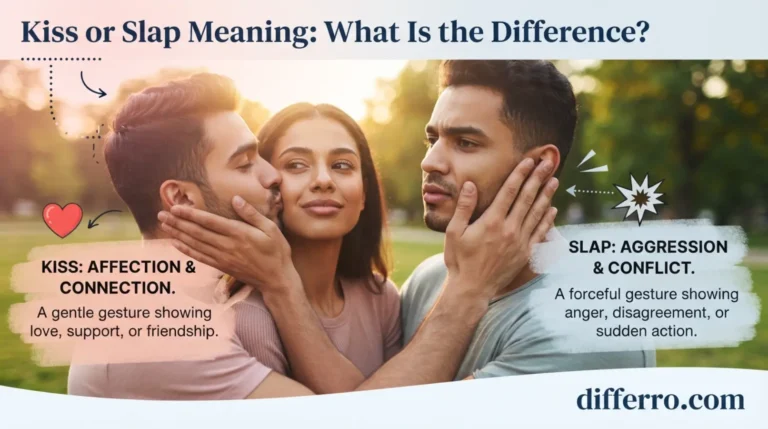
Kiss or Slap Meaning is a phrase that can describe two very different actions. A kiss usually expresses affection, love, romance, or friendship. A slap involves striking someone with an open hand, often showing anger or aggression. People may encounter this phrase in games, social media trends, relationship discussions, and everyday conversations.
Understanding the difference between kiss and slap helps you interpret the phrase correctly. The meaning often depends on the situation, tone, and relationship between the people involved. For example, a playful question might ask someone to choose between a kiss and a slap. In another context, the phrase may describe a conflict or an uncomfortable interaction.
This guide explains both words, their meanings, common uses, and differences. You will also find practical examples, common mistakes, related keywords, and answers to frequently asked questions.
⭐ Quick Answer
A kiss usually expresses affection, while a slap means striking someone with an open hand. The phrase “kiss or slap” often presents two contrasting choices, depending on the context.
Example: “Would you choose a kiss or a slap?” asks someone to choose between affection and a physical strike.
💋 Meaning of Kiss
A kiss is an action in which someone touches another person or something with their lips. People commonly kiss to express love, affection, respect, or friendship.
A kiss can also carry cultural or social meaning. Its meaning depends on the relationship, setting, and consent of everyone involved.
Examples of Kiss
Example 1: She gave her mother a kiss before leaving for school.
Example 2: The couple shared a kiss after their wedding ceremony.
Common Uses of Kiss
- Romantic affection: A kiss between partners.
- Family affection: A parent kissing a child on the forehead.
- Friendly greeting: A customary cheek kiss in some cultures.
- Symbolic meaning: The phrase “kiss of death” describes something that causes failure or ruin.
👋 Meaning of Slap
A slap is a strike made with an open hand. People often associate slapping with anger, punishment, aggression, or disrespect.
The word can also describe a sudden or forceful action in figurative expressions. For example, “a slap in the face” can mean a deeply insulting or disappointing experience.
Examples of Slap
Example 1: The argument became serious when one person threatened to slap the other.
Example 2: Losing the competition felt like a slap in the face to the team.
Common Uses of Slap
- Physical action: Striking someone with an open hand.
- Anger: Showing hostility during a conflict.
- Figurative expression: Describing an insult or painful disappointment.
- Informal language: “Slap a label on it” means applying a label quickly or casually.
Physical slapping can cause injury and may violate someone’s boundaries. Never assume another person welcomes physical contact.
🔎 Kiss or Slap: Key Differences
| Feature | Kiss | Slap |
|---|---|---|
| Meaning | Touching with the lips | Striking with an open hand |
| Typical tone | Affectionate, romantic, or friendly | Angry, aggressive, or confrontational |
| Common purpose | Expressing affection or greeting someone | Physical aggression or expressing hostility |
| Emotional effect | May communicate warmth and closeness | May cause pain, fear, or humiliation |
| Social context | Often positive when welcome | Often negative or harmful |
| Figurative usage | “Kiss of death” | “Slap in the face” |
| Everyday popularity | Common in affectionate interactions | Common in descriptions of conflict and figurative expressions |
Neither word has only one emotional meaning. A kiss may be unwelcome, and a slap may appear in fictional comedy. Context and consent matter.

📚 Origin and History of Kiss or Slap
The words Kiss or Slap Meaning have different linguistic histories.
Kiss comes from Old English cyssan, meaning to kiss. The word has long described affectionate or ceremonial contact with the lips.
Slap appeared in English as an expressive word associated with a sharp blow. Its sound helps convey the sudden impact of the action.
Both words appear in modern expressions, stories, films, and everyday conversations.
Similar Word Examples
- Kiss or hug: Two common ways to express affection.
- Hug or handshake: Two forms of greeting or social contact.
- Hit or slap: Two physical actions that can describe aggression.
- Love or hate: Opposing emotional concepts.
- Smile or frown: Facial expressions that often communicate different feelings.
These comparisons show how English frequently places contrasting actions or emotions together.
🇬🇧 British English vs American English Spelling
Kiss and slap have the same spelling in British and American English.
Both varieties also use the same basic meanings for these words.
Some related expressions may differ by region, but these two words have no standard spelling difference.
British vs American English Comparison
| Feature | British English | American English |
|---|---|---|
| Kiss | Kiss | Kiss |
| Slap | Slap | Slap |
| Past tense of kiss | Kissed | Kissed |
| Past tense of slap | Slapped | Slapped |
| General meaning | Same | Same |
💋 When to Use Kiss
Use kiss when describing contact with the lips or expressing affection, provided the context supports that meaning.
1. Expressing Love
A kiss can communicate romantic feelings between partners.
Example: He kissed his partner goodbye before leaving for work.
2. Showing Family Affection
Family members may use kisses to express care and closeness.
Example: The mother kissed her child on the forehead.
3. Greeting Someone
Some cultures use cheek kisses as a customary greeting.
Example: They exchanged a friendly cheek kiss when they met.
4. Using Figurative Expressions
The word kiss appears in expressions that do not describe literal kissing.
Example: Missing the final deadline was the kiss of death for the project.
👋 When to Use Slap
Use slap when describing an open-handed strike or an appropriate figurative expression.
1. Describing a Physical Action
The word can describe an actual strike with an open hand.
Example: The character slapped the table in frustration.
2. Describing Conflict
Writers may use slap when discussing aggression or a physical confrontation.
Example: The argument escalated when one character threatened a slap.
3. Describing an Insult
The phrase a slap in the face often describes an upsetting experience.
Example: Being excluded from the meeting felt like a slap in the face.
4. Using Informal Expressions
The word can describe a quick or forceful action.
Example: She slapped a sticker onto the notebook.
⚠️ Common Mistakes When Using Kiss or Slap
Mistake 1: Treating Both Words as Synonyms
Incorrect: A Kiss or Slap Meaning both mean showing affection.
Correct: A kiss can express affection, while a slap describes an open-handed strike.
Mistake 2: Ignoring Context
Incorrect: Every use of “kiss or slap” describes a romantic situation.
Correct: The phrase may appear in a game, joke, relationship discussion, or conflict.
Mistake 3: Confusing Literal and Figurative Meanings
Incorrect: “That decision was a slap in the face” always describes physical violence.
Correct: The expression usually describes an insult, disappointment, or perceived disrespect.
Mistake 4: Assuming a Kiss Always Shows Love
Incorrect: Every kiss proves romantic love.
Correct: A kiss may express affection, greeting, respect, or a different meaning depending on context.
Mistake 5: Using the Wrong Past Tense
Incorrect: She slaped the table.
Correct: She slapped the table.
The past tense of slap doubles the final consonant before adding -ed. The past tense of kiss is kissed.
Mistake 6: Ignoring Consent
Incorrect: A person can kiss or slap someone whenever they want.
Correct: Respect personal boundaries and consent. Unwanted kissing and physical aggression can harm others.
🧠 Easy Trick to Remember
Use this simple memory tip:
- Kiss = Lips and affection.
- Slap = Open hand and impact.
Think of a kiss as an action commonly associated with closeness. Think of a slap as an action associated with striking.
Remember that context can change the emotional meaning, but it does not change the basic definitions.
🎯 Everyday-Life Examples of Kiss or Slap
1. A Question Between Friends
Two friends play a conversation game and ask each other, “Kiss or slap?”
The phrase presents two contrasting options. Everyone should feel comfortable participating, and nobody should face unwanted contact.
Related keyword: Kiss or slap game.
2. A Romantic Relationship
One partner asks whether the other would prefer a kiss or a hug.
The question concerns affection rather than aggression. Both people should agree to any physical contact.
Related keyword: Kiss or slap meaning in relationships.
3. A Scene in a Movie
A film character kisses someone during a romantic scene. In another scene, a character slaps a table during an argument.
The actions communicate different emotions through context and body language.
Related keyword: Difference between kiss and slap.
4. A Difficult Conversation
Someone describes a rejected proposal as “a slap in the face.”
The phrase expresses disappointment or disrespect. It does not necessarily describe a physical strike.
Related keyword: Slap meaning in conversation.
5. A Family Greeting
A child gives a parent a kiss before going to school.
The action expresses affection and care. It illustrates a common positive use of the word kiss.
Related keyword: Meaning of kiss in everyday life.
🌍 Google Trends and Usage Insights: Five Countries
Google Trends measures relative search interest rather than providing a complete count of searches. Exact country rankings require current data.
- USA: Searches may relate to social games, relationship questions, entertainment, and slang.
- UK: Users may search for word meanings, social trends, and expressions involving kisses or slaps.
- Australia: Search intent may include casual conversations, games, and relationship-related content.
- India: Users may explore the phrase through social media, entertainment, and English vocabulary searches.
- Pakistan: Searches may focus on meanings, translation, online trends, and differences between the two words.
SEO insight: These are possible search intents, not verified Google Trends results. Compare the exact phrase and related variations before claiming that one country has higher search interest. Search meaning-based variations can help you understand what readers want to learn.
Comparison Table: Keyword Variations
| Keyword variation | Search intent | Suggested content |
|---|---|---|
| Kiss or slap | General phrase meaning | Main article |
| Kiss vs slap | Word comparison | Key differences |
| Kiss or slap meaning | Definition | Quick answer |
| Kiss or slap game | Entertainment | Game explanation |
| Kiss or slap meaning in relationships | Relationship context | Relationship examples |
| What does slap mean? | Vocabulary | Slap definition |
| What does kiss mean? | Vocabulary | Kiss definition |
❓ Frequently Asked Questions
1. Is “kiss or slap” a correct phrase?
Yes. “Kiss or slap” is grammatically understandable and presents two contrasting choices. Its exact meaning depends on the conversation or situation.
2. What is the difference between kiss and slap?
A kiss involves touching with the lips and often expresses affection. A slap involves striking with an open hand and often suggests aggression or anger.
3. Which word is more common, kiss or slap?
Both words are common in everyday English, but they serve different purposes. Their relative frequency depends on the type of conversation, written material, and search context.
4. Is “kiss or slap” suitable for formal writing?
The phrase is understandable but informal in many contexts. Formal writing should explain the intended choice directly, such as “affectionate contact or physical aggression,” when appropriate.
5. Why do people confuse kiss and slap?
People may encounter both words in games, jokes, films, and social media trends. The phrase combines contrasting actions, so readers may need context to understand its intended meaning.
🏁 Final Verdict: Kiss or Slap?
Kiss or Slap Meaning have different meanings, uses, and emotional associations. A kiss commonly expresses affection, love, or greeting. A slap describes an open-handed strike and often appears in discussions of anger, conflict, or figurative insults.
Neither word is universally better. Choose kiss when you mean lip contact or an expression of affection. Choose slap when you mean a strike or a suitable figurative expression.
When you encounter “kiss or slap,” examine the context to understand the intended choice. In games and social conversations, always respect everyone’s boundaries and consent. Understanding these differences helps you use both words accurately and interpret the phrase with confidence.
Conclusion
Kiss or slap compares two actions with very different meanings. A kiss often communicates Affection, love, friendship, or a greeting. A slap describes an open-handed strike and may suggest anger, aggression, or conflict.
The phrase can appear in games, social media, relationships, films, and everyday conversations. Its intended meaning depends on the situation and the speaker’s purpose. Remember that a kiss can also have figurative meanings, while a slap can describe an insult rather than physical contact.
Both words have the same spelling in British and American English. Choose the word that matches the action or expression you want to describe. Most importantly, respect personal boundaries and consent whenever physical contact is involved.

Imran Lodhra is a comparison-focused content writer at Differro.com.
He specializes in creating clear, simple, and informative comparison articles.
His work helps readers understand key differences, pros and cons, and important details.
Imran focuses on accurate, practical, and easy-to-read content for everyday readers.
1 thought on “Kiss or Slap Meaning: What Is the Difference?”