
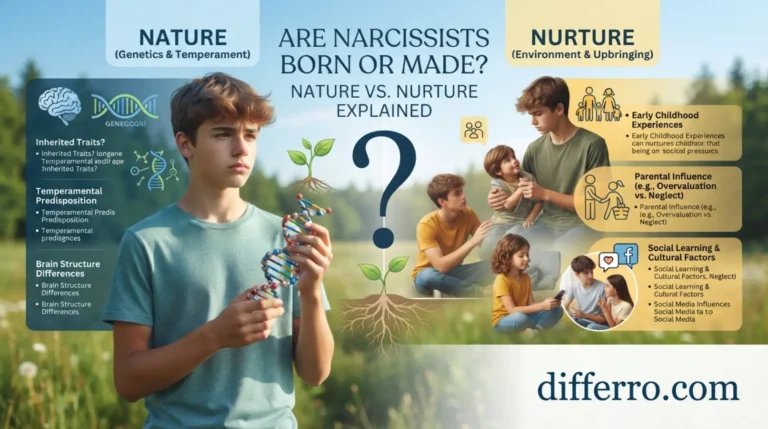
Are narcissists born or made? This question explores how genetics, childhood experiences, and social environments may shape narcissistic traits. Some people show a strong need for attention, admiration, or control. Others struggle with empathy, criticism, or relationships. These behaviors can raise questions about how narcissism develops.
The answer is not simply one or the other. Research suggests that both inherited traits and life experiences may influence narcissistic tendencies. Genetics can affect personality, while parenting, relationships, culture, and childhood experiences may also play a role. However, no single factor explains every case.
Understanding narcissism requires more than labeling someone as selfish or arrogant. Narcissistic traits exist on a spectrum, and they do not automatically indicate a mental health disorder. This guide explains the difference between being born with certain tendencies and developing them through life experiences. It also explores common myths, examples, and signs worth understanding.
⭐ Quick Answer
Are narcissists born or made? Narcissism appears to develop through a combination of genetic influences, temperament, and life experiences. Neither genetics nor parenting alone explains every case, and researchers continue to study how these factors interact.
Example: A child may inherit a strong, outgoing temperament, while family relationships and social experiences influence how that child handles attention, criticism, and empathy.
🧠 Meaning of “Born” in the Nature vs. Nurture Debate
In this discussion, born refers to the biological and inherited influences that may affect personality. These influences can include genetic differences and early temperament.
Genes do not determine a person’s entire personality. They may influence tendencies such as emotional sensitivity, impulsivity, or social behavior. A person’s experiences and environment can also shape how these tendencies develop.
Examples of the “Born” Influence
Example 1: A child naturally seeks attention and enjoys leading group activities. Supportive guidance may help the child develop confidence without needing to dominate others.
Example 2: A child reacts strongly to criticism because of their temperament. With time and guidance, the child may learn to accept feedback and respect other viewpoints.
These examples illustrate possible personality influences. They do not establish that either child will develop narcissistic traits.
🌱 Meaning of “Made” in the Nature vs. Nurture Debate
In this context, made refers to the influence of life experiences, relationships, and social environments on personality development.
Family dynamics, peer relationships, cultural expectations, and learned behaviors may shape how people view themselves and others. Researchers have explored how excessive praise, harsh criticism, emotional neglect, and inconsistent boundaries relate to narcissistic traits.
However, no single parenting style automatically creates a narcissist. Children respond differently to similar experiences, and many other factors affect development.
Examples of the “Made” Influence
Example 1: Parents repeatedly tell a child that ordinary achievements make them better than everyone else. Without guidance about respect and responsibility, the child may develop unrealistic expectations.
Example 2: A child receives affection only when they win or impress others. The child may begin to connect self-worth with praise and achievement.
These situations may influence personality, but they do not guarantee narcissism. Warm relationships, healthy boundaries, and emotional support can help children develop balanced self-esteem.
🔎 Are Narcissists Born or Made? Key Differences
The nature-versus-nurture debate compares biological influences with environmental influences. Both may contribute to narcissistic traits, but neither offers a complete explanation alone.
| Feature | Born (Nature) | Made (Nurture) |
|---|---|---|
| Meaning | Genetic and biological influences | Environmental and social influences |
| Main factors | Genes and temperament | Parenting, relationships, culture, and experiences |
| Timing | Some influences begin before birth or early in life | Experiences continue throughout development |
| Role | May influence personality tendencies | May reinforce or change behavior patterns |
| Examples | Temperament and emotional sensitivity | Learned entitlement or responses to criticism |
| Limitations | Genes do not determine destiny | Experiences do not produce the same outcome in everyone |
| Research status | Evidence supports genetic contributions to personality | Evidence supports environmental contributions to personality |
Key takeaway: Narcissism does not fit neatly into a born-or-made category. Biological predispositions and life experiences can interact throughout a person’s life.
📚 Origin and History of the Term “Narcissism”
The term narcissism comes from the Greek myth of Narcissus, a young man who became fascinated with his own reflection. The story later inspired psychological discussions about self-focus and admiration.
Psychologists developed different theories about narcissism during the nineteenth and twentieth centuries. Modern research examines narcissistic traits, personality development, and narcissistic personality disorder.
Today, psychologists often distinguish between everyday narcissistic traits and a diagnosable personality disorder. This distinction matters because confidence, ambition, and enjoying praise do not automatically indicate a mental health problem.
Related Psychological Terms
- Self-esteem: How a person evaluates their own worth.
- Entitlement: The belief that someone deserves special treatment.
- Grandiosity: An exaggerated sense of importance, ability, or status.
- Empathy: The ability to understand or respond to another person’s feelings.
- Narcissistic traits: Patterns involving self-importance, admiration, entitlement, or difficulties with empathy.
- Narcissistic personality disorder (NPD): A mental health condition involving a persistent pattern of narcissistic characteristics that causes significant difficulties.
These terms describe different concepts. Avoid treating them as interchangeable labels.
🇬🇧 British English vs. American English Spelling
The words narcissist, narcissism, and narcissistic have the same standard spelling in British and American English.
Neither country uses a different spelling for these terms, although pronunciation and everyday usage may vary.
Both forms of English use the same psychological terminology when discussing narcissism and narcissistic personality disorder.
British vs. American English Comparison
| Feature | British English | American English |
|---|---|---|
| Narcissist | Narcissist | Narcissist |
| Narcissism | Narcissism | Narcissism |
| Narcissistic | Narcissistic | Narcissistic |
| Narcissistic personality disorder | Same spelling | Same spelling |
| Meaning | Same | Same |
🧬 When to Consider Genetic Influences
Genetic influences matter when researchers study why people develop different personality traits. Some individuals may inherit tendencies that affect emotional responses, confidence, or social behavior.
However, scientists cannot determine whether someone will become a narcissist by examining their genes alone. Personality develops through interactions between biology and experience.
Example of Genetic Influences
Two siblings may grow up in the same household but develop different personalities. One may seek frequent recognition, while the other may prefer quiet activities.
Their differences may reflect temperament, individual experiences, genetic variation, and other developmental factors. Neither sibling’s behavior alone proves that genetics caused narcissism.
What Does Research Suggest?
Research on personality indicates that genetic factors contribute to differences in narcissistic traits. The size and nature of those contributions vary across studies and measures.
Heritability estimates describe differences within a studied population. They do not tell us what percentage of one person’s narcissism comes from genes. They also do not mean a trait cannot change.
Genetic influence is not genetic destiny. Relationships, personal choices, social expectations, and psychological support can still matter.
🌍 When to Consider Environmental Influences
Environmental influences include family relationships, school experiences, friendships, cultural values, and adult relationships. These experiences can shape how people manage emotions and respond to others.
Some studies have linked particular parenting patterns with narcissistic traits. However, researchers have not established one universal pathway from childhood experiences to narcissism.
Example of Environmental Influences
A child receives constant praise for being the best but rarely learns to accept mistakes. Over time, the child may struggle when others receive recognition.
Another child receives affection alongside clear boundaries and honest feedback. That child may learn to value personal achievements without believing they deserve more than everyone else.
These examples show possible learning patterns, not guaranteed outcomes. Children can develop healthy self-esteem in many different family situations.
Can Childhood Experiences Cause Narcissism?
Childhood experiences may influence narcissistic development, but they rarely provide a complete explanation.
Researchers have investigated several possible influences:
- Excessive praise that encourages unrealistic beliefs about superiority
- Harsh criticism that affects self-worth and emotional responses
- Emotional neglect or inconsistent caregiving
- Family environments that reward dominance or entitlement
- Social settings that strongly emphasize status and appearance
These factors do not affect every child in the same way. Supportive relationships and later experiences can also influence personality development.
⚠️ Common Mistakes About Whether Narcissists Are Born or Made
Mistake 1: Believing Every Narcissist Was Born That Way
Incorrect: Narcissists inherit their personalities, so they cannot change.
Correct: Genetic influences may contribute to personality, but development also involves environmental and personal factors.
Mistake 2: Blaming Parents for Every Narcissistic Trait
Incorrect: Parents always create narcissists through poor parenting.
Correct: Parenting may influence personality, but no single parenting style explains every case. Genetics, temperament, relationships, and wider social factors also matter.
Mistake 3: Calling Every Selfish Person a Narcissist
Incorrect: Anyone who wants attention or dislikes criticism is a narcissist.
Correct: Many people sometimes act selfishly or seek approval. Narcissistic traits involve broader patterns, and NPD requires professional assessment.
Mistake 4: Assuming Childhood Trauma Always Causes Narcissism
Incorrect: Everyone who experiences childhood trauma develops narcissistic traits.
Correct: People respond to difficult experiences differently. Trauma does not automatically cause narcissism, and many survivors develop healthy relationships.
Mistake 5: Assuming Narcissism Cannot Change
Incorrect: A person with narcissistic traits will always behave the same way.
Correct: Personality patterns can change over time. Motivation, circumstances, relationships, and appropriate psychological support may help some people develop healthier behaviors.
Mistake 6: Confusing Confidence With Narcissism
Incorrect: People who feel proud of their achievements are narcissists.
Correct: Healthy confidence allows people to value themselves while respecting others. Narcissistic patterns may involve persistent entitlement, excessive admiration needs, or difficulty recognizing other people’s needs.

🧠 Easy Trick to Remember: Nature vs. Nurture
Use this simple memory tip:
- Nature = what biology contributes. Think about genes and temperament.
- Nurture = what experience contributes. Think about parenting, relationships, culture, and learning.
For the question “Are narcissists born or made?”, remember that nature and nurture work together. Neither factor alone explains every person’s personality.
🌟 Everyday-Life Examples: Are Narcissists Born or Made?
1. A Child Who Always Wants to Win
A child becomes upset whenever another student wins a competition. The child also demands praise for ordinary achievements.
Possible explanation: Temperament, learned expectations, and experiences with competition may influence this behavior. It does not prove that the child will develop narcissism.
2. An Adult Who Needs Constant Praise
An adult frequently seeks compliments and becomes defensive when someone offers feedback. The person also struggles to acknowledge other people’s achievements.
Possible explanation: These behaviors may reflect narcissistic traits or other emotional difficulties. A professional would need broader information before making any diagnosis.
3. A Person Raised With Excessive Praise
Parents repeatedly tell a child that they are more important than everyone else. They rarely encourage the child to consider other people’s feelings.
Possible explanation: This environment may reinforce entitlement or unrealistic self-beliefs. It does not guarantee that the child will develop narcissistic personality disorder.
4. A Person Who Experienced Harsh Criticism
A person grows up receiving frequent criticism and little emotional support. As an adult, they become highly defensive whenever someone points out a mistake.
Possible explanation: Early experiences may influence emotional reactions and self-esteem. Defensiveness alone does not establish narcissism.
5. A Person Who Learns Healthier Relationship Skills
An adult notices that they often dismiss other people’s feelings. They begin working on empathy, accountability, and accepting criticism.
Possible explanation: Self-awareness and consistent effort can support healthier behavior. This example also shows why personality should not be viewed as completely fixed.
🔑 Related Keywords
Use these related phrases naturally in the article and relevant subheadings:
- Are narcissists born or created?
- Is narcissism genetic or learned?
- What causes narcissistic personality disorder?
- Can childhood trauma cause narcissism?
- Does parenting create narcissists?
- Can narcissistic traits change?
- Nature vs. nurture in narcissism
🌍 Google Trends and Usage Insights: Five Countries
Google Trends reports relative search interest rather than exact search volumes. Without a live comparison, country-specific rankings for this keyword cannot be confirmed.
- USA: The question may attract readers exploring relationships, personality, and mental health.
- UK: Related searches may focus on narcissistic traits, childhood influences, and relationship behavior.
- Australia: Readers may seek explanations of narcissism and the roles of genetics and upbringing.
- India: Searches may connect narcissism with family relationships, personality, and emotional well-being.
- Pakistan: Related queries may focus on narcissistic behavior, parenting, and relationship challenges.
SEO insight: These points describe plausible search interests, not verified Google Trends results. Compare the exact keyword with related phrases across all five countries before reporting trends or rankings.
Comparison Table: Keyword Variations
| Keyword variation | Search intent | Suggested use |
|---|---|---|
| Are narcissists born or made | Direct informational question | Main title and introduction |
| Are narcissists born or created | Alternative wording | Related keyword section |
| Is narcissism genetic or learned | Nature-versus-nurture research | Genetics and environment sections |
| What causes narcissism | General informational intent | Causes and history sections |
| Can childhood trauma cause narcissism | Childhood and development | Environmental influences section |
| Can narcissistic traits change | Change and treatment | FAQ and conclusion |
| Are narcissists made by their parents | Parenting and family influence | Parenting discussion |
❓ Frequently Asked Questions
1. Is “Are narcissists born or made?” a correct question?
Yes. It is a grammatically correct question about the origins of narcissistic traits. It asks whether biological influences, life experiences, or both contribute to narcissism.
2. What is the difference between being born narcissistic and becoming narcissistic?
Being born narcissistic suggests that inherited traits contribute to narcissistic tendencies. Becoming narcissistic suggests that experiences and environmental influences help shape those tendencies. Research supports considering both influences rather than choosing only one.
3. Which explanation is more common: born or made?
Neither explanation accounts for every case. Research suggests that genetic and environmental factors both contribute to personality differences. Their relative influence varies, and no simple rule explains every person’s development.
4. Is this topic suitable for formal or academic writing?
Yes. The question suits general educational writing, but academic discussions should distinguish narcissistic traits from narcissistic personality disorder. Writers should also rely on credible psychological research and avoid unsupported claims about causes.
5. Why do people disagree about whether narcissists are born or made?
People emphasize different explanations for personality development. Some focus on genetics and temperament, while others highlight childhood experiences and relationships. The debate continues because biological and environmental influences interact in complex ways.
📝 Final Verdict: Are Narcissists Born or Made?
Narcissists are not simply born or made. Research suggests that narcissistic traits develop through a combination of biological predispositions, temperament, and environmental experiences.
Genetics may influence personality tendencies, while parenting, relationships, culture, and life events may shape how those tendencies develop. However, no single factor guarantees narcissism. Childhood experiences also affect people differently.
It is equally important to distinguish narcissistic traits from narcissistic personality disorder. Confidence, ambition, or a desire for attention alone does not establish a diagnosis.
The clearest answer is that both nature and nurture can contribute to narcissism. Understanding this interaction offers a more accurate view than blaming genes, parents, or childhood experiences alone.
Conclusion
Are Narcissists born or made? The most accurate answer involves both biology and life experiences. Genetic differences and temperament may influence personality, while family relationships, parenting, culture, and social experiences can also shape behavior.
Neither genes nor childhood experiences determine a person’s future on their own. People respond differently to similar circumstances, and personality patterns may change over time. Researchers continue to investigate how these influences interact.
Remember that narcissistic traits do not automatically mean someone has narcissistic personality disorder. A qualified mental health professional must assess persistent patterns and their effects before making a diagnosis. Avoid labeling people based on isolated behaviors or difficult relationships.
Ultimately, understanding narcissism requires a balanced view of nature and nurture. This approach encourages more accurate information, less blame, and greater awareness of personality development.

Imran Lodhra is a comparison-focused content writer at Differro.com.
He specializes in creating clear, simple, and informative comparison articles.
His work helps readers understand key differences, pros and cons, and important details.
Imran focuses on accurate, practical, and easy-to-read content for everyday readers.
2 thoughts on “Are Narcissists Born or Made? Nature vs. Nurture Explained”