
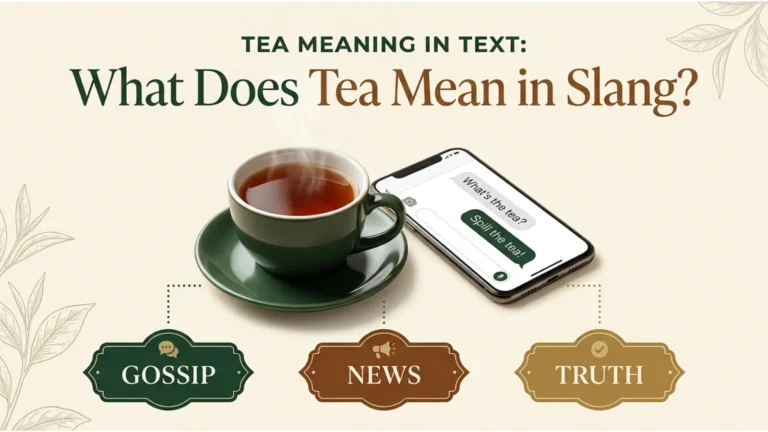
Tea meaning slang is a popular topic for people who see the word “tea” in text messages, TikTok videos, Instagram comments, or everyday conversations. Although tea is traditionally a drink, its slang meaning is completely different.
In modern internet culture, tea usually refers to gossip, interesting news, private information, or the truth about a situation. You might see someone write “Spill the tea!” when they want to hear the latest details about a friendship, relationship, or celebrity drama.
The expression is especially common among social media users and people who enjoy discussing trending topics. However, understanding the meaning also requires knowing the context, because tea can be used playfully, casually, or critically.
Quick Answer:
In slang, “tea” means gossip, interesting information, or the truth about a situation. “Spill the tea” means to share the details, reveal information, or tell someone what happened.
What Does Tea Mean in Text?
The word “tea” is informal slang for gossip, news, rumors, or information that people find interesting. It often refers to details about someone’s personal life, a disagreement, a relationship, or a trending event.
For example:
- “What’s the tea?” means “What’s the latest news or gossip?”
- “Spill the tea!” means “Tell me what happened.”
- “That’s the tea” means “That’s the truth” or “That’s how things are.”
- “No tea, no shade” introduces a comment that is not intended to insult someone, although the following statement may still sound critical.
In text messages, the word helps people communicate curiosity, excitement, or a desire to know more without writing a long explanation.
Tea Full Form: What Does Tea Stand For?
Unlike many texting abbreviations, tea does not have a standard full form. It is a regular English word that developed a slang meaning.
The slang is commonly associated with the letter T, which can represent “truth.” This connection helps explain why people use tea to describe honest information or someone’s version of events.
However, tea is not officially an acronym. Its modern slang usage is connected to the expression “the T” and LGBTQ+ drag culture.
Tea Meaning Slang in Different Contexts
The meaning of tea can change slightly depending on the conversation.
1. Tea as Gossip
This is one of the most common meanings. It refers to personal news or stories about other people.
Example:
“Girl, I have some tea about yesterday’s party!”
Meaning: The speaker has interesting gossip to share.
2. Tea as the Truth
Tea can also refer to something that someone considers true, accurate, or worth acknowledging.
Example:
“Your advice is the tea.”
Meaning: Your advice is correct or makes a lot of sense.
3. Tea as Interesting News
People also use tea when discussing celebrities, influencers, public events, or online controversies.
Example:
“What’s the tea about that new celebrity couple?”
Meaning: What is happening with the couple, and what information is available?
4. Tea in Relationship Conversations
In relationship discussions, tea often refers to details about dating, breakups, crushes, or romantic drama.
Example:
“Give me the tea about your date last night.”
Meaning: Tell me how the date went and whether anything interesting happened.
Is Tea Rude, Offensive, or Neutral?
The slang word “tea” is generally neutral and informal. It is not inherently rude or offensive. Its effect depends on the information being shared and the way someone discusses it.
Tea can be positive when friends share exciting news or celebrate a funny situation. It can also become negative when it involves embarrassing details, rumors, private information, or personal attacks.
Consider these examples:
- Friendly: “I’ve got some tea about our favorite show.”
- Neutral: “What’s the tea about the meeting?”
- Potentially hurtful: “Let’s spread the tea about her private life.”
The last example may encourage gossip that damages someone’s reputation or privacy.
Use the term freely in casual conversations, but be thoughtful about sharing information that could hurt another person.
Where Is Tea Slang Commonly Used?
Tea is widely recognized in informal online conversations and popular culture.
Common places include:
- Text messages: Friends asking for updates or gossip.
- TikTok: Videos discussing celebrity news, relationships, or online drama.
- Instagram: Comments, captions, Stories, and direct messages.
- Snapchat: Casual conversations between friends.
- X: Discussions about public figures, trending topics, and controversies.
- Everyday conversations: People asking for details about something interesting.
The expression also appears in entertainment, reality television, podcasts, and online communities that discuss celebrity culture.
Real-Life Conversation Examples
Here are examples showing how people use tea naturally.
Friendly Examples
Example 1
A: “You look excited. What’s going on?”
B: “I’ve got some tea about our school reunion!”
Meaning: The speaker has interesting news to share.
Example 2
A: “Did you hear about Sarah’s engagement?”
B: “No! Spill the tea!”
Meaning: The second person wants to know more details.
Casual Examples
Example 3
A: “What’s the tea on the new movie?”
B: “Everyone says the ending is amazing.”
Meaning: The person is asking for the latest information or opinions.
Example 4
A: “That review is the tea.”
B: “Right? It explains everything.”
Meaning: The review seems accurate or insightful.
Argumentative Examples
Example 5
A: “You said you knew what happened. Tell me the tea.”
B: “I don’t want to get involved in this drama.”
Meaning: One person wants information, while the other avoids the discussion.
Example 6
A: “That’s not the whole tea.”
B: “I’m telling you what I know.”
Meaning: The speaker believes some details are missing from the story.
These examples show that tea can sound playful, curious, skeptical, or confrontational depending on tone.
Emotional and Psychological Meaning of Tea
People often use tea because gossip and interesting stories create a sense of curiosity and social connection.
The expression can communicate several feelings:
- Excitement: Someone has discovered something interesting.
- Curiosity: A person wants to know more about a situation.
- Trust: Friends may share personal updates with people they feel comfortable around.
- Humor: People use tea to make conversations about everyday drama more entertaining.
- Suspicion: Someone may want the full story before deciding what to believe.
However, sharing gossip is not always harmless. Repeating unverified information can create misunderstandings, damage relationships, and spread false claims. Being interested in a story does not mean every detail should be shared.
Origin and Background of Tea Slang
The modern slang use of tea is strongly associated with Black American LGBTQ+ and drag culture. The expression “the T” has been linked to “truth,” including the truth about someone’s personal life.
The term became more widely recognized through drag culture and entertainment, including the popular expression “What’s the T?” Over time, tea became a familiar word for gossip, revealing information, and discussing drama.
Social media platforms helped spread expressions such as “spill the tea,” “the tea is hot,” and “that’s the tea” to a much wider audience.
Today, people from many backgrounds use the term in casual conversation. Its history is worth recognizing, particularly because some of its modern popularity comes from communities whose language and cultural expressions helped shape internet slang.
Variations and Types of Tea Slang
Several expressions use tea in slightly different ways.
| Slang expression | Meaning | Example |
|---|---|---|
| Spill the tea | Share gossip or details | “Come on, spill the tea!” |
| What’s the tea? | What’s the news or story? | “What’s the tea about the party?” |
| The tea is hot | The gossip is exciting or dramatic | “The tea is hot today.” |
| That’s the tea | That’s the truth or final point | “I said what I said. That’s the tea.” |
| No tea, no shade | Often introduces a comment intended to avoid direct insult | “No tea, no shade, but I disagree.” |
| Sipping tea | Figuratively watching drama without getting involved | “I’m just sipping tea and watching.” |
| Hot tea | Fresh, exciting, or dramatic gossip | “I’ve got some hot tea for you.” |
These expressions are informal. Their precise meaning depends on the speaker and the conversation.
Tea vs. Similar Slang Terms
Tea is related to other slang words, but the terms are not always interchangeable.
| Slang term | Meaning | Main difference |
|---|---|---|
| Tea | Gossip, news, or truth | Focuses on information being shared |
| Gossip | Talk about other people’s lives | Can sound more negative or judgmental |
| Drama | Conflict or a complicated situation | Focuses on the situation rather than the information |
| Receipts | Evidence, screenshots, or proof | Supports a claim with evidence |
| Facts | Something true or a statement of agreement | Emphasizes truth or agreement |
| Shade | Subtle disrespect or criticism | Focuses on a negative or mocking comment |
| Rumor | An unverified story | May be true or false |
For example, someone might say, “Spill the tea,” to request information, then ask for “receipts” to verify the story.
When Should You Use Tea Slang?
Tea is suitable for relaxed, informal settings where the people involved understand internet slang.
Use it when:
- Chatting with friends.
- Discussing a TV show or celebrity news.
- Sharing harmless, non-sensitive updates.
- Commenting on funny or surprising events.
- Posting casual content on social media.
Avoid it when:
- Writing formal emails or professional reports.
- Speaking in a setting where slang could confuse your audience.
- Discussing confidential information.
- Spreading unverified claims about another person.
- Someone has asked you to keep personal information private.
In professional situations, words such as “update,” “information,” “details,” or “news” are usually clearer and more appropriate.
Polite Alternatives to Tea Slang
If you want to sound more formal or avoid gossip, try these expressions:
- “What’s the latest update?”
- “Can you tell me what happened?”
- “Do you have any news?”
- “Could you explain the situation?”
- “I’d like to understand the full story.”
- “Is there any confirmed information about this?”
These alternatives communicate curiosity without making the conversation sound like gossip.
Common Misunderstandings About Tea Slang
People who are unfamiliar with internet slang may misunderstand the term.
Misunderstanding 1: Tea always means the drink.
Correction: In casual conversations, it can refer to gossip, information, or truth.
Misunderstanding 2: Tea is always negative.
Correction: It can describe exciting news, funny stories, or a statement someone agrees with.
Misunderstanding 3: Tea is an official abbreviation.
Correction: It does not have a standard full form. Its slang meaning is associated with the expression “the T” and truth.
Misunderstanding 4: All tea is true.
Correction: Gossip can be inaccurate or unverified. Calling something tea does not make it factual.
Misunderstanding 5: Everyone uses tea in the same way.
Correction: Meaning and tone can vary by community, generation, and situation.
How to Respond When Someone Says Tea
Your response depends on whether the person is asking for gossip, sharing information, or expressing agreement.
- If someone asks, “What’s the tea?” you can say, “Nothing much,” “I’ve got an interesting update,” or “I’ll tell you what happened.”
- If someone says, “Spill the tea!” you can share an appropriate story or reply, “It’s a long story!”
- If someone says, “That’s the tea,” you might respond, “Exactly!” or “I agree.”
- If the discussion involves private information, you can say, “I’d rather not discuss someone else’s personal business.”
You do not need to share every detail simply because someone asks.
Regional and Cultural Usage
Tea slang is common in American internet culture and is also understood by many English speakers in the United Kingdom, Canada, Australia, and other countries.
Its popularity varies by age group, online community, and exposure to social media. Younger internet users may encounter it frequently in memes, videos, and comments, while others may be more familiar with traditional expressions such as “What’s the gossip?”
The word also has a cultural history connected to Black American LGBTQ+ and drag communities. Recognizing that background provides a better understanding of how the expression entered mainstream internet language.
Although its general meaning is widely recognizable online, not everyone uses it regularly. When communicating with an unfamiliar audience, choose words that fit the context.
Is Tea Slang Safe to Use on Social Media?
Yes. The word itself is generally safe for ordinary social media posts, captions, and comments. It is not inherently offensive or inappropriate.
However, the content attached to it matters. Posting rumors, private messages, screenshots, or sensitive personal details can violate someone’s privacy or lead to harassment.
For responsible communication:
- Check facts before repeating claims.
- Avoid sharing private information without permission.
- Do not use gossip to bully or embarrass someone.
- Separate personal opinions from verified facts.
- Respect other people’s boundaries.
Using slang responsibly helps keep online conversations entertaining without causing unnecessary harm.
FAQs About Tea Meaning Slang
1. What does tea mean in texting?
Tea means gossip, interesting news, or the truth about a situation. For example, “What’s the tea?” means “What’s the latest news?”
2. What does spill the tea mean?
“Spill the tea” means to reveal information, share gossip, or explain what happened. It is usually used informally among friends.
3. What does tea stand for in slang?
Tea is not a standard acronym. It is associated with “the T,” a slang expression connected to truth and personal information.
4. Is tea slang rude?
No, tea is generally neutral and informal. However, using it to spread hurtful rumors or expose someone’s private life can be disrespectful.
5. What does that’s the tea mean?
“That’s the tea” means “That’s the truth,” “That’s the point,” or “That’s how it is.” It can express agreement or confidence in a statement.
6. What is the difference between tea and gossip?
Tea and gossip overlap in meaning. Tea often sounds playful and internet-oriented, while gossip is a broader word for talking about other people’s personal lives.
Conclusion
Tea meaning slang refers to gossip, interesting news, personal details, or the truth about a situation. Expressions such as “spill the tea,” “what’s the tea,” and “that’s the tea” are common in texts, social media comments, and everyday conversations.
The term is generally informal and harmless, but its meaning depends on context and tone. It can make conversations more entertaining, help friends share updates, or describe information people find interesting. Still, it is important to distinguish confirmed facts from rumors and respect people’s privacy.
Now that you understand tea meaning slang, you can recognize it in messages, use it naturally with friends, and choose more appropriate language when a conversation requires a professional or respectful tone.

Ali Raza is an M.Phil. scholar and English language expert specializing in English grammar, slang meanings, vocabulary, and everyday expressions. He writes clear, practical, and easy-to-understand content that helps readers master confusing English words, phrases, spelling, and modern slang. His goal is to make English learning simple, useful, and accessible for students, beginners, and everyday readers.
1 thought on “Tea Meaning Slang What Does Tea Mean in Text”