
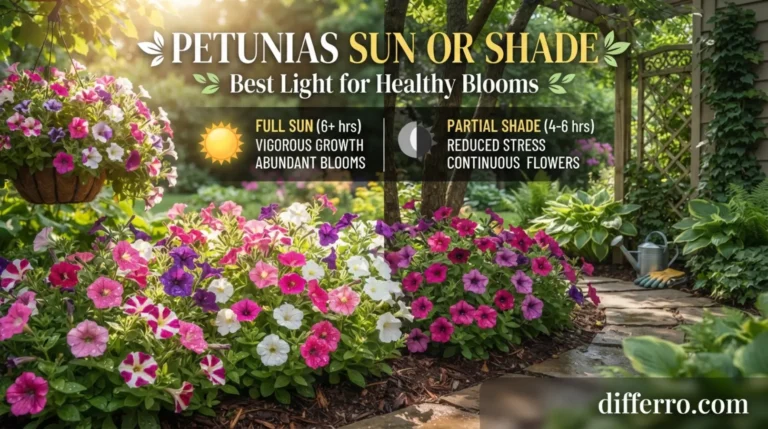
petunias sun or shade is a common question among gardeners growing these colorful flowering plants. The simple answer is that petunias prefer plenty of sunlight. Most varieties produce the most flowers with about six hours of direct sun each day.
Petunias can tolerate partial shade, especially during very hot weather. However, too much shade can reduce flowering and cause weak, stretched growth. Some modern petunia varieties also perform well with four to six hours of sun.
Your climate also matters. Gardeners in very hot regions may protect plants from intense afternoon heat. Good watering, drainage, and regular feeding also help petunias stay healthy and colorful.
⭐ Quick Answer
Petunias prefer full sun rather than shade. Give them about six hours of direct sunlight for the best flowering. They can tolerate partial shade, but heavy shade usually means fewer flowers.
Example: Place a petunia where it receives morning and afternoon sunlight instead of deep shade.
🌸 Meaning of Petunias
Petunias are flowering plants known for colorful, trumpet-shaped blooms. Gardeners commonly grow them in beds, pots, window boxes, and hanging baskets.
They come in many colors, including pink, purple, white, red, and mixed shades. Trailing types work especially well in containers and hanging baskets.
Examples:
- I planted pink petunias around the garden border.
- Her purple petunias look beautiful in the hanging basket.
☀️ Meaning of Sun and Shade
Sun means a location receives direct sunlight for several hours during the day. Full sun usually means at least six hours of direct sunlight.
Shade means an area receives limited direct sunlight because of buildings, trees, walls, or other objects.
Examples:
- The petunias receive full sun beside the garden wall.
- The flowers receive partial shade under a light tree canopy.
🌿 Petunias Sun or Shade: Key Differences
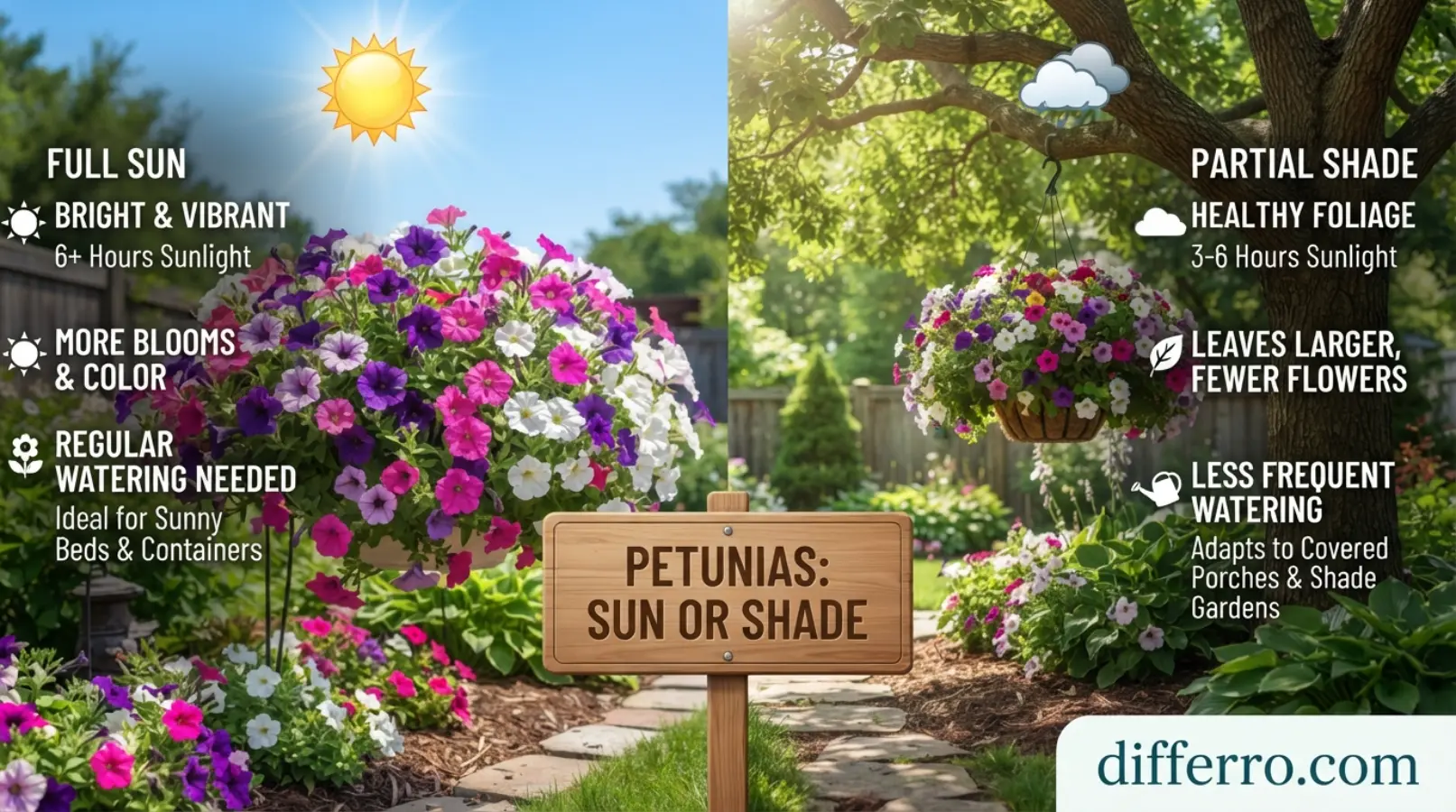
| Factor | Full Sun | Partial Shade |
|---|---|---|
| Meaning | About 6+ hours of direct sun | About 4–6 hours of direct sun |
| Flowering | Usually heavier and more reliable | Usually reduced |
| Growth | Compact and vigorous | Can become stretched |
| Best use | Maximum blooms | Useful in hotter locations |
| Popularity | Most common recommendation | Useful alternative |
Proven Winners defines full sun as six or more hours and part sun as four to six hours.
🌱 Origin & History of Petunias
Petunias belong to the genus Petunia and became popular ornamental garden plants because of their colorful flowers.
Modern garden petunias include many hybrids and specialized varieties. Breeders have developed types for containers, landscapes, hanging baskets, and long-lasting displays.
Trailing petunias became especially popular for baskets and containers. Modern Supertunia varieties can perform well from part sun to full sun.
Similar Gardening Terms
Gardeners often compare petunias with other flowering plants that have different light needs.
Similar terms include:
- Full sun
- Part sun
- Partial shade
- Full shade
- Direct sunlight
- Filtered light
- Morning sun
- Afternoon shade
🇬🇧 British English vs 🇺🇸 American English Spelling
The word petunia has the same spelling in British and American English.
The main difference appears in gardening terminology and regional growing conditions. Gardeners in both countries commonly describe petunias as sun-loving plants.
| British English | American English |
|---|---|
| Petunia | Petunia |
| Full sun | Full sun |
| Partial shade | Partial shade |
| Hanging basket | Hanging basket |
| Bedding plant | Bedding plant |
☀️ When to Use Full Sun for Petunias
Choose full sun when you want the strongest flowering performance.
A sunny location works particularly well for most traditional petunia varieties. Aim for around six hours of direct sunlight daily.
Full sun can help petunias:
- Produce more flowers
- Maintain stronger growth
- Develop fuller plants
- Reduce weak, stretched stems
- Create better displays in containers and beds
For example, a south-facing or otherwise sunny garden area may work well.
However, intense heat can change the situation. In very hot climates, some afternoon protection can help plants cope with heat.
🌤️ When to Use Partial Shade for Petunias
Partial shade can work when your garden becomes extremely hot.
Some petunia varieties tolerate four to six hours of direct sunlight. Several Supertunia cultivars are specifically listed for part sun to sun.
Partial shade can help during periods of intense heat. However, do not confuse partial shade with deep shade.
A location with only a few hours of weak light may produce fewer flowers.
For hot regions, try giving petunias morning sun and some protection from harsh afternoon heat.
⚠️ Common Mistakes With Petunias Sun or Shade
1. Growing Petunias in Deep Shade
Incorrect: I planted my petunias under a dense tree for shade.
Correct: I planted my petunias where they receive several hours of direct sunlight.
Deep shade usually limits flowering.
2. Assuming All Petunias Need Identical Light
Incorrect: Every petunia variety needs exactly the same amount of sunlight.
Correct: Most prefer full sun, but some varieties tolerate part sun.
Always check the plant label for the specific cultivar.
3. Giving Hot-Climate Petunias Unlimited Afternoon Heat
Incorrect: More intense heat always means healthier petunias.
Correct: Petunias need strong light, but extreme heat can stress plants.
In very hot climates, some afternoon protection may help.
4. Choosing Shade Because the Plant Looks Wilted
Incorrect: My petunia wilted, so I moved it into deep shade.
Correct: Check its soil moisture and heat exposure before changing its location.
Petunias need consistent moisture, especially in containers.
5. Ignoring Container Conditions
Incorrect: My potted petunia needs the same watering schedule as my garden bed.
Correct: Check container soil regularly because pots can dry quickly.
Good light and consistent moisture work together for strong growth.
🧠 Easy Trick to Remember
Remember this simple rule:
Petunias love sunlight, but they do not love extreme stress.
Think “Sun for flowers, shade for relief.”
Give your petunias plenty of direct sunlight. Provide some afternoon protection when extreme heat becomes a problem.
🌼 Everyday Life Examples
1. Petunias in a Sunny Garden
Example: I planted my petunias beside the sunny garden path.
Primary keyword: petunias sun or shade
Secondary keyword: petunias full sun
2. Petunias in a Hanging Basket
Example: Her hanging basket receives morning and afternoon sunlight.
Primary keyword: petunias sun or shade
Secondary keyword: petunias sunlight requirements
3. Petunias on a Hot Patio
Example: We moved the petunias where they receive morning sun and afternoon protection.
Primary keyword: petunias sun or shade
Secondary keyword: petunias partial shade
4. Petunias Under a Tree
Example: The petunias stopped flowering after growing under a dense tree.
Primary keyword: petunias sun or shade
Secondary keyword: do petunias grow in shade
5. Petunias in Containers
Example: My container petunias bloom best after receiving several hours of direct sunlight.
Primary keyword: petunias sun or shade
Secondary keyword: best light for petunias
📊 Google Trends & Usage Insight: USA, UK, Australia, India, Pakistan
Search interest for this topic is closely tied to gardening seasons and planting decisions. The phrase appears as a practical question because gardeners want to know where to place their plants.
The USA and UK have strong gardening interest, while Australia often requires extra attention to heat and sun exposure. Indian gardening searches also commonly focus on sunlight requirements, with local sources recommending several hours of direct sun.
For Pakistan, the topic has practical value because intense summer heat can make afternoon exposure important. Across these markets, variations such as “do petunias like sun or shade” and “how much sun do petunias need” can capture related search intent.
Important: Google Trends interest changes by date, location, and search wording. Exact country-by-country scores should come from a live Google Trends comparison rather than guessed numbers.
Keyword Variations Comparison
| Keyword Variation | Search Intent | SEO Value |
|---|---|---|
| petunias sun or shade | Direct question | Very High |
| do petunias like sun or shade | Informational | Very High |
| petunias full sun | Growing advice | High |
| petunias partial shade | Problem solving | High |
| do petunias grow in shade | Informational | High |
| how much sun do petunias need | Care guide | Very High |
| best light for petunias | Gardening advice | Medium-High |
🌺 Final Verdict: Sun or Shade?
Sun is the better choice for most petunias.
Give petunias around six hours of direct sunlight when possible. This usually produces better flowering and stronger growth.
Partial shade can still work, especially in very hot climates. Some modern varieties perform well with four to six hours of direct sun.
Avoid deep shade if you want abundant flowers. Too little light can reduce blooms and encourage weak growth.
The best location balances sunlight, moisture, and temperature. Always consider your specific petunia variety and local climate.
❓ FAQ: Petunias Sun or Shade
Is it correct to say petunias prefer sun?
Yes. Most petunias prefer full sun and produce their best blooms with about six hours of direct sunlight.
What is the difference between petunias in sun and shade?
Petunias in full sun usually produce more flowers. Plants in partial shade can survive but often produce fewer blooms.
Which is more common for petunias, sun or shade?
Full sun is the more common recommendation for petunias. Many varieties are specifically listed for full sun or part sun.
Is full sun a formal gardening term?
Yes. Gardeners use full sun to describe locations receiving about six or more hours of direct sunlight.
Why does confusion about petunias sun or shade exist?
The confusion exists because petunias can tolerate partial shade. Different varieties also have different light tolerances.
Can petunias grow with only morning sun?
Yes, some can grow with morning sun. However, fewer hours of direct light may reduce flowering.
Can petunias grow in full shade?
They may survive for a while, but full shade is not a good choice for abundant blooms. Petunias generally need substantial direct sunlight.
Should petunias get afternoon shade in very hot weather?
Some afternoon protection can help in extremely hot climates. The goal is to provide enough light while reducing severe heat stress.
🌸 Conclusion
The answer to petunias sun or shade is simple: petunias generally prefer sun. Most varieties bloom best with around six hours of direct sunlight each day.
Partial shade can still work, especially in hot climates. Some modern varieties tolerate four to six hours of direct sunlight.
Avoid placing petunias in deep shade if you want many flowers. Limited light can reduce blooming and create weak, stretched growth.
For the best results, combine good sunlight with consistent moisture and well-drained soil. Check your variety’s growing instructions before planting.
In short, choose sun for more flowers and partial shade when heat becomes a concern.

Imran Lodhra is a comparison-focused content writer at Differro.com.
He specializes in creating clear, simple, and informative comparison articles.
His work helps readers understand key differences, pros and cons, and important details.
Imran focuses on accurate, practical, and easy-to-read content for everyday readers.
1 thought on “Petunias Sun or Shade: Best Light for Healthy Blooms”