
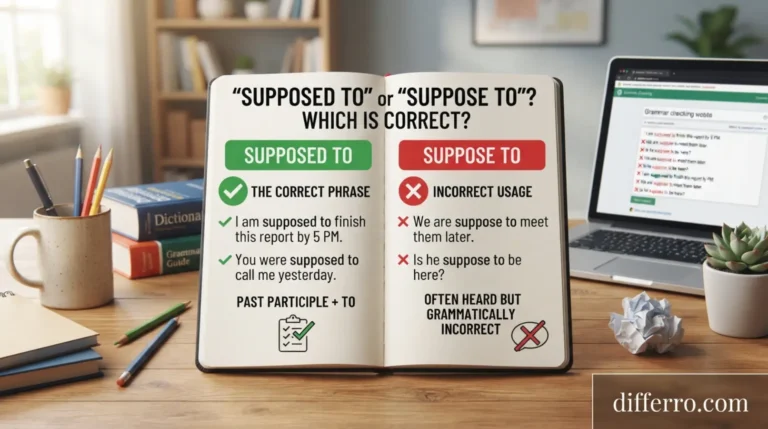
supposed to or suppose to is a common English grammar and spelling confusion. Many people hear these phrases in fast speech and wonder which form they should write. Use “supposed to” when you mean that someone expects, requires, or intends you to do something.
Suppose is a separate verb that means to assume, think, or imagine.
The confusion mainly happens because the -d in supposed to is often difficult to hear. In natural speech, supposed to can sound very similar to suppose to. However, standard written English requires the d in supposed. This rule applies in both American and British English.
⭐ Quick Answerquired
Example: I am supposed to finish my homework tonight.
Meaning of Supposed To
Supposed to expresses expectation, duty, obligation, or an intended action.
It normally follows a form of be, such as am, is, are, was, or were.
Examples:
- You are supposed to follow the rules.
- She was supposed to call me yesterday.
It can also describe something that people expect to happen.
Example:
- The train should arrive at 8 p.m.
Meaning of Suppose To
Suppose is a real English verb, but suppose to is not the correct form when expressing duty or expectation.
Suppose means to think, assume, imagine, or consider something possible.
Examples:
- I suppose he is right.
- Suppose we leave early tomorrow.
You can correctly use suppose before to when the grammar requires a different structure.
Example:
- What do you suppose to be the main reason?
Here, suppose is the main verb. It does not mean be expected to.

🔎 Supposed to or Suppose to: Key Differences
| Feature | Supposed to | Suppose to |
|---|---|---|
| Meaning | Expected, required, or intended | Not correct for this meaning |
| Tone | Standard English | Usually a spelling or grammar error |
| Usage | Common in speech and writing | Avoid in standard writing |
| Popularity | Very common | Mostly appears as an error |
| Grammar | Be + supposed to + base verb | Incorrect for obligation |
The key difference is grammatical. Supposed to is the correct fixed expression for expectation or duty.
📚 Origin and History
The word suppose comes from Latin supponere, meaning roughly “to assume” or “to place under.” It entered English through Old French before developing into the modern verb suppose.
English later formed supposed by adding the regular -ed ending. The expression be supposed to developed to express what someone expects or requires another person to do.
Similar word forms include:
- suppose → supposed
- use → used
- expect → expected
- intend → intended
- assume → assumed
The -ed ending matters in written English, even when speech makes it hard to hear.
🇬🇧 British English vs American English Spelling
There is no spelling difference between British and American English for suppose or supposed to. Both varieties use supposed to for expectation or obligation.
The difference is not regional. It is mainly a matter of grammar and pronunciation.
| English Variety | Correct Form | Incorrect Form |
|---|---|---|
| British English | supposed to | suppose to |
| American English | supposed to | suppose to |
| Australian English | supposed to | suppose to |
| Indian English | supposed to | suppose to |
| Pakistani English | supposed to | suppose to |
✅ When to Use Supposed To
Use supposed to when people expect, require, plan, or intend something.
1. To Show a Duty
- Students are supposed to complete their work.
- You must wear a seat belt.
2. To Show an Expectation
- The schedule says the bus will arrive at noon.
- He should be here soon.
3. To Talk About a Past Expectation
- I was supposed to meet Sarah yesterday.
- They were supposed to arrive early.
4. To Describe What Something Should Do
- This button is supposed to open the door.
- The medicine is supposed to reduce the pain.
💭 When to Use Suppose
Use suppose when you mean think, assume, imagine, or consider.
1. To Express an Opinion
- I suppose you are right.
- I suppose we could try again.
2. To Make an Assumption
- I suppose he forgot the meeting.
- We suppose the information is accurate.
3. To Introduce a Situation
- Suppose you won the lottery. What would you do?
- Suppose we took a different route.
Remember this simple difference:
Suppose = think or imagine
Supposed to = expected or required to
❌ Common Mistakes
Mistake 1: Dropping the D
❌ I am suppose to call him.
✅ I am supposed to call him.
Mistake 2: Forgetting the Be Verb
❌ I supposed to finish this today.
✅ I am supposed to finish this today.
Mistake 3: Using the Wrong Form
❌ She is suppose to arrive soon.
✅ She is supposed to arrive soon.
Mistake 4: Adding the Wrong Verb Form
❌ He is supposed to goes home.
He is supposed to go home.
However, this sentence is still passive in form because of “is supposed to.”
After supposed to, use the base form of the main verb.
Mistake 5: Writing What You Hear
❌ They are suppose to study tonight.
✅ They should study tonight.
Fast speech can make the d difficult to hear. BBC Learning English notes that speakers do not clearly pronounce the d in natural speech.
🧠 Easy Trick to Remember
Use this simple memory trick:
Suppose = Think
Supposed to = Expected to
Try replacing the phrase with expected to.
If the sentence still makes sense, use supposed to.
Example:
I expect to arrive at 6.
“I am supposed to arrive at 6” is grammatically correct, but it does not have exactly the same meaning. It means that someone expects or requires me to arrive at 6.
Another easy rule:
Duty or expectation? Add the D.
🌟 Everyday Life Examples
1. At School
Students should arrive before the class begins. They should bring their books every day.
2. At Work
I need to send the report before lunch.
My manager needs to review it today.
3. At Home
At Home
- You should clean your room.
- We should eat dinner together.
4. While Traveling
- The airline expects the plane to land at 9 p.m.
- I planned to take the earlier flight.
5. In Everyday Conversation
“I suppose we can talk tomorrow.”
“I thought you needed to call me.”
These examples show how the primary keyword supposed to or suppose to connects with related searches such as supposed to meaning, suppose meaning, and supposed to grammar.
📊 Google Trends & Usage Data: USA, UK, Australia, India, Pakistan
Search interest for this grammar confusion comes from both native speakers and English learners. Available usage discussions consistently show that supposed to is the standard form, while suppose to often reflects the way the phrase sounds in speech.
In the USA, UK, Australia, India, and Pakistan, the underlying grammar rule remains the same. Search intent commonly focuses on correctness, meaning, and spelling.
For SEO, targeting both forms is useful because people search the incorrect version while looking for the correct answer. The article should clearly state that writers use “supposed to” as the standard written form.
| Country | Main Search Intent | Correct Form |
|---|---|---|
| USA | Grammar and usage | supposed to |
| UK | Grammar and learner usage | supposed to |
| Australia | Spelling and usage | supposed to |
| India | English learning and correction | supposed to |
| Pakistan | English learning and correction | supposed to |
📈 Comparison Table: Keyword Variations
| Keyword Variation | Search Intent | Recommended Usage |
|---|---|---|
| supposed to or suppose to | Spelling confusion | Use both in the article |
| suppose to or supposed to | Grammar comparison | Target as a secondary keyword |
| supposed to vs suppose to | Comparison | Strong supporting keyword |
| is it supposed to or suppose to | Grammar question | FAQ keyword |
| am I supposed to or suppose to | Sentence correction | Long-tail keyword |
| supposed to meaning | Definition | Informational keyword |
| suppose meaning | Word meaning | Supporting keyword |
🏁 Final Verdict
When you mean expected, required, or intended, use supposed to.
Suppose to is not the standard form for this meaning.
Use suppose when you mean think, assume, or imagine.
“I need to finish the work.”
Correct: I suppose he will finish the work.
So, for the common phrase expressing duty or expectation, always choose supposed to.
❓ FAQ
1. Is “suppose to” correct?
Not when you mean “expected to” or “required to.” Active voice: “Writers use supposed to as the standard form.”
2. What is the difference between suppose to and supposed to?
Suppose means think, assume, or imagine. Supposed to means expected, required, or intended to.
3. Which is more common, suppose to or supposed to?
“Supposed to” is the standard form, and people widely use it in both speech and writing. “Suppose to” commonly appears as a spelling or grammar error.
4. Do people consider “supposed to” formal English?
Yes. Supposed to is standard English and works in both everyday and formal writing.
5. Why does “supposed to” sound like “suppose to”?
The d sound can become difficult to hear before the t sound in to. This happens especially in fast, natural speech.
📝 Conclusion
The difference between supposed to or suppose to becomes simple once you understand the grammar. Supposed to is the correct phrase when you describe an expectation, duty, requirement, or intended action. Suppose is a separate verb that means to think, assume, or imagine.
The most common mistake is dropping the d from supposed because the phrase can sound like suppose to in fast speech. However, standard written English keeps the d. This rule applies across American, British, Australian, Indian, and Pakistani English.
Remember the easiest rule: suppose means think, while supposed to means expected to. When your sentence describes a duty or expectation, use supposed to.

Imran Lodhra is a comparison-focused content writer at Differro.com.
He specializes in creating clear, simple, and informative comparison articles.
His work helps readers understand key differences, pros and cons, and important details.
Imran focuses on accurate, practical, and easy-to-read content for everyday readers.