
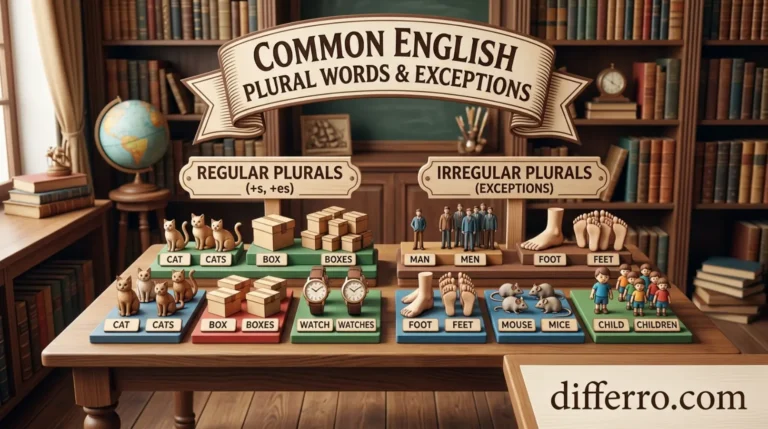
Common English Plural Words and Exceptions can confuse even confident English learners. Most English nouns form plurals by adding -s, but many words follow different patterns. Some take -es, some change their spelling, and others change completely.
For example, book becomes books, while child becomes children. The plural of baby is babies, but boy becomes boys. Some words, such as sheep and deer, keep the same form in singular and plural.
Learning these patterns makes English writing easier. It also helps you avoid common spelling and grammar mistakes. This guide explains regular plural words, irregular plurals, spelling exceptions, and useful examples. You will also learn when different plural forms apply in everyday English.
⭐ Quick Answer
Common English plural words usually add -s, such as book → books and car → cars. Exceptions use forms such as -es, -ies, -ves, irregular changes, or no spelling change.
Example: one child → two children, but one table → two tables.
📚 Meaning of Common English Plural Words and Exceptions
Meaning of Common English Plural Words
A plural word refers to more than one person, animal, place, object, or idea. Most countable English nouns form their plural by adding -s.
Examples:
- One book → two books
- One car → three cars
The regular pattern is simple, but the spelling can change with certain word endings.
Meaning of Plural Exceptions
Plural exceptions are nouns that do not follow the basic add -s rule. They may change their ending, change completely, or stay unchanged.
Examples:
- One child → two children
- One mouse → two mice
Words such as sheep, fish, and deer can keep the same form when plural.
🔍 Common English Plural Words and Exceptions: Key Differences
| Feature | Common Plural Words | Plural Exceptions |
|---|---|---|
| Meaning | More than one noun | More than one noun |
| Main pattern | Usually add -s | May change spelling or form |
| Tone | Normal everyday English | Normal, but rule-dependent |
| Usage | Extremely common | Common in specific words |
| Examples | books, cars, houses | children, mice, feet |
| Main challenge | Choosing the correct ending | Remembering the special form |
The biggest difference is the formation pattern. Regular nouns usually follow predictable rules. Irregular nouns require you to remember their individual forms.
📖 Common English Plural Rules
Understanding the main rules helps you recognize most plural forms.
1. Add -s
Most nouns simply take -s.
- book → books
- pen → pens
- house → houses
- teacher → teachers
- apple → apples
This is the most common plural pattern.
2. Add -es
Nouns ending in -s, -sh, -ch, -x, or -z commonly take -es.
- bus → buses
- dish → dishes
- watch → watches
- box → boxes
- quiz → quizzes
The extra syllable also makes the plural easier to pronounce.
3. Change -y to -ies
When a noun ends in a consonant + y, change y to i and add -es.
- baby → babies
- city → cities
- family → families
- country → countries
However, words ending in a vowel + y normally take -s.
- boy → boys
- toy → toys
- day → days
- key → keys
4. Some -f and -fe Words Change to -ves
Some nouns ending in -f or -fe change to -ves.
- wife → wives
- knife → knives
- life → lives
- leaf → leaves
- thief → thieves
However, this rule has important exceptions.
- roof → roofs
- belief → beliefs
- chief → chiefs
- cliff → cliffs
Cambridge specifically notes that some -f nouns take -ves, while others keep -f and add -s.
5. Some -o Words Take -es
Some nouns ending in -o form plurals with -es.
- potato → potatoes
- tomato → tomatoes
- hero → heroes
- echo → echoes
Other words simply add -s.
- radio → radios
- video → videos
- piano → pianos
- photo → photos
Therefore, the ending -o does not always guarantee one plural pattern.
🌍 Origin and History of English Plural Words
English developed from several languages, including Old English, Norse, French, Latin, and Greek. This history helps explain why English has different plural patterns.
The regular -s ending became highly productive in English. However, many older words retained older plural patterns. Some academic and scientific terms also entered English from Latin and Greek.
Examples include:
- formula → formulae
- phenomenon → phenomena
- crisis → crises
- analysis → analyses
- criterion → criteria
Cambridge identifies words such as formula, phenomenon, and crisis as examples of special plural forms.
English also contains older irregular forms that remain common today:
- man → men
- woman → women
- child → children
- tooth → teeth
- foot → feet
- mouse → mice
These forms cannot usually be predicted by simply adding -s.
🇬🇧 British English vs American English Spelling
British and American English share most plural rules. The main differences usually involve individual spelling choices rather than completely different plural systems.
For example, British English often uses -our while American English uses -or, as in colour/color. Some words also have different preferred endings.
Plural formation itself usually remains the same in both varieties. Cambridge notes that British and American English differ in several spelling and vocabulary areas.
British vs American English Comparison
| Word or Pattern | British English | American English |
|---|---|---|
| Colour | colour | color |
| Plural | colours | colors |
| Favourite | favourite | favorite |
| Plural | favourites | favorites |
| Centre | centre | center |
| Plural | centres | centers |
| Catalogue | catalogue | catalog |
| Plural | catalogues | catalogs |
| Organisation | organisation | organization |
| Plural | organisations | organizations |
These differences usually reflect spelling conventions rather than different meanings.

📝 When to Use Common English Plural Words
★Use regular plural forms when the noun follows the normal spelling pattern.
Use -s for Most Nouns
Use -s with ordinary countable nouns.
Examples:
- The shop sells new books.
- We planted five trees.
- Two students joined the class.
Use -es After Certain Endings
Use -es with many nouns ending in -s, -sh, -ch, -x, and -z.
Examples:
- The farmer owns three boxes.
- She washed several dishes.
- We watched two matches.
Use -ies After a Consonant + Y
Change y to i before adding -es.
Examples:
- The school has many libraries.
- Several families attended the event.
🧩 When to Use Plural Exceptions
Use irregular forms when the noun has an established special plural.
Child → Children
Use children, not childs.
Examples:
- The children are playing outside.
- Five children joined the activity.
Man → Men
Use men for more than one man.
Examples:
- Three men entered the room.
- The men carried the boxes.
Woman → Women
Use women for more than one woman.
Examples:
- Several women attended the meeting.
- The organization supports working women.
Mouse → Mice
Use mice for more than one mouse.
Examples:
- The farmer found two mice.
- The mice hid behind the cupboard.
Sheep → Sheep
Use sheep for both singular and plural in common usage.
Examples:
- One sheep is near the gate.
- Ten sheep are in the field.
Cambridge lists sheep, fish, and deer among nouns that can keep the same singular and plural form.
❌ Common Mistakes With English Plurals
Mistake 1: Childs Instead of Children
Incorrect: I saw three childs.
Correct: I saw three children.
The noun child has the irregular plural children.
Mistake 2: Mans Instead of Men
Incorrect: Two mans were waiting.
Correct: Two men were waiting.
The plural of man is men.
Mistake 3: Babys Instead of Babies
Incorrect: The babys are sleeping.
Correct: The babies are sleeping.
A consonant before y changes the ending to -ies.
Mistake 4: Boxs Instead of Boxes
Incorrect: Put the toys in those boxs.
Correct: Put the toys in those boxes.
Words ending in -x commonly take -es.
Mistake 5: Sheeps Instead of Sheep
Incorrect: The farmer has ten sheeps.
Correct: The farmer has ten sheep.
Sheep normally has the same singular and plural form.
Mistake 6: Informations Instead of Information
Incorrect: I need some informations.
Correct: I need some information.
Information is normally uncountable in English. It does not normally take a plural -s.
Mistake 7: Advices Instead of Advice
Incorrect: She gave me useful advices.
Correct: She gave me useful advice.
Use a piece of advice when you need to count individual suggestions.
Mistake 8: Sister-in-Laws Instead of Sisters-in-Law
Incorrect: She has two sister-in-laws.
Correct: She has two sisters-in-law.
Compound nouns can form plurals in different places. Cambridge gives sisters-in-law as the correct plural pattern.
🧠 Easy Trick to Remember English Plurals
Use the “Check the Ending” trick.
First, look at the final letters of the noun.
- Normal word → usually add -s
- Ends in s, sh, ch, x, z → often add -es
- Consonant + y → change y to ies
- Some f/fe words → change to ves
- Familiar irregular word → memorize its special form
Then ask one simple question:
“Does this word have a special plural?”
If yes, check the dictionary or remember the irregular form.
🌟 Everyday Life Examples of Common English Plurals
1. Books and Schools
Students often use plural nouns when discussing school items.
Example:
The students carried their books into the classrooms.
Here, students, books, and classrooms are regular plural words.
2. Shopping and Food
Shopping conversations contain many plural nouns.
Example:
I bought three boxes of cereal and two tomatoes.
The words boxes and tomatoes show different plural endings.
3. Family Conversations
Family discussions often use irregular plurals.
Example:
The children played with their toys while the women prepared dinner.
Here, children and women are irregular plurals.
4. Animals and Nature
Animal names provide several useful plural exceptions.
Example:
The farmer saw several sheep, deer, and mice near the field.
These words demonstrate three different plural patterns.
5. Work and Communication
Professional English also requires correct plural forms.
Example:
The managers reviewed the reports, analyses, and documents.
The word analyses is an important irregular plural of analysis.
📊 Google Trends & Usage Insight
Search interest for plural grammar varies by country, season, education level, and search intent. English-learning searches are especially relevant in countries where English is widely studied as an additional language.
For USA, UK, Australia, India, and Pakistan, the strongest practical search intent usually centers on plural rules, irregular nouns, spelling exceptions, and grammar examples. Exact Google Trends scores can change daily and depend on the selected date range and search category.
| Country | Common Search Intent | Usage Insight |
|---|---|---|
| USA | Grammar and writing | Learners often search specific plural forms |
| UK | English grammar and spelling | British spelling can influence searches |
| Australia | English learning and writing | British-based spelling is also relevant |
| India | Grammar and exam preparation | Plural rules have strong educational value |
| Pakistan | English learning and grammar | Common plural mistakes are frequent learning topics |
SEO insight: The broad keyword common English plural words can target informational searches. Supporting phrases such as irregular plural nouns, plural rules, and plural exceptions expand topical coverage.
📈 Keyword Variations Comparison
| Keyword Variation | Search Intent | Main User Need |
|---|---|---|
| Common English plural words | Informational | Learn common plural forms |
| English plural words | Informational | Understand plural nouns |
| Common plural nouns | Educational | Find everyday examples |
| Irregular plural nouns | Informational | Learn special plural forms |
| English plural rules | Educational | Understand formation rules |
| Plural words and exceptions | Confusion | Solve difficult plural forms |
| Common plural mistakes | Problem-solving | Avoid grammar errors |
⚖️ Final Verdict: Which Plural Form Is Better?
There is no single plural ending that works for every English noun.
Use -s for most regular nouns:
- car → cars
- book → books
- teacher → teachers
★Use -es after certain endings:
- box → boxes
- dish → dishes
- watch → watches
Use -ies for many consonant + y nouns:
- baby → babies
- city → cities
Use special forms for irregular nouns:
- child → children
- mouse → mice
- tooth → teeth
Some nouns keep the same form:
- sheep → sheep
- deer → deer
- fish → fish
The best approach is to learn the main patterns and memorize important exceptions.
❓ FAQ About Common English Plural Words and Exceptions
Is it correct to add -s to every English noun?
No. Most nouns take -s, but many nouns use different plural patterns. Examples include children, mice, and feet.
What is the difference between regular and irregular plural nouns?
Regular plurals usually follow predictable spelling patterns. Irregular plurals use special forms that cannot always be predicted.
For example, car → cars is regular, while child → children is irregular.
Which English plural form is more common?
The -s ending is the most common plural pattern for English nouns. However, other patterns are necessary for specific word endings and irregular nouns.
What plural forms should I use in formal English?
Use the standard dictionary form of each noun. Formal writing does not create different plural rules. Accuracy matters more than choosing a special style.
For example, write children, not childs, in both formal and everyday English.
Why do English plural exceptions exist?
English developed from several languages and retained many older word forms. Latin and Greek also contributed special plural patterns. This history created several plural systems in modern English.
Is “fishes” a correct plural?
Fishes can be correct in specific contexts, especially when discussing different species or types of fish. Fish is the common plural when referring to multiple fish generally.
Is “deers” correct?
Deer is normally used for both singular and plural. For example, you can say, “We saw three deer.”
Is “sheeps” correct?
No, sheep is normally used for both singular and plural. Say one sheep and ten sheep.
Conclusion
Common English Plural Words and Exceptions follow several useful patterns. Most regular nouns form plurals by adding -s, while others need -es or -ies. Some words also change -f to -ves, although this rule has exceptions.
Irregular nouns require more attention. Words such as child, mouse, tooth, man, and woman change their forms completely. Other nouns, including sheep, deer, and fish, can keep the same form in plural contexts. English also contains uncountable nouns such as information and advice, which normally do not take -s.
The easiest way to master English plurals is to learn the main rules first. Then memorize the most common exceptions. With regular practice, correct plural forms become much easier to recognize and use.

Imran Lodhra is a comparison-focused content writer at Differro.com.
He specializes in creating clear, simple, and informative comparison articles.
His work helps readers understand key differences, pros and cons, and important details.
Imran focuses on accurate, practical, and easy-to-read content for everyday readers.
1 thought on “Common English Plural Words and Exceptions”