
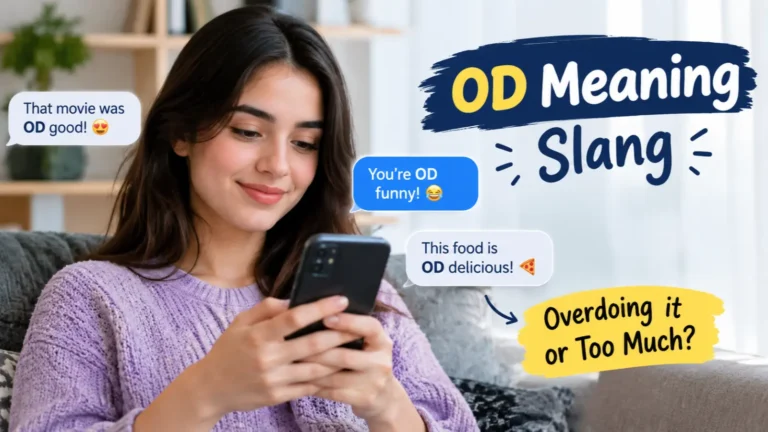
OD meaning slang can be confusing because these two letters can mean different things depending on the conversation. If you have seen someone text “That’s OD,” “You’re OD,” or “This is OD funny,” you may wonder what they are trying to say.
In casual texting and social media, OD usually means “overdoing it,” “too much,” “extremely,” or “over the top.” It can describe something funny, impressive, annoying, dramatic, or excessive.
However, OD can also mean “overdose” in medical or serious conversations. That meaning is very different, so context matters.
You may see OD in texts, TikTok comments, Instagram posts, Snapchat messages, gaming chats, and conversations between friends. Understanding the context helps you avoid misunderstanding the speaker.
Quick Answer
OD in slang usually means “overdoing it,” “too much,” or “extremely.” For example, “That movie was OD good” means “That movie was extremely good.” In medical contexts, OD can mean overdose.
What Does OD Mean in Text?
In modern casual texting, OD is commonly used to describe something as excessive, extreme, or over the top.
It can work in several ways:
- “You’re OD.” → You are doing too much.
- “That’s OD.” → That is excessive or crazy.
- “She’s OD funny.” → She is extremely funny.
- “This food is OD good.” → This food is extremely good.
- “He’s ODing.” → He is taking something too far.
The exact meaning depends on how the word is placed in the sentence.
In many casual conversations, OD acts almost like “very,” “really,” “extremely,” or “too much.”
OD Full Form and Definition
People often search for the OD full form because the abbreviation can have more than one meaning.
Common slang meaning
OD = Overdoing it / Overdo
It suggests that someone is doing something excessively or going beyond what seems normal.
Example:
“Bro, you OD with these jokes.”
This means:
“Bro, you are taking these jokes too far.”
Another common meaning
OD = Overdose
This is the serious meaning. It is commonly used in medical, health, drug-related, or emergency contexts.
For example:
“The report mentioned an OD.”
Here, OD may mean an overdose, not slang for “too much.”
So, when someone asks “What does OD stand for?”, the answer depends on context.
OD Meaning in Different Contexts
OD can carry different meanings in different situations.
1. OD as “too much”
“You put OD cheese on that pizza.”
Meaning: You put way too much cheese on it.
2. OD as “extremely”
“That game was OD difficult.”
Meaning: That game was extremely difficult.
3. OD as “overdoing it”
“You’re ODing with the decorations.”
Meaning: You are going overboard with the decorations.
4. OD as “overdose”
“The doctor was treating an OD.”
Here, OD refers to an overdose and should be understood seriously.
Context is therefore the most important clue.
Is OD Rude, Offensive, or Neutral?
OD is generally casual rather than offensive.
When friends use it, it can sound playful:
“You’re OD 😂”
However, tone can change its meaning.
If someone says:
“You’re being OD annoying.”
they are criticizing the person’s behavior.
OD itself is not necessarily rude. The words around it and the relationship between the speakers determine whether it sounds friendly, teasing, or insulting.
The medical meaning of OD should be treated differently and not used casually when discussing a real overdose.
Where Is OD Commonly Used?
You may encounter OD in:
- Text messages
- TikTok comments
- Snapchat
- X
- Gaming chats
- Group chats
- Memes
- Casual conversations
It is especially useful in fast, informal communication because two letters can communicate a strong reaction.
For example:
“That video was OD funny 😂”
is much quicker than:
“That video was extremely funny.”
Modern social media has helped casual slang spread across different communities and platforms.
OD Meaning in Friendly and Casual Conversations
Friends may use OD to exaggerate something in a humorous way.
Friendly examples
“Your new shoes are OD clean.”
Meaning: Your shoes look extremely good.
“You’re OD funny today.”
Meaning: You are extremely funny today.
“That food was OD good.”
Meaning: The food was really good.
In these examples, OD usually creates emphasis rather than negativity.
OD in Argumentative Conversations
OD can also appear during disagreements.
“You’re OD right now.”
This may mean:
“You are taking this way too far.”
Another example:
“Why are you OD mad about this?”
Meaning:
“Why are you getting so angry about this?”
Here, OD can sound critical. The speaker is suggesting that the other person’s reaction is excessive.
Emotional and Psychological Meaning of OD
OD does not have one specific psychological meaning.
In slang, it often communicates intensity.
Someone might say:
- “I’m OD tired.”
- “I’m OD excited.”
- “That made me OD happy.”
- “I’m OD stressed.”
The abbreviation strengthens the emotion.
It can therefore make a text sound more energetic, dramatic, humorous, or expressive.
Origin and Background of OD Slang
The casual slang use of OD is associated with American informal speech, including East Coast and New York slang. Some sources connect its development with hip-hop-influenced language and the idea of doing something excessively.
The abbreviation also has a long-established literal association with overdose.
Because “overdose” involves taking too much of something, the idea of excess naturally overlaps with the slang sense of doing something too much.
However, you should not assume every casual use of OD refers to drugs or an actual overdose.
OD vs Similar Slang Terms
| Slang | Common meaning | Example |
|---|---|---|
| OD | Extremely, excessive, or overdoing it | “That movie was OD good.” |
| Extra | Excessive or dramatic | “You’re being extra.” |
| Doing too much | Going beyond what is necessary | “You’re doing too much.” |
| Over the top | Excessive or extreme | “That reaction was over the top.” |
| Wild | Extreme, surprising, or crazy | “That story is wild.” |
OD is shorter and more informal than many of these alternatives.
When Should You Use OD?
OD is best for informal communication.
You can use it with:
- Close friends
- Casual group chats
- Social media comments
- Informal messages
- Memes
- Gaming conversations
For example:
“That concert was OD fun.”
This sounds natural in a casual setting.
When should you avoid OD?
Avoid it in formal situations such as:
- Job applications
- Professional emails
- Academic assignments
- Business reports
- Formal presentations
- Official documents
Instead of:
“The meeting was OD long.”
say:
“The meeting was extremely long.”
Clear language is usually better in professional communication.
Polite Alternatives to OD
If your audience may not understand slang, use a clearer expression.
Depending on the sentence, alternatives include:
- Very
- Extremely
- Really
- Excessively
- Too much
- Over the top
- Excessive
- Going too far
- Doing too much
For example:
Slang:
“That was OD expensive.”
Standard English:
“That was extremely expensive.”
Why Do People Use OD?
People use OD because it is:
- Short
- Expressive
- Easy to type
- Casual
- Flexible
- Good for emphasis
Texting often favors short expressions. OD allows people to communicate intensity without writing a longer phrase.
It can also make messages feel more natural among friends who already understand the slang.
Impact of OD on Communication
Slang can make communication feel more relaxed and personal.
For example:
“That was extremely funny.”
sounds clear and neutral.
“That was OD funny 😂”
sounds more casual and expressive.
The downside is that slang can create confusion between people from different age groups, regions, or language backgrounds.
OD is a good example because the same abbreviation can refer to excessive behavior in one message and an overdose in another.
Is OD Safe for Social Media?
Yes, OD is generally safe as casual slang, but context matters.
If you use it to mean “extremely” or “too much,” it is normally harmless.
However, remember that OD can also mean overdose. A message such as:
“He OD’d”
can be interpreted as a serious statement about an overdose.
Therefore, do not joke about a possible real overdose or use the term carelessly in a health or emergency situation.
Common Misunderstandings About OD
Misunderstanding 1: OD always means overdose
Not necessarily.
In casual slang, it can mean excessive, extreme, or overdoing something.
Misunderstanding 2: OD is always negative
Not true.
“That song is OD good.”
is positive.
“That person is OD annoying.”
is negative.
Misunderstanding 3: OD always means “very”
Sometimes it means “very,” but it can also mean too much or going too far.
Misunderstanding 4: OD is appropriate everywhere
No. It is informal slang and is usually better suited to casual communication.
Variations and Types of OD
You may see several forms online.
OD
“That is OD.”
Usually means something is excessive or extreme.
ODing
“You’re ODing.”
Usually means someone is overdoing something.
OD’d
“He OD’d on the jokes.”
Depending on context, this can mean he overdid something. In another context, OD’d can mean overdosed, so context is especially important.
OD good / OD funny / OD hard
Here, OD works as an intensifier.
“That movie was OD funny.”
Meaning:
“That movie was extremely funny.”
How to Respond When Someone Uses OD
Your response depends on the context.
If someone says:
“That outfit is OD 🔥”
You could reply:
“Haha, thank you!”
If someone says:
“You’re OD 😂”
you could ask:
“OD how? 😂”
if you are unsure whether they are complimenting or teasing you.
If OD appears in a serious health-related conversation, do not assume it is casual slang. Read the surrounding messages carefully.
Regional and Cultural Usage
OD slang is strongly associated with informal American English and has been linked to East Coast, particularly New York, slang. Its use has spread more widely through hip-hop culture, online communities, and social media.
That does not mean everyone in the United States uses OD in the same way.
Regional speech, age, online communities, and personal vocabulary can all affect how someone understands it.
Real-Life Examples of OD Meaning Slang
Friendly
“Your new haircut is OD nice.”
Meaning: Your haircut looks extremely good.
Casual
“I’m OD tired today.”
Meaning: I am extremely tired today.
Positive
“That restaurant was OD good.”
Meaning: The restaurant was extremely good.
Negative
“This homework is OD difficult.”
Meaning: This homework is extremely difficult.
Teasing
“Bro, you’re OD 😂.”
Meaning: Bro, you are doing too much.
Argumentative
“You’re OD mad about something so small.”
Meaning: You are getting far too angry about something minor.
Serious context
“The patient suffered an OD.”
Meaning: The patient suffered an overdose.
The final example shows why context is essential.
FAQs About OD Meaning Slang
1. What does OD mean in slang?
OD usually means overdoing it, excessive, too much, or extremely in casual slang.
2. What does OD stand for in text?
In casual texting, OD can refer to overdoing it or something being extremely excessive. In medical contexts, OD can mean overdose.
3. What does OD mean on TikTok?
On TikTok and similar social platforms, OD commonly means extremely, excessive, or over the top. For example, “OD funny” means “extremely funny.”
4. Is OD a bad word?
No. OD is generally not a swear word. It is informal slang, although it can sound critical depending on the sentence.
5. Does OD mean overdose?
Yes, OD can mean overdose, especially in medical, drug-related, or emergency contexts. However, casual slang uses may mean “overdoing it” or “extremely.”
6. Can I use OD in formal writing?
It is better to avoid OD in formal writing. Use standard words such as extremely, excessive, very, or over the top instead.
Conclusion
The od meaning slang is usually connected to the idea of something being too much, excessive, extreme, or over the top.
In casual texts, someone might say “That’s OD,” “You’re OD,” or “That’s OD funny.” Depending on the sentence, it can be positive, negative, playful, or critical.
However, OD has another important meaning: overdose. This meaning is common in medical and serious contexts and should not be confused with casual slang.
The best way to understand OD is to look at the surrounding words and conversation. Use it with friends and in casual online settings, but choose clearer standard English for school, work, and professional communication.

Ali Raza is an M.Phil. scholar and English language expert specializing in English grammar, slang meanings, vocabulary, and everyday expressions. He writes clear, practical, and easy-to-understand content that helps readers master confusing English words, phrases, spelling, and modern slang. His goal is to make English learning simple, useful, and accessible for students, beginners, and everyday readers.
1 thought on “OD Meaning Slang: What Does OD Mean in Text?”