
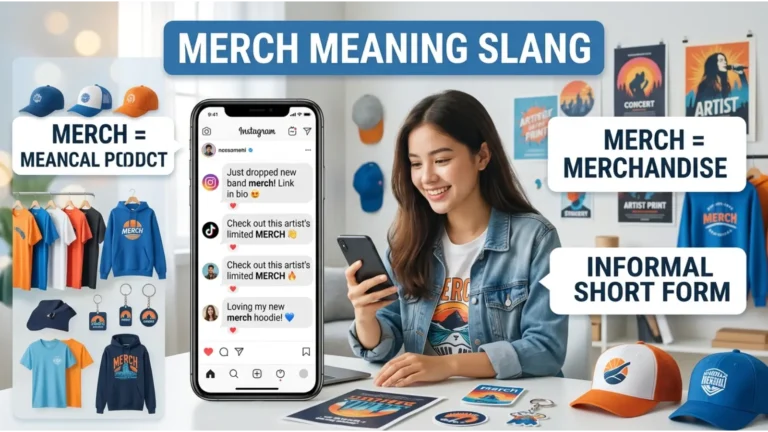
Merch meaning slang can be confusing because “merch” is an informal shortened form of merchandise. You may see it in social media posts, online stores, music communities, gaming groups, and conversations about favorite creators or brands.
For example, someone might say, “I bought their new merch,” meaning they purchased official products connected to that person, band, brand, or community.
The word is especially common online because it is short, casual, and easy to understand from context. It can refer to clothing, accessories, collectibles, or other products sold to fans and customers.
Quick Answer:
“Merch” is slang or informal shorthand for merchandise, usually meaning products such as T-shirts, hoodies, hats, posters, or other branded items.
What Does Merch Mean in Text?
In text messages and online conversations, merch usually means merchandise.
Merchandise refers to products that are bought and sold. In modern slang, however, “merch” often has a more specific meaning: products associated with a particular person, creator, band, team, brand, event, or community.
For example:
- “Did you see the new merch?”
- “I want that band’s merch.”
- “Her merch sold out quickly.”
- “Where can I buy your merch?”
In each example, “merch” refers to products being promoted or sold.
Merch Full Form and Definition
The merch full form is merchandise.
“Merchandise” is the standard English word, while “merch” is a shortened, informal version.
| Term | Meaning | Usage |
|---|---|---|
| Merchandise | Products or goods offered for sale | Formal/standard |
| Merch | Short form of merchandise | Informal/casual |
| Merch drop | A new release of merchandise | Online/social media |
| Official merch | Products officially connected to a creator or brand | Casual/marketing |
So, if someone asks “what does merch stand for?”, the simple answer is merchandise.
Merch Meaning in Different Contexts
The exact meaning can change slightly depending on where you see it.
Music
Musicians and bands often sell merch to fans.
Examples include:
- Band T-shirts
- Hoodies
- Posters
- Caps
- Tour shirts
- Collectibles
Example:
“I bought some merch after the concert.”
Here, “merch” means products related to the musician or concert.
Social Media and Influencers
Content creators frequently sell branded products to their followers.
Example:
“Her new merch is finally available.”
This means the creator has released products for fans to purchase.
Gaming
Gaming communities commonly use “merch” for products connected to a game, streamer, esports team, or gaming creator.
Example:
“I ordered some streamer merch.”
Sports
Sports teams and athletes may have official merchandise such as jerseys, caps, scarves, and jackets.
Example:
“Where can I get the team’s merch?”
Events
Events, festivals, and conventions may sell branded merchandise.
Example:
“I got some merch at the festival.”
Is Merch Rude, Offensive, or Neutral?
Merch is generally neutral and not offensive.
It is an informal word, so it fits better in casual conversations, social media posts, advertising, and everyday speech than in highly formal writing.
For example:
Casual:
“Check out my new merch!”
Formal:
“Our new merchandise collection is now available.”
The difference is mainly formality, not politeness.
Where Is Merch Commonly Used?
You are likely to encounter “merch” in:
- TikTok posts
- Instagram captions
- YouTube videos
- Text messages
- Online stores
- Music communities
- Gaming communities
- Sports fandoms
- Creator websites
- Concerts and festivals
- Promotional campaigns
It is particularly common when people discuss products connected to something they follow or support.
Real-Life Conversation Examples
Friendly Example
A: “I love that hoodie!”
B: “Thanks! It’s from my favorite creator’s merch store.”
Casual Example
A: “Did you buy the new merch?”
B: “Yeah, I got the black hoodie.”
Excited Example
A: “The new merch just dropped!”
B: “Seriously? I’m going to check it out now.”
Promotional Example
Creator: “New merch is available today!”
Here, “merch” refers to the creator’s newly released merchandise.
Argumentative Example
A: “You spent that much on merch?”
B: “Yes, because I really like the band.”
The word itself is not argumentative. The tone of the conversation makes the exchange argumentative.
Emotional and Psychological Meaning of Merch
“Merch” does not have a specific psychological meaning. However, merchandise can have emotional value for people.
Fans may purchase merch because it can:
- Show support for a creator or artist
- Express personal interests
- Create a sense of belonging
- Provide a memory of an event
- Connect someone with a community
- Show fandom or identity
For example, a concert T-shirt may remind someone of a favorite performance even years later.
Origin and Background of Merch
“Merch” comes from the word merchandise. It developed as an informal shortening, similar to many other shortened words used in everyday English.
As fan communities, online creators, musicians, and brands became more prominent, “merch” became increasingly common in informal marketing and internet culture.
Today, phrases such as “new merch,” “official merch,” “merch drop,” and “merch store” are widely recognizable in online communities.
Merch vs. Merchandise vs. Swag
These terms can overlap, but they are not always identical.
| Term | Basic Meaning | Typical Use |
|---|---|---|
| Merch | Short form of merchandise | Casual conversations |
| Merchandise | Products or goods for sale | Formal and general use |
| Swag | Promotional or branded items | Marketing and informal speech |
| Products | Items sold by a business | General/business contexts |
Merch usually focuses on products connected to a creator, artist, brand, team, or community.
Swag can refer to free promotional items, such as branded pens, bags, or T-shirts, although its meaning can vary.
When Should You Use Merch?
Use “merch” when the conversation is casual and the audience understands informal language.
Good examples include:
- “I love this merch.”
- “Where’s the merch store?”
- “The new merch looks amazing.”
- “I bought some merch at the show.”
For a formal report, business document, academic paper, or official communication, merchandise is usually more appropriate.
Polite and Formal Alternatives
“Merch” is not offensive, so you don’t need to avoid it for politeness.
However, you can use these alternatives in formal situations:
- Merchandise
- Products
- Branded products
- Promotional products
- Official merchandise
- Retail products
- Branded merchandise
For example:
Informal:
“Check out our new merch.”
More formal:
“Explore our new merchandise collection.”
Why Do People Use Merch?
People use “merch” because it is:
- Shorter than “merchandise”
- Easy to type
- Common online
- Familiar to fans and customers
- Suitable for casual conversation
- Easy to use in marketing
Shortened words are common in modern communication because people often prefer quick and simple expressions.
Impact of Using Merch in Communication
Using “merch” can make communication sound casual, modern, and conversational.
For example:
“Our new merchandise collection has launched.”
sounds more formal than:
“Our new merch just dropped!”
The second version feels more suitable for social media or a creator’s announcement.
Neither is inherently better; the appropriate choice depends on the audience and setting.
Is Merch Safe for Social Media?
Yes. “Merch” is generally safe and neutral for social media.
It is not normally considered a swear word, insult, or offensive slang term. Businesses, creators, musicians, and influencers regularly use it when discussing products.
However, always consider the surrounding content. A neutral word can still appear in a message with an inappropriate or offensive context, but the word “merch” itself is not generally offensive.
Common Misunderstandings About Merch
Some people may initially think “merch” refers only to clothing. That’s not necessarily true.
Merch can include:
- Clothing
- Accessories
- Posters
- Stickers
- Mugs
- Collectibles
- Bags
- Phone cases
- Other branded products
Another common misunderstanding is that “merch” always means official products. In practice, people may use the term broadly for products associated with a creator, fandom, event, or brand.
Variations and Common Phrases
You may see several related expressions online.
Merch Drop
A merch drop means a new release of merchandise.
“The new merch drop is tonight.”
Official Merch
This usually means merchandise officially connected to a creator, company, artist, team, or organization.
“I’m only buying official merch.”
Merch Store
A merch store is a place where merchandise is sold.
“The link to the merch store is in her bio.”
Merch Collection
A group of related merchandise released together.
“The winter merch collection is now available.”
How to Respond When Someone Uses Merch
Your response depends on the conversation.
If someone says:
“I bought the new merch!”
You could respond:
- “Nice! What did you get?”
- “That’s cool!”
- “Which design did you choose?”
- “I saw that collection too.”
- “How do you like it?”
If you don’t know what they mean, simply ask:
“Do you mean their merchandise?”
Regional and Cultural Usage
“Merch” is especially common in English-speaking internet culture, including social media, music fandoms, gaming, sports, and creator communities.
Because internet language crosses borders, people who speak English as a second language may also encounter and use the term.
The level of familiarity can vary by community. Someone who frequently follows online creators or music artists may understand “merch” immediately, while someone who rarely uses social media may prefer the full word merchandise.
FAQs About Merch Meaning Slang
What does merch mean in slang?
“Merch” is an informal shortened form of merchandise. It commonly refers to branded products associated with a creator, artist, team, brand, or community.
What is the merch full form?
The merch full form is merchandise.
Is merch a bad word?
No. “Merch” is generally a neutral, informal term and is not normally considered offensive.
What does merch mean on social media?
On social media, “merch” usually means products sold or promoted by a creator, musician, influencer, brand, team, or other public figure.
Is merch formal English?
“Merch” is informal English. In formal writing, merchandise is usually the better choice.
What does merch stand for?
“Merch” stands for merchandise, meaning goods or products offered for sale.
Conclusion
Merch meaning slang is simple: merch is an informal short form of merchandise. In modern conversations, it often refers to products connected to a creator, musician, sports team, brand, event, or online community.
The term is neutral rather than rude or offensive and is especially common in social media, texting, music, gaming, sports, and online shopping.
Use merch when you want a casual and conversational tone. For academic, business, or highly formal writing, use merchandise instead. Understanding the context helps you choose the word that sounds most natural.

Ali Raza is an M.Phil. scholar and English language expert specializing in English grammar, slang meanings, vocabulary, and everyday expressions. He writes clear, practical, and easy-to-understand content that helps readers master confusing English words, phrases, spelling, and modern slang. His goal is to make English learning simple, useful, and accessible for students, beginners, and everyday readers.
1 thought on “Merch Meaning Slang in Text: What Does “Merch” Mean?”