
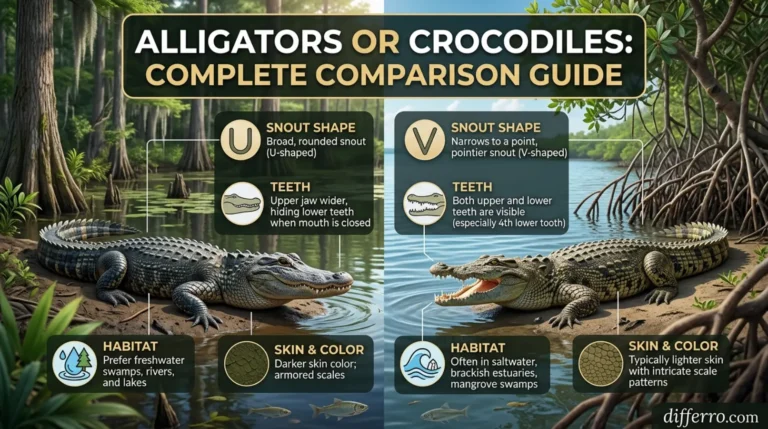
Alligators or Crocodiles can look similar, but they are not the same animal. Both belong to the crocodilian group and live near water. Their body shape, habitat, snout, teeth, and behavior help you tell them apart. Alligators usually have wider, U-shaped snouts. Crocodiles often have longer, V-shaped snouts. Their teeth also look different when their mouths close. An alligator’s lower teeth often hide from view. A crocodile can show several lower teeth along its jaw. Geographic range also provides a useful clue. American alligators mainly live in the southeastern United States. Crocodiles live across parts of Africa, Asia, Australia, and the Americas. South Florida is unusual because both animals live there naturally. Understanding these differences makes the Alligators or Crocodiles question much easier to answer. The simplest clue is the snout: alligators look wider, while crocodiles look more pointed.
⭐ Quick Answer
Alligators and crocodiles are different crocodilian reptiles. Alligators usually have wider U-shaped snouts, while crocodiles usually have narrower V-shaped snouts.
Example: An American alligator lives mainly in the southeastern United States, while an American crocodile also lives in southern Florida.
🐊 Meaning of Alligator
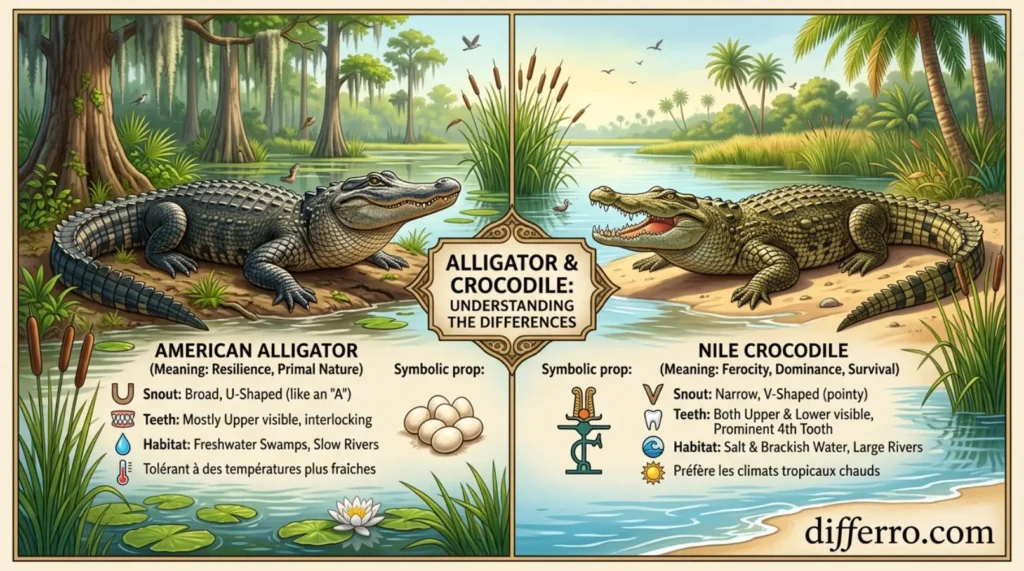
An alligator is a large semiaquatic reptile belonging to the family Alligatoridae.
Alligators have broad snouts and strong jaws. Their skin usually appears dark gray, black, or olive.
Examples:
- The American alligator lives across much of the southeastern United States.
- The Chinese alligator is a smaller alligator species found in China.
🐊 Meaning of Crocodile
A crocodile is a large semiaquatic reptile from the family Crocodylidae.
Crocodiles generally have longer bodies and more pointed snouts than alligators.
Examples:
- The saltwater crocodile lives across parts of South and Southeast Asia and Australia.
- The Nile crocodile lives across many parts of Africa.
🔎 Alligators or Crocodiles: Key Differences
| Feature | Alligators | Crocodiles |
|---|---|---|
| Meaning | A crocodilian reptile in Alligatoridae | A crocodilian reptile in Crocodylidae |
| Snout | Usually broad and U-shaped | Usually narrow and V-shaped |
| Teeth | Lower teeth often hide when the mouth closes | Several lower teeth can remain visible |
| Color | Usually darker | Often lighter brown, gray, or olive |
| Saltwater tolerance | Lower overall tolerance | Many species tolerate saltwater well |
| Main range | United States and China | Africa, Asia, Australia, and the Americas |
| Tone | Neutral animal name | Neutral animal name |
| Usage | Common in American English | Common worldwide |
| Popularity | Strong association with the United States | More globally recognized |
🌎 Origin and History
The word alligator comes from Spanish el lagarto, meaning “the lizard.”
English speakers later adapted the Spanish expression into the modern word alligator.
The word crocodile has older roots. It traces back through Latin and Greek terms connected with the animal.
Ancient writers used related words for large river reptiles.
Other related reptile names include:
- Caiman
- Gharial
- Lizard
- Reptile
- Crocodilian
These animals share broad biological connections, but they are not interchangeable names.
🇬🇧 British English vs American English Spelling
Alligator has the same spelling in British and American English.
Crocodile also keeps the same spelling in both varieties.
The main difference involves animal references and regional familiarity, not spelling.
British vs American English Comparison
| Term | British English | American English |
|---|---|---|
| Alligator | Alligator | Alligator |
| Crocodile | Crocodile | Crocodile |
| Spelling change | None | None |
| Common regional association | Crocodile | Alligator |
🐊 When to Use “Alligator”
Use alligator when you mean a member of the Alligatoridae family.
The term works best when discussing American or Chinese alligators.
Examples:
- We saw an alligator near the marsh.
- The American alligator has a broad snout.
- An alligator can spend long periods in water.
Do not use alligator as a general replacement for every crocodilian.
🐊 When to Use “Crocodile”
Use crocodile when you mean a member of the Crocodylidae family.
The word is especially useful when discussing species such as Nile or saltwater crocodiles.
Examples:
- The crocodile rested beside the river.
- A saltwater crocodile can grow extremely large.
- The Nile crocodile lives in many African regions.
Do not use crocodile when the animal specifically belongs to the alligator family.
⚠️ Common Mistakes
Mistake 1: Treating Them as the Same Animal
❌ Incorrect: An alligator and crocodile are exactly the same.
✅ Correct: Alligators and crocodiles are different crocodilian reptiles.
Mistake 2: Using Snout Shape as an Absolute Rule
❌ Incorrect: Every crocodile has the exact same snout shape.
✅ Correct: Crocodiles generally have more pointed snouts than alligators.
Mistake 3: Assuming All Crocodilians Are Crocodiles
❌ Incorrect: Every crocodilian is a crocodile.
✅ Correct: Crocodilians include crocodiles, alligators, caimans, and gharials.
Mistake 4: Calling an American Alligator a Crocodile
❌ Incorrect: We photographed a crocodile in Louisiana.
✅ Correct: We photographed an American alligator in Louisiana.
Mistake 5: Thinking the Words Have Different Spellings
❌ Incorrect: British English uses “crocodile,” but American English uses another spelling.
✅ Correct: Both varieties use the spelling “crocodile.”
🧠 Easy Trick to Remember
Use this simple memory trick:
Alligator = A = American association.
Crocodile = C = Common worldwide association.
For appearance, remember:
Alligator = U-shaped snout.
Crocodile = V-shaped snout.
The snout clue is useful, but species and location provide stronger evidence.
🌿 Everyday Life Examples
1. At a Wildlife Park
A visitor may see a large reptile behind a secure barrier.
Example: The wildlife park has an American alligator.
Primary keyword: Alligators or Crocodiles
Secondary keyword: American alligator
2. During a Nature Documentary
A documentary may show reptiles hunting near rivers.
Example: The documentary follows a crocodile hunting in Africa.
Primary keyword: Alligators or Crocodiles
Secondary keyword: crocodile species
3. In a School Lesson
Students often learn the differences between these reptiles.
Example: The teacher explained how alligators differ from crocodiles.
Primary keyword: Alligators or Crocodiles
Secondary keyword: alligator vs crocodile
4. During a Zoo Visit
A zoo may display several crocodilian species.
Example: We compared the alligator and crocodile exhibits.
Primary keyword: Alligators or Crocodiles
Secondary keyword: crocodilian reptiles
5. In a Wildlife Article
Writers can use the correct name for each species.
Example: The article explains how crocodiles differ from alligators.
Primary keyword: Alligators or Crocodiles
Secondary keyword: difference between alligators and crocodiles
📈 Google Trends & Usage Data
Google Trends measures relative search interest, not exact monthly search volume. Search patterns can also change by country and season.
- USA: “alligator” has especially strong recognition because of native American alligator populations.
- UK: “crocodile” generally has stronger worldwide animal-name familiarity.
- Australia: “crocodile” has strong relevance because several crocodile species occur there.
- India: “crocodile” is a familiar wildlife term because crocodiles occur across the region.
- Pakistan: “crocodile” is generally the more familiar broad term for this reptile group.
SEO insight: The best strategy targets the comparison intent instead of treating both terms as synonyms. Long-tail phrases such as alligator vs crocodile can capture users seeking a direct answer.
📊 Comparison Table: Keyword Variations
| Keyword Variation | Search Intent | Best Content Type |
|---|---|---|
| Alligators or Crocodiles | Comparison | Detailed guide |
| alligator vs crocodile | Comparison | Comparison article |
| crocodile vs alligator | Confusion | Quick answer |
| difference between alligators and crocodiles | Informational | Educational guide |
| alligator crocodile difference | Informational | FAQ section |
| alligator and crocodile comparison | Comparison | Table or infographic |
| how to tell an alligator from a crocodile | Educational | Visual guide |
Current keyword research also shows strong demand for broader crocodile terms. One recent keyword dataset reported about 1 million monthly searches for “crocodile,” while “alligator crocodile” showed lower but steady demand. These figures come from third-party keyword research, not Google Trends, so they should not be treated as official Google search volumes.
⚖️ Final Verdict
Alligators and crocodiles are both correct terms, but they describe different animals.
Choose alligator for members of the Alligatoridae family.
Choose crocodile for members of the Crocodylidae family.
If you need a quick visual clue, check the snout. Alligators usually have broader U-shaped snouts. Crocodiles generally have narrower V-shaped snouts.
For SEO content, Alligators or Crocodiles works well as a comparison keyword. Supporting phrases can capture users searching for specific differences.
❓ FAQ
1. Is “Alligators or Crocodiles” correct?
Yes. Alligators or Crocodiles is correct when comparing the two reptile groups.
2. What is the main difference between alligators and crocodiles?
The snout is one useful difference. Alligators usually have wider U-shaped snouts. Crocodiles generally have narrower V-shaped snouts.
3. Which term is more common?
Crocodile has broad worldwide usage. Alligator has especially strong usage in the United States.
4. Are these terms suitable for formal writing?
Yes. Both terms are standard scientific and everyday English words.
5. Why does confusion exist between alligators and crocodiles?
They look similar because both belong to the crocodilian group. Their body shapes and lifestyles also share many features.
📝 Conclusion
Alligators or Crocodiles often creates confusion because both reptiles look remarkably similar. They still represent different animal groups. Alligators usually have wider U-shaped snouts and darker bodies. Crocodiles often have narrower V-shaped snouts and lighter coloring. Their teeth provide another useful clue. Geographic location can also help identify them. American alligators mainly occur in the southeastern United States. Crocodiles occur across several regions worldwide. Both names are spelled the same in British and American English. The best term depends on the actual animal you mean. For comparison searches, alligator vs crocodile remains a useful supporting keyword. Remember the simple rule: alligators usually look broader, while crocodiles generally look more pointed.

Imran Lodhra is a comparison-focused content writer at Differro.com.
He specializes in creating clear, simple, and informative comparison articles.
His work helps readers understand key differences, pros and cons, and important details.
Imran focuses on accurate, practical, and easy-to-read content for everyday readers.