

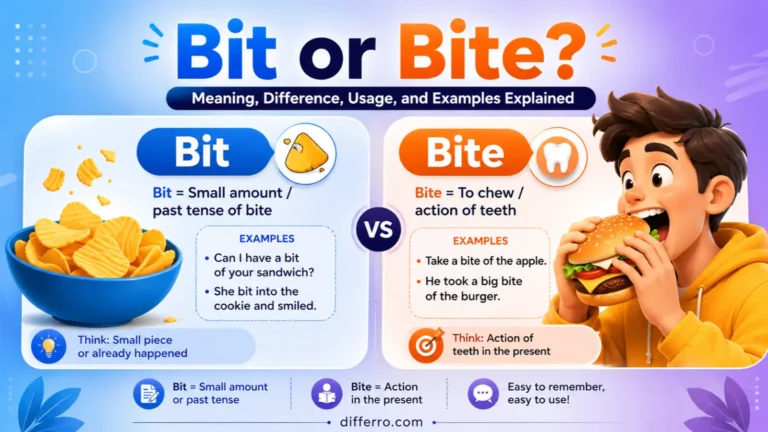
Bit or Bite is a common English language confusion that many learners face. These two words look similar and sound related, but they have very different meanings. Using the wrong word can change the meaning of your sentence completely.
A bit usually means a small piece or a small amount of something. A bite refers to using your teeth to cut into food or something else. Because both words are short and commonly used, people often mix them up in writing and conversation.
In this guide, you will learn the meaning of bit and bite, their differences, correct usage, examples, history, common mistakes, and an easy trick to remember them.
⭐ Quick Answer
Bit means a small piece, amount, or part of something.
Bite means to cut or grip something with your teeth.
Example:
✔ I ate a small bit of cake.
✔ I took a bite of cake.
Meaning of Bit
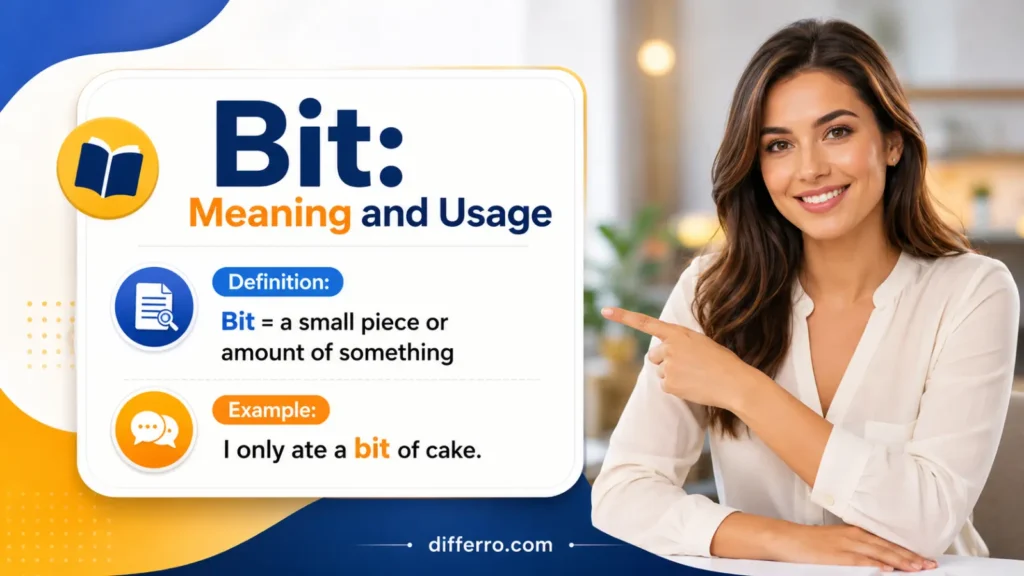
Bit means a small piece, part, or amount of something.
Examples
- I need a little bit of help.
- There is a bit of chocolate left.
Meaning of Bite
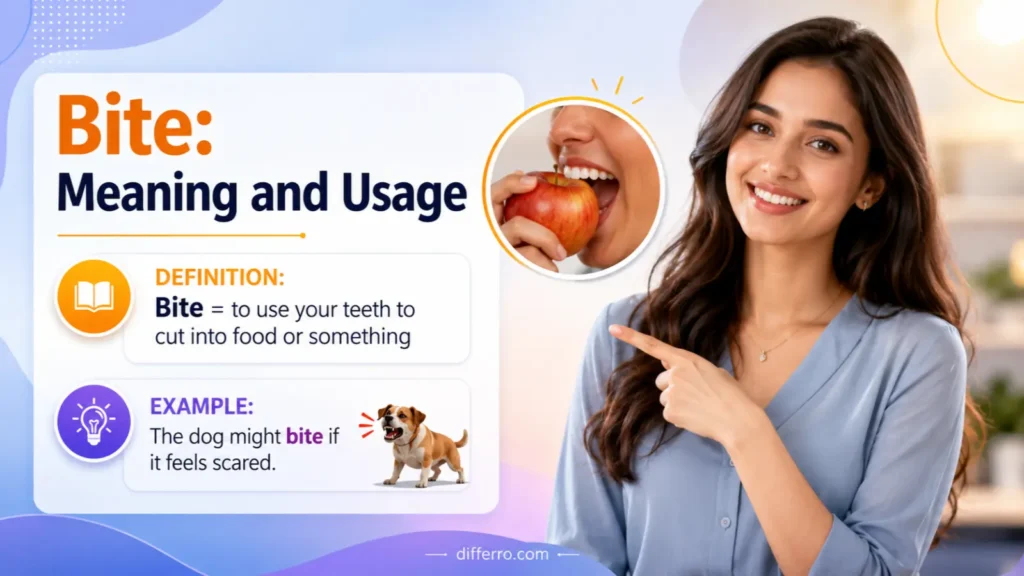
Bite means to cut into something using your teeth.
Examples
- The dog tried to bite the toy.
- She took a bite of the sandwich.
Key Differences Between Bit and Bite
| Feature | Bit | Bite |
|---|---|---|
| Meaning | Small piece or amount | Act of using teeth |
| Tone | General and descriptive | Physical action |
| Usage | Quantity or portion | Eating or attacking |
| Popularity | Common in daily speech | Common in eating contexts |
Origin & History
The word bit comes from Old English and originally meant a small piece broken off from something larger.
The word bite also comes from Old English and referred to the action of cutting with teeth.
Similar word examples include:
- Sit vs Site
- Brake vs Break
- Bare vs Bear
- Piece vs Peace
British English vs American English Spelling
The words bit and bite have the same spelling in both British and American English. There is no spelling difference between the two versions of English.
However, pronunciation may vary slightly depending on the accent.
British vs American English Comparison Table
| Feature | British English | American English |
|---|---|---|
| Bit | Bit | Bit |
| Bite | Bite | Bite |
| Meaning | Same | Same |
| Spelling | Same | Same |
When to Use Bit
Use bit when talking about:
- A small amount
- A small piece
- A short period
Examples
- Give me a bit of time.
- Only a bit of pizza remains.
- I feel a bit tired today.
When to Use Bite
Use bite when talking about:
- Eating food
- Using teeth
- Animal attacks
Examples
- Take one bite of the apple.
- The mosquito bite itched all day.
- The puppy tried to bite my shoe.
Common Mistakes
Mistake 1
❌ Take a bit of the burger.
✔ Take a bite of the burger.
Mistake 2
❌ I only need a bite of information.
✔ I only need a bit of information.
Mistake 3
❌ The dog gave me a bit.
✔ The dog gave me a bite.
Mistake 4
❌ Can I have a bite of help?
✔ Can I have a bit of help?
Easy Trick to Remember
Remember this simple trick:
- Bit = Small Piece
- Bite = Teeth Action
The extra letter “e” in bite can remind you of eating.
Write 5 Examples
Example 1: At Breakfast
I ate a small bit of toast before taking a large bite.
Example 2: At School
The teacher explained a bit of grammar during class.
Example 3: At a Restaurant
She took a bite of pizza and smiled.
Example 4: During a Conversation
I know a bit about digital marketing.
Example 5: With Pets
The puppy tried to bite a rubber ball.
Related Keywords
- bit meaning
- bite meaning
- bit vs bite
- difference between bit and bite
- bit or bite grammar
- bit and bite examples
- how to use bit and bite
Final Verdict
Neither word is better than the other. They serve different purposes.
Use bit when referring to a small amount or piece.
Use bite when referring to eating or using teeth.
Choosing the correct word depends entirely on the context.
Google Trends & Usage Data
The keyword “bit or bite” receives searches from English learners across several countries. Interest remains steady because it is a common vocabulary confusion.
The USA and UK, searches often come from students and writers. Australia, usage is similar to the UK. In India and Pakistan, many English learners search for grammar explanations and usage examples.
The confusion mainly exists because both words share similar spelling and pronunciation patterns.
Usage Comparison Table
| Country | Bit Usage | Bite Usage | Search Interest |
|---|---|---|---|
| USA | Very High | Very High | High |
| UK | High | High | High |
| Australia | High | High | Medium |
| India | Medium | High | High |
| Pakistan | Medium | High | High |
Keyword Variations Comparison Table
| Keyword Variation | Search Intent |
|---|---|
| bit or bite | Word confusion |
| bit vs bite | Comparison |
| bit meaning | Definition |
| bite meaning | Definition |
| difference between bit and bite | Educational |
| how to use bit and bite | Usage |
| bit and bite examples | Learning |
FAQs
Is it correct to use bit instead of bite?
No. Use bit for a small amount and bite for using teeth.
What is the difference between bit and bite?
Bit means a small piece. Bite means to cut with teeth.
Which is more common, bit or bite?
Both are common, but they appear in different situations.
Which word is more formal?
Both words are acceptable in formal and informal English.
Why does the confusion exist?
The confusion exists because the words look similar and are closely related in pronunciation.
Conclusion
Understanding the difference between bit or bite is simple once you know their meanings. A bit refers to a small piece, amount, or part of something. A bite refers to using your teeth to cut into food or another object.
Although the words look similar, they serve completely different purposes in English. Using the correct word improves clarity and helps you communicate more effectively.

