

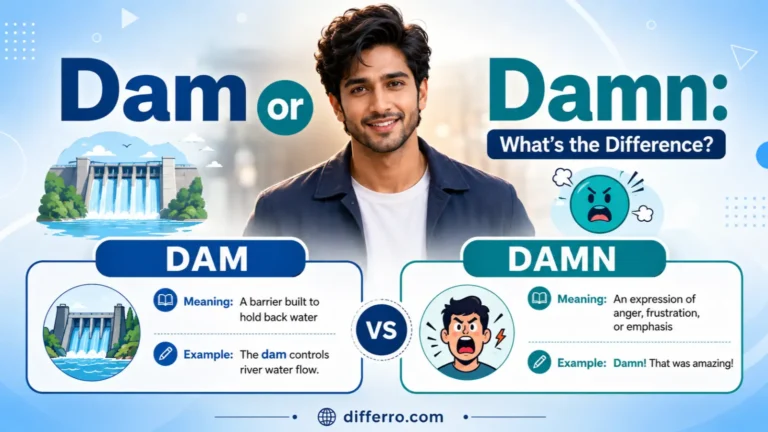
Dam or Damn is a common word confusion that many English learners and native speakers face. Although these two words look and sound similar, they have very different meanings. Using the wrong one can completely change the meaning of your sentence.
A dam is a structure built to stop or control water. On the other hand, damn is an expression used to show anger, surprise, frustration, or emphasis. Because only one letter separates them, many people accidentally mix them up in writing.
Understanding the difference between dam and damn will help you communicate clearly and avoid embarrassing mistakes. In this guide, you’ll learn their meanings, origins, correct usage, common mistakes, and simple memory tricks.
⭐ Quick Answer
Dam is a noun that refers to a barrier built across a river to control water flow.
Damn is an expression or verb used to show strong emotion, criticism, or frustration.
Example:
- The dam protects the town from flooding.
- Damn, I forgot my keys at home!
Meaning of Dam
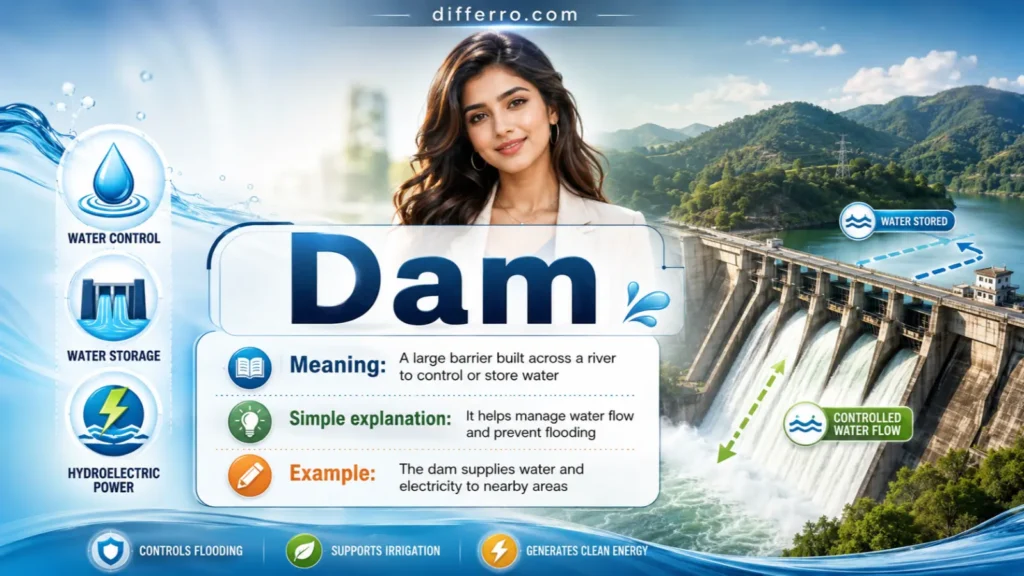
A dam is a structure built across a river, lake, or stream to hold back water.
Examples:
- The new dam supplies water to nearby farms.
- The government repaired the old dam after heavy rains.
Meaning of Damn
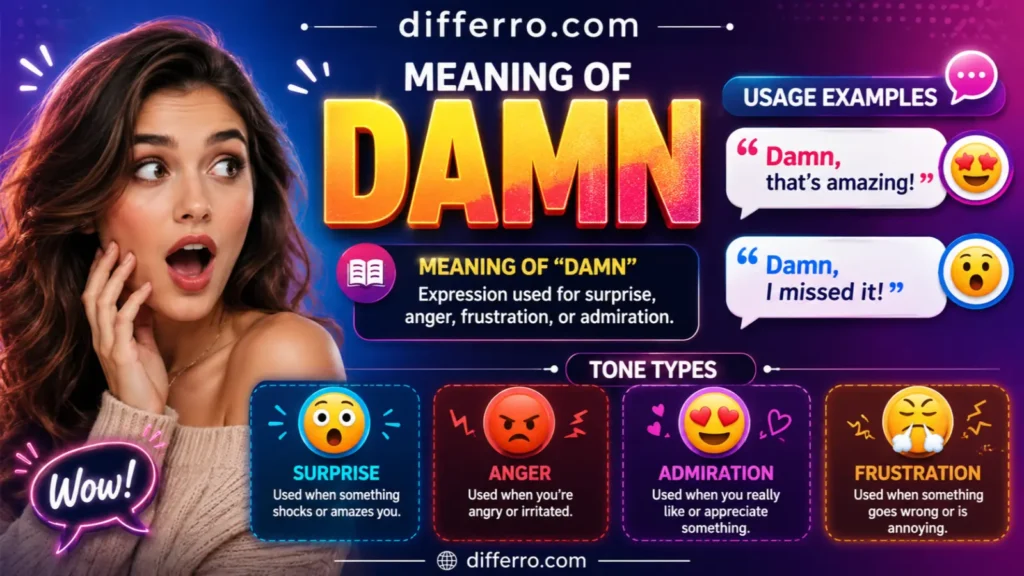
Damn is a word used to express anger, disappointment, surprise, or emphasis.
Examples:
- Damn, that was an unexpected result.
- He said, “Damn, I missed the train.”
Key Differences Between Dam and Damn
| Feature | Dam | Damn |
|---|---|---|
| Meaning | Water barrier | Expression of emotion |
| Tone | Neutral | Emotional or strong |
| Usage | Engineering, geography | Conversation, emotions |
| Part of Speech | Noun | Interjection, verb, adjective |
| Popularity | Common in environmental topics | Common in everyday speech |
Origin & History
The word dam comes from Middle Dutch and Old Germanic languages. It originally referred to barriers built to stop water.
The word damn comes from the Latin word damnare, meaning “to condemn” or “declare guilty.”
Similar Word Examples
- Dam → Reservoir, barrier, levee
- Damn → Curse, condemn, criticize
British English vs American English Spelling
There is no spelling difference between dam and damn in British and American English. Both countries use the same spelling and meanings.
However, usage frequency may vary depending on culture and context. The words remain identical in written English.
British vs American English Comparison Table
| Word | British English | American English |
|---|---|---|
| Dam | Dam | Dam |
| Damn | Damn | Damn |
| Meaning Difference | None | None |
| Spelling Difference | None | None |
When to Use Dam
Use dam when discussing:
- Rivers
- Water storage
- Hydroelectric power
- Flood control
- Engineering projects
Examples
- The dam generates electricity.
- Workers inspected the dam after the storm.
- The river flows through the dam.
When to Use Damn
Use damn when expressing:
- Frustration
- Anger
- Surprise
- Emphasis
Examples
- Damn, that was expensive.
- The movie was damn good.
- Damn, I forgot the meeting.
Common Mistakes
Mistake 1
❌ The damn controls river water.
✅ The dam controls river water.
Mistake 2
❌ Dam, I lost my wallet.
✅ Damn, I lost my wallet.
Mistake 3
❌ The city built a new damn.
✅ The city built a new dam.
Mistake 4
❌ The dam movie was amazing.
✅ The damn movie was amazing.
Easy Trick to Remember
Remember this simple rule:
- Dam = Water barrier
- Damn = Emotion
Think of the extra “n” in damn as standing for “negative emotion.”
If emotion is involved, use damn.
If water is involved, use dam.
Write 5 Examples
1. At a River
The dam prevents flooding during heavy rain.
2. During a Power Project
The new dam provides electricity to thousands of homes.
3. Missing a Bus
Damn, I arrived too late for the bus.
4. Watching Sports
Damn, that was an incredible goal.
5. School Geography Lesson
Students learned how a dam stores water and generates power.
Related Keywords
- Dam vs Damn
- Difference between Dam and Damn
- Dam meaning
- Damn meaning
- Dam or Damn grammar
- Dam vs Damn examples
- English word confusion
Google Trends & Usage Data
1 In the USA, damn is searched more often because it appears frequently in conversations and media.
2 In the UK, both words are common, but damn receives more language-related searches.
3 In Australia, people often search damn meaning and expression-related queries.
4 In India, searches for dam or damn usually come from students and English learners.
5 In Pakistan, many users search for spelling differences and correct English usage.
Insight
Globally, damn generally receives higher search volume because people use it more often in daily communication. However, dam remains important in geography, engineering, and environmental topics.
Comparison Table: Keyword Variations
| Keyword Variation | Search Intent |
|---|---|
| Dam or Damn | Word confusion |
| Dam vs Damn | Comparison |
| Dam meaning | Definition |
| Damn meaning | Definition |
| Difference between Dam and Damn | Educational |
| How to use Damn | Usage |
| How to use Dam | Usage |
Final Verdict
Neither word is better than the other. The correct choice depends on context.
- Use dam when talking about water, rivers, or engineering structures.
- Use damn when expressing emotion, frustration, surprise, or emphasis.
Choosing the right word ensures your writing stays clear and accurate.
FAQs
Is it correct to use “dam” instead of “damn”?
No. They have different meanings. Use dam for water structures and damn for emotions.
What is the difference between dam and damn?
Dam is a water barrier, while damn is an emotional expression or exclamation.
Which is more common, dam or damn?
Damn is generally more common in everyday conversation and online searches.
Is damn formal English?
Usually no. It is considered informal and may be inappropriate in professional writing.
Why does the confusion exist?
The words look and sound similar. The only spelling difference is the extra letter “n” in damn.
Conclusion
Understanding Dam or Damn is simple once you know their meanings. A dam is a structure that controls water, while damn expresses emotion such as frustration, surprise, or emphasis. Although they differ by only one letter, their meanings are completely unrelated.
Using the correct word helps avoid misunderstandings and improves your writing accuracy. Remember the easy memory trick: dam equals water, damn equals emotion. Whether you’re writing an academic paper, a social media post, or a professional email, choosing the right word shows strong language skills.
Keep practicing with examples, and you’ll never confuse dam and damn again.

