
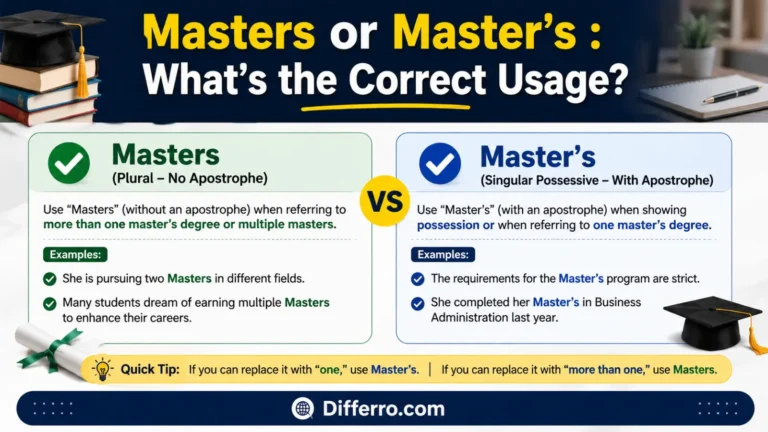
Masters or Master’s is a common grammar confusion in English writing. Many people feel unsure about which form is correct. You may see both words online, in resumes, and in university documents. That often creates confusion.
The difference mainly depends on grammar and sentence structure. One form shows possession, while the other is usually incomplete or informal. Knowing the correct usage helps you write clearly in academic and professional settings.
This guide explains the meaning, usage, spelling rules, and key differences between “masters” and “master’s” in simple English. You will also learn easy memory tricks, common mistakes, and real-life examples. By the end, you will know exactly which form to use and when.
⭐ Quick Answer
“Master’s” is the correct form when talking about a graduate degree. It uses an apostrophe because the degree belongs to a master.
Example:
- Correct: I completed my master’s degree in English.
- Incorrect: I completed my masters degree in English.

📘 Meaning of Masters
“Masters” is the plural form of “master.” It refers to more than one master.
Examples
- The chess masters joined the tournament.
- Ancient masters created famous paintings.

📘 Meaning of Master’s
“Master’s” is a possessive noun. It is commonly used for academic degrees like a master’s degree.
Examples
- She earned a master’s degree in biology.
- He started his master’s program last year.
📊 Key Differences Table
| Feature | Masters | Master’s |
|---|---|---|
| Meaning | Plural form of master | Possessive form |
| Tone | General or informal | Academic and formal |
| Usage | Refers to multiple masters | Refers to a graduate degree |
| Popularity | Less correct in education | Most accepted form |
🕰️ Origin & History
The word “master” comes from the Latin word magister, meaning teacher or chief. Over time, English added apostrophes to show possession. That is why “master’s degree” became the standard academic term.
Similar examples include:
- Bachelor’s degree
- Associate’s degree
🇬🇧 British English vs American English Spelling
British and American English mostly use “master’s degree” the same way. However, some universities remove the apostrophe in official program names. That is a style choice, not a grammar rule.
Comparison Table: British vs American English
| Type | British English | American English |
|---|---|---|
| Standard Grammar | Master’s degree | Master’s degree |
| University Style Variations | MA degree | Master’s degree |
| Apostrophe Usage | Common | Common |
✍️ When to Use Each Word
Use “Masters”
Use “masters” when talking about several experts or leaders.
Examples
- The martial arts masters trained the students.
- The old masters inspired modern artists.
Use “Master’s”
Use “master’s” when referring to a graduate degree.
Examples
- She completed her master’s in education.
- A master’s degree can improve career options.
❌ Common Mistakes
| Incorrect Usage | Correct Usage |
|---|---|
| I finished my masters degree. | I finished my master’s degree. |
| He has a masters in math. | He has a master’s in math. |
| She applied for a masters program. | She applied for a master’s program. |
| My brother earned two master’s. | My brother earned two master’s degrees. |
🧠 Easy Trick to Remember
Think of it this way:
- The degree belongs to a master.
- That is why it needs an apostrophe.
So:
- ✔ Master’s degree
- ❌ Masters degree
📝 Write 5 Examples
1. College Application Example
She added her master’s degree to the application form.
2. Resume Example
A master’s in business helped him get promoted.
3. Classroom Example
The art masters taught painting techniques.
4. Conversation Example
I plan to start my master’s next year.
5. Online Profile Example
Her LinkedIn profile mentions a master’s degree in marketing.
🔍 Related Keywords
- master’s degree meaning
- masters vs master’s
- correct spelling of master’s
- master degree or master’s degree
- academic degree grammar
- bachelor’s vs master’s
- master’s program meaning
🌍 Google Trends & Usage Data
In countries like the USA, UK, Australia, India, and Pakistan, “master’s degree” is far more common than “masters degree.” Search data shows that users often search the incorrect form first because it sounds natural in speech. Academic institutions still prefer the apostrophe version. In Pakistan and India, confusion is higher because many people follow mixed English styles.
Comparison Table: Keyword Variations
| Keyword Variation | Popularity | Correctness |
|---|---|---|
| Master’s degree | Very High | Correct |
| Masters degree | High | Incorrect |
| Masters | Medium | Context dependent |
| Master degree | Low | Incorrect |
| Master’s program | High | Correct |
⚠️ Final Verdict
“Master’s” is the correct choice when talking about an academic degree. It follows standard English grammar rules and appears in formal writing.
Use “masters” only when referring to multiple experts or leaders.
So:
- ✔ Master’s degree
- ✔ Master’s program
- ❌ Masters degree
FAQs ,
Is it correct to say masters degree?
No. The correct form is “master’s degree.”
What is the difference between masters and master’s?
“Masters” is plural. “Master’s” shows possession and refers to a degree.
Which is more common?
“Master’s degree” is more common in formal English.
Is master’s formal usage?
Yes. Universities and employers prefer “master’s.”
Why does this confusion exist?
People often skip apostrophes in casual writing and online searches.
📝 Conclusion
Understanding the difference between masters or master’s is important for correct English writing. “Master’s” is the proper form when talking about an academic degree because it uses possession. “Masters” is only correct when referring to multiple masters or experts.
Many people make this mistake in resumes, applications, and conversations. Luckily, the rule is simple once you understand it. If you are talking about education, use “master’s degree.” This small grammar detail makes your writing look more professional and accurate.
Using the correct form also improves clarity and credibility in academic and workplace communication.
Discover More Post ,
Bingeing or Binging : Which Spelling Is Correct?
More Or Less : Meaning, Differences, Usage & Grammar Guide
Whisky or Whiskey Explained Simply

Sara Taylor is a passionate writer and language enthusiast. She specializes in creating simple and easy-to-understand articles about English grammar, spelling differences, and commonly confused words. Her writing style focuses on helping students, writers, and English learners improve their language skills with confidence. Through informative guides and practical examples, Sara makes complex grammar topics easier for everyday readers.