
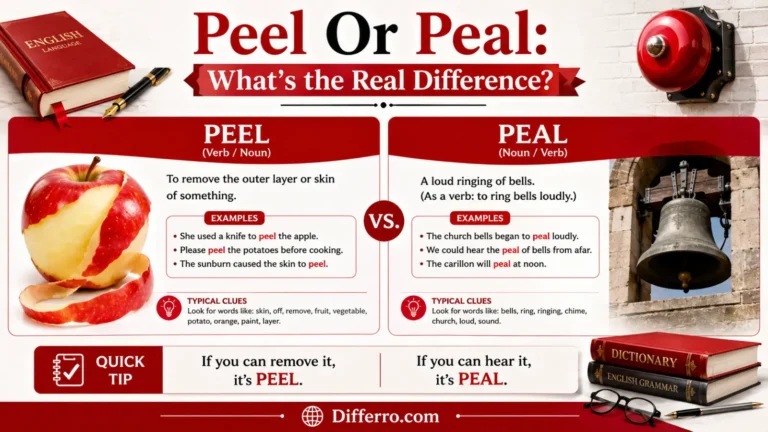
Peel Or Peal is a common word confusion in English. These two words sound the same, but they have very different meanings. That makes them homophones. Many writers mix them up because English spelling can be tricky.
“Peel” usually relates to removing the outer layer of something. You often hear it with fruits and vegetables. “Peal,” however, refers to a loud ringing sound, especially from bells or laughter.
Using the wrong word can change your sentence completely. That is why understanding the difference matters. This guide explains the meanings, uses, examples, history, and common mistakes in simple English. You will also learn memory tricks and SEO-friendly examples to help you use both words correctly in daily writing.
⭐ Quick Answer
Peel means to remove an outer layer, like the skin of a banana.
Peal means a loud ringing sound, usually from bells or laughter.
Examples:
- She used a knife to peel the apple. 🍎
- A loud peal of thunder shook the house. ⚡
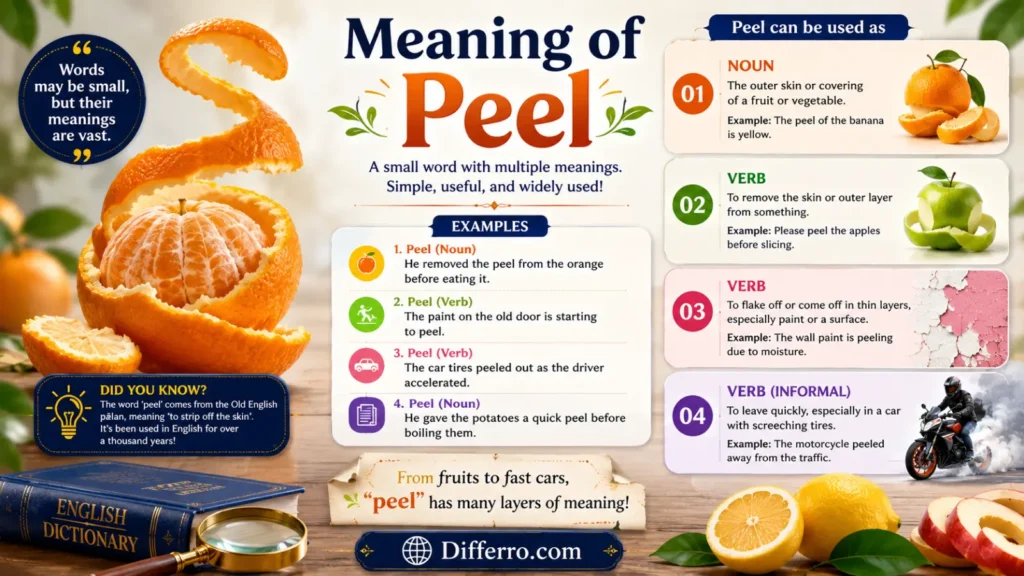
Meaning of Peel
Peel is a verb or noun. It usually refers to removing the outer covering of something.
Simple Definition:
To remove the skin, covering, or outer layer.
Examples:
- Please peel the potatoes before cooking.
- The orange peel smelled fresh and sweet.

Meaning of Peal
Peal is mainly a noun. It describes a loud repeated sound.
Simple Definition:
A loud ringing sound or burst of noise.
Examples:
- We heard a peal of church bells.
- Her funny joke caused a peal of laughter.
📊 Key Differences Between Skin and Ring
| Feature | Peel | Peal |
|---|---|---|
| Meaning | Remove outer skin | Loud ringing sound |
| Tone | Everyday and practical | Formal or literary |
| Usage | Food, fruits, paint | Bells, thunder, laughter |
| Popularity | Very common | Less common |
🕰️ Origin & History
The word peel comes from Middle English and old French roots. It originally referred to skin or bark.
The word peal comes from old French and Latin words linked to ringing bells.
English has many similar homophones, including:
- Sale vs Sail
- Flour vs Flower
- Brake vs Break
These words sound alike but carry different meanings.
🇬🇧 British English vs American English Spelling
Both peel and peal use the same spelling in British and American English. There is no regional spelling difference. However, “peal” appears more in British literature and formal writing.
Comparison Table: British vs American English
| Word | British English | American English |
|---|---|---|
| Peel | Peel | Peel |
| Peal | Peal | Peal |
✍️ When to Use Peel
Use peel when talking about:
- Fruits and vegetables
- Removing paint or stickers
- Skin coming off
Examples:
- I need to peel this mango.
- The wallpaper began to peel off the wall.
- His sunburned skin started to peel.
🔔 When to Use Peal
Use peal when describing:
- Bell sounds
- Thunder
- Loud laughter
Examples:
- A peal of thunder echoed outside.
- We heard a joyful peal of bells.
- Her laugh came in a sudden peal.
❌ Common Mistakes
| Incorrect | Correct |
|---|---|
| Please peal the banana. | Please peel the banana. |
| A peel of thunder scared us. | A peal of thunder scared us. |
| I heard church peel today. | I heard church peal today. |
| The potato peal is thick. | The potato peel is thick. |
🧠 Easy Trick to Remember
- Peel has “ee” like “eat.” You peel food before eating. 🍌
- Peal has “al” like “alarm.” Bells and alarms make loud sounds. 🔔
✨ write 5 examples
1. In the Kitchen 🍎
You must peel the apple before baking the pie.
2. During a Storm ⚡
A loud peal of thunder woke everyone up.
3. At School 🎒
The children laughed in a joyful peal after the joke.
4. Home Cleaning 🏠
The old paint started to peel from the ceiling.
5. At a Wedding 💒
A happy peal of church bells filled the air.
🔍 Related Keywords
- Peel meaning
- Peal meaning
- Peel vs Peal
- Homophones in English
- Common spelling mistakes
- English word confusion
- Difference between peel and peal
🌍 Google Trends & Usage Data
In the USA, UK, Australia, India, and Pakistan, peel is searched far more often than peal. This happens because “peel” appears in daily cooking and skincare topics. “Peal” is less common and mostly appears in literature or weather-related searches. The confusion mainly comes from pronunciation because both words sound identical.
Comparison Table: Keyword Variations
| Keyword Variation | Search Popularity |
|---|---|
| Peel | Very High |
| Peal | Low |
| Peel vs Peal | Medium |
| Meaning of Peel | Medium |
| Meaning of Peal | Low |
⚖️ Final Verdict
Both words are correct, but they serve different purposes.
- Use peel for removing skin or outer layers.
- Use peal for loud ringing sounds or laughter.
“Peel” is much more common in everyday English. “Peal” appears more in formal writing and storytelling.
FAQs Section
1. Is “peel” a correct word?
Yes, “peel” is correct and commonly used for removing outer layers.
2. What is the difference between skin and ring?
“Peel” relates to skin or covering, while “peal” relates to loud sounds.
3. Which word is more common?
“Peel” is far more common in everyday English.
4. Is “peal” formal?
Yes, “peal” often appears in literary or formal contexts.
5. Why does the confusion exist?
The confusion exists because both words sound exactly alike.
Conclusion
Understanding Peel Or Peal becomes easy once you know their meanings. Although they sound the same, they describe completely different things. “Peel” connects with removing skin, covering, or layers. “Peal” refers to loud ringing sounds, thunder, or laughter. Using the correct word improves your writing and avoids confusion. Remember the simple memory trick: you peel food before eating, and a peal sounds like an alarm. With practice, you will quickly recognize which word fits your sentence. These homophones may confuse many learners, but mastering them helps you write more clearly and confidently in English every day.
Discover More Post ;
Tardies Or Tardys: Which Spelling Is Correct?
Griefing Or Grieving Meaning: Correct Usage Guide
Difference Between Waisted and Wasted in English

Sara Taylor is a passionate writer and language enthusiast. She specializes in creating simple and easy-to-understand articles about English grammar, spelling differences, and commonly confused words. Her writing style focuses on helping students, writers, and English learners improve their language skills with confidence. Through informative guides and practical examples, Sara makes complex grammar topics easier for everyday readers.