
Parenthesis or parentheses is a common grammar confusion in English. Many people mix these words because they look almost the same. However, they have different meanings and uses.
The confusion usually happens when writing sentences with extra information. Writers often ask whether they should use parenthesis or parentheses in formal and informal writing.
The good news is that the difference is simple. One word is singular, and the other is plural. Once you understand this rule, you can use both correctly every time.
This guide explains the meanings, differences, examples, grammar rules, and usage tips in simple English. You will also learn common mistakes, memory tricks, and real-life examples to improve your writing skills.
⭐ Quick Answer
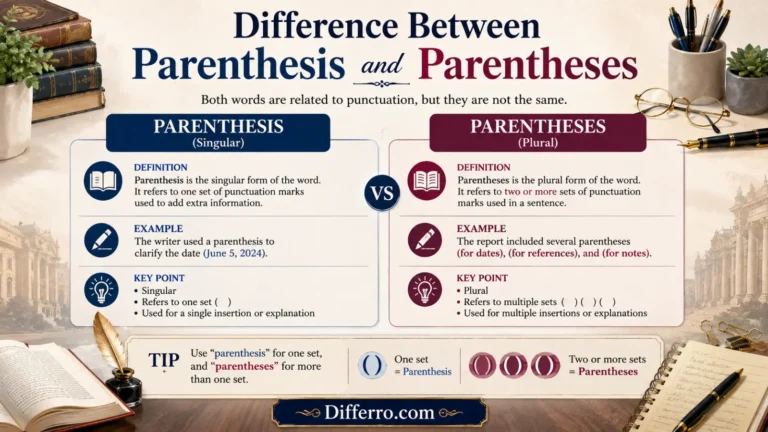
Parenthesis is singular. It refers to one curved punctuation mark or one inserted idea.
Parentheses is plural. It refers to two punctuation marks used together.
Example:
- Correct: Please place the word inside the parentheses.
- Correct: The sentence contains one parenthesis.
Meaning of Parenthesis
Parenthesis means:
- A single curved punctuation mark: (
- Or an extra word, phrase, or sentence added to writing
Examples:
- There is one missing parenthesis in the equation.
- The writer added a short parenthesis for clarification.
Meaning of Parentheses
Parentheses means:
- A pair of curved punctuation marks: ( )
- They add extra information to a sentence
Examples:
- Put the date inside the parentheses.
- The sentence includes additional details in parentheses.
📊 Key Differences Between Parenthesis and Parentheses
| Feature | Parenthesis | Parentheses |
|---|---|---|
| Meaning | One punctuation mark or inserted phrase | Two punctuation marks together |
| Grammar | Singular | Plural |
| Usage | Less common | More common |
| Tone | Technical or grammatical | Everyday writing |
| Popularity | Lower | Higher |
📚 Origin & History
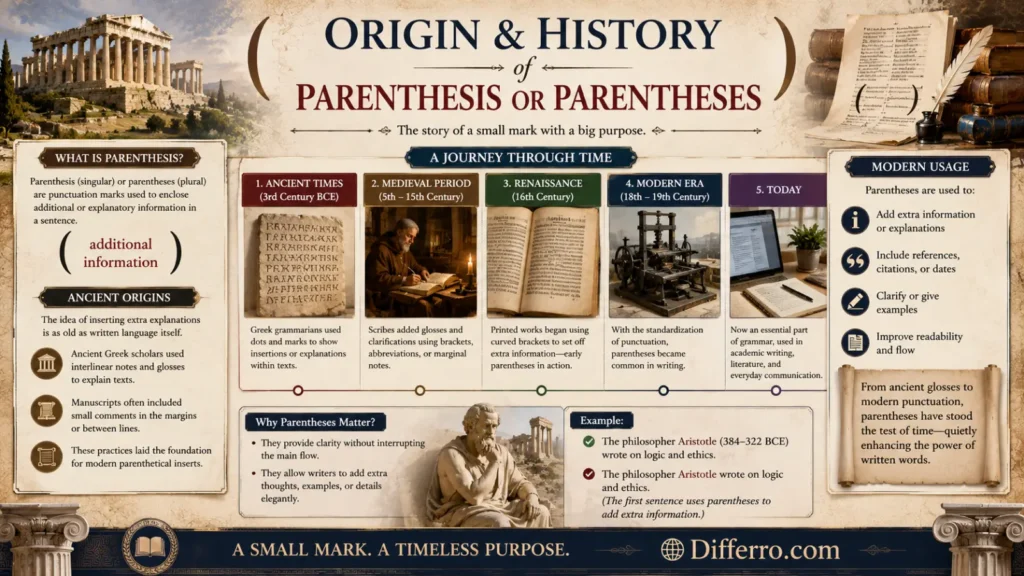
Both words come from the Greek word “parentithenai.”
It means “to put beside.”
English later adopted:
- Parenthesis as singular
- Parentheses as plural
Many Greek-origin words follow this pattern.
Similar Word Examples:
- Analysis → Analyses
- Thesis → Theses
- Crisis → Crises
🇬🇧 British English vs American English Spelling
There is no spelling difference between British and American English for these words. Both countries use:
- Parenthesis
- Parentheses
However, American English uses parentheses more often in casual writing.
Comparison Table: British vs American English
| Feature | British English | American English |
|---|---|---|
| Parenthesis | Correct | Correct |
| Parentheses | Correct | Correct |
| Usage Style | Slightly formal | More common in daily writing |
| Grammar Rule | Same | Same |
✍️ When to Use Parenthesis
Use parenthesis when talking about:
- One punctuation mark
- One inserted thought
- Grammar discussions
Examples:
- The editor found one misplaced parenthesis.
- This mathematical formula lacks a closing parenthesis.
✍️ When to Use Parentheses
Use parentheses when referring to:
- A pair of brackets
- Extra information inside a sentence
Examples:
- Add your nickname inside the parentheses.
- The author included examples in parentheses.
❌ Common Mistakes
| Incorrect Usage | Correct Usage |
|---|---|
| Put the word in parenthesis. | Put the word in parentheses. |
| There are two parenthesis here. | There are two parentheses here. |
| I added details in parenthesis. | I added details in parentheses. |
| One parentheses is missing. | One parenthesis is missing. |
🧠 Easy Trick to Remember
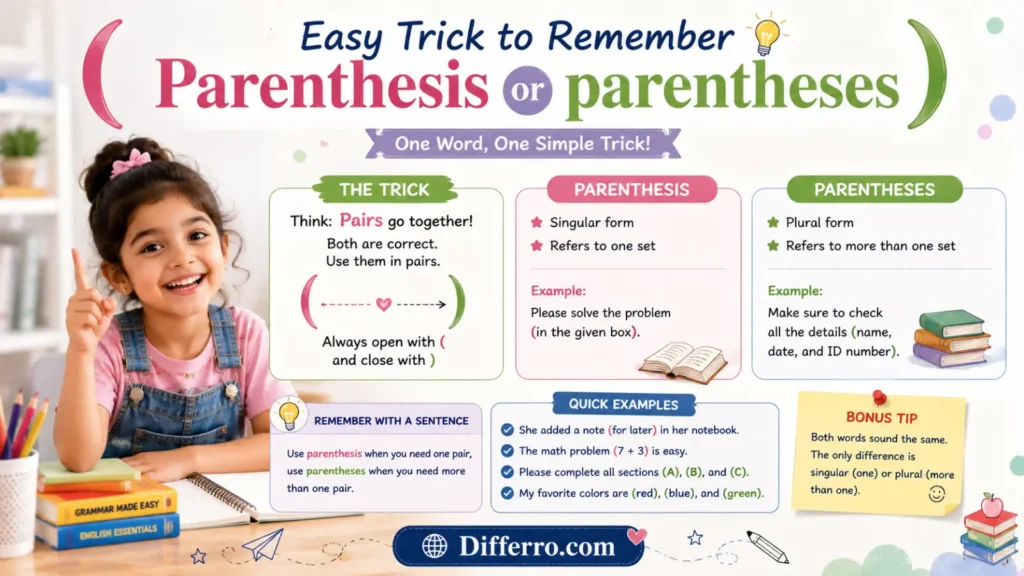
Remember this simple rule:
- Parenthesis = One
- Parentheses = Many
The ending “-es” usually shows plural words.
Think of:
- Thesis → Theses
- Crisis → Crises
The same pattern applies here.
📝 Write 5 Examples
1. Academic Writing Example
The teacher asked students to place citations inside parentheses.
2. Grammar Lesson Example
One closing parenthesis was missing from the sentence.
3. Office Email Example
Please include your department name in parentheses.
4. Math Equation Example
The equation contains one incorrect parenthesis.
In math, “parenthesis” refers to one curved symbol: ( or ).
“Parentheses” is the plural form and refers to both symbols together: ( ).
5. Blog Writing Example
Writers often use parentheses for extra details.
🔍 Related Keywords
- Parenthesis vs Parentheses
- Difference between Parenthesis and Parentheses
- Parentheses meaning
- Parenthesis meaning
- Grammar punctuation rules
- Singular and plural punctuation
- English grammar confusion
🌍 Google Trends & Usage Data
In the USA, UK, Australia, India, and Pakistan, parentheses is searched more often than parenthesis.
Most users search the plural form because it appears in daily writing and grammar lessons.
The singular form mainly appears in technical grammar discussions.
Students and writers commonly confuse these terms worldwide.
📈 Comparison Table: Keyword Variations
| Keyword Variation | Search Popularity |
|---|---|
| Parentheses | Very High |
| Parenthesis | Medium |
| Parenthesis vs Parentheses | High |
| Difference between Parenthesis and Parentheses | Medium |
| Parentheses meaning | Medium |
| Grammar parentheses rules | Medium |
🏆 Final Verdict
Parentheses is the more common and practical word in everyday English.
Use it when referring to the pair of curved punctuation marks ( ).
Use parenthesis only when talking about one punctuation mark or one inserted idea.
Both words are correct, but they serve different grammatical purposes.
FAQs ;
Is parenthesis correct?
Yes, parenthesis is correct. It is the singular form.
What is the difference between parenthesis and parentheses?
Parenthesis is singular. Parentheses is plural.
Which is more common?
Parentheses is more common in everyday writing.
Is parentheses formal usage?
Yes. It is correct in both formal and informal English.
Why does this confusion exist?
The words look very similar and come from Greek plural rules.
Conclusion
Understanding parenthesis or parentheses is easier than many people think. The main difference is singular versus plural usage. Use parenthesis for one punctuation mark or inserted idea. Use parentheses for the pair of curved marks used in writing.
This grammar rule appears often in essays, emails, books, and academic writing. That is why knowing the correct form matters. Many English learners confuse these terms because they look alike, but practice makes them simple to remember.
A quick memory trick helps:
- One = Parenthesis
- More than one = Parentheses
Once you learn this difference, your writing becomes clearer and more professional.
Discover More Post ;
Peel Or Peal: What’s the Real Difference?
Lily Or Lilly: Which Spelling Is Correct? 🌸
Griefing Or Grieving Meaning: Correct Usage Guide

Sara Taylor is a passionate writer and language enthusiast. She specializes in creating simple and easy-to-understand articles about English grammar, spelling differences, and commonly confused words. Her writing style focuses on helping students, writers, and English learners improve their language skills with confidence. Through informative guides and practical examples, Sara makes complex grammar topics easier for everyday readers.