
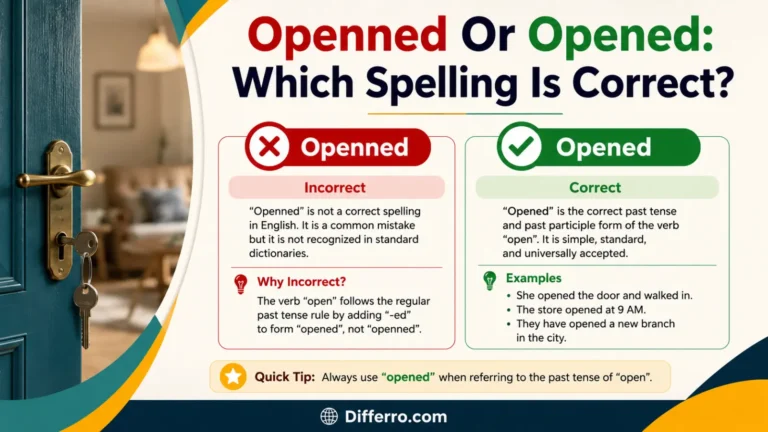
Openned or Opened is a common spelling confusion in English. Many people wonder which word is correct when writing emails, essays, or social media posts. The mistake usually happens because some English verbs double their final letter before adding “-ed.”
However, the verb “open” does not follow that rule. That is why “openned” looks possible but is actually incorrect.
Understanding the right spelling helps improve your grammar and writing confidence. It also prevents mistakes in professional and academic communication.
In this guide, you will learn the difference between “openned” and “opened,” their meanings, examples, common mistakes, and easy memory tricks. You will also see how these words are used in American and British English.
⭐ Quick Answer
“Opened” is the correct spelling.
“Openned” is a misspelling and is not accepted in English grammar.
✅ Correct: She opened the door quietly.
❌ Incorrect: She openned the door quietly.
📖 Meaning of Openned
Meaning of “Openned”
“Openned” has no official meaning in English dictionaries because it is an incorrect spelling.
People mistakenly write it by adding an extra “n” before “-ed.”
Examples of Incorrect Usage
- ❌ He openned the package yesterday.
- ❌ They openned the shop early.
📖 Meaning of Opened
Meaning of “Opened”
“Opened” is the past tense and past participle of the verb “open.”
It means:
- To move something so it is no longer closed
- To begin or start something
Examples
- ✅ Sarah opened the window.
- ✅ The restaurant opened at 9 AM.
📊 Key Differences Between Openned and Opened
| Feature | Openned | Opened |
|---|---|---|
| Meaning | No valid meaning | Past tense of “open” |
| Correct Spelling | ❌ Incorrect | ✅ Correct |
| Usage | Grammar mistake | Standard English |
| Popularity | Very rare | Widely used |
| Tone | Informal error | Professional and formal |

🕰️ Origin & History
The word “open” comes from Old English openian, meaning “to make accessible” or “uncover.”
Over time, the correct past tense became “opened.”
Some English verbs double the last consonant before adding “-ed.” Examples include:
- Stop → Stopped
- Plan → Planned
However, “open” does not follow this pattern because the stress is not on the final syllable.
🇬🇧 British English vs American English Spelling
Both British and American English use “opened” as the correct spelling.
There is no regional difference for this word. “Openned” is incorrect in every major English dialect.
Comparison Table: British vs American English
| English Style | Correct Form |
|---|---|
| British English | Opened |
| American English | Opened |
| Australian English | Opened |
| Canadian English | Opened |
📝 When to Use Each Word
When to Use “Opened”
Use “opened” when talking about:
- Something no longer closed
- A business starting
- An event beginning
Examples
- The teacher opened the classroom door.
- A new mall opened downtown.
- She opened her laptop quickly.
When to Use “Openned”
You should never use “openned” in formal or informal writing.
Incorrect Examples
- ❌ The bank openned late.
- ❌ I openned the email.
❌ Common Mistakes
Here are common grammar mistakes people make:
| Incorrect | Correct |
|---|---|
| He openned the box. | He opened the box. |
| She openned the app. | She opened the app. |
| The store openned today. | The store opened today. |
| They have openned it already. | They have opened it already. |
🧠 Easy Trick to Remember
Remember this simple rule:
👉 “Open” only needs one “n.”
If the base word has one “n,” the past tense also keeps one “n.”
- Open → Opened ✅
- Not → Openned ❌
✨ write 5 examples
1. Opening a Door
- She opened the front door quietly.
- ❌ She openned the front door quietly.
2. Starting a Business
- They opened a new bakery last week.
- ❌ They openned a new bakery last week.
3. Checking an Email
- I opened your message this morning.
- ❌ I openned your message this morning.
4. Using a Mobile App
- He opened the weather app.
- ❌ He openned the weather app.
5. Beginning an Event
- The manager opened the meeting with a speech.
- ❌ The manager openned the meeting with a speech.
🔍 Related Keywords
- opened meaning
- openned spelling
- opened vs openned
- correct spelling of opened
- open past tense
- grammar mistakes in English
- common spelling confusion
⚖️ Final Verdict
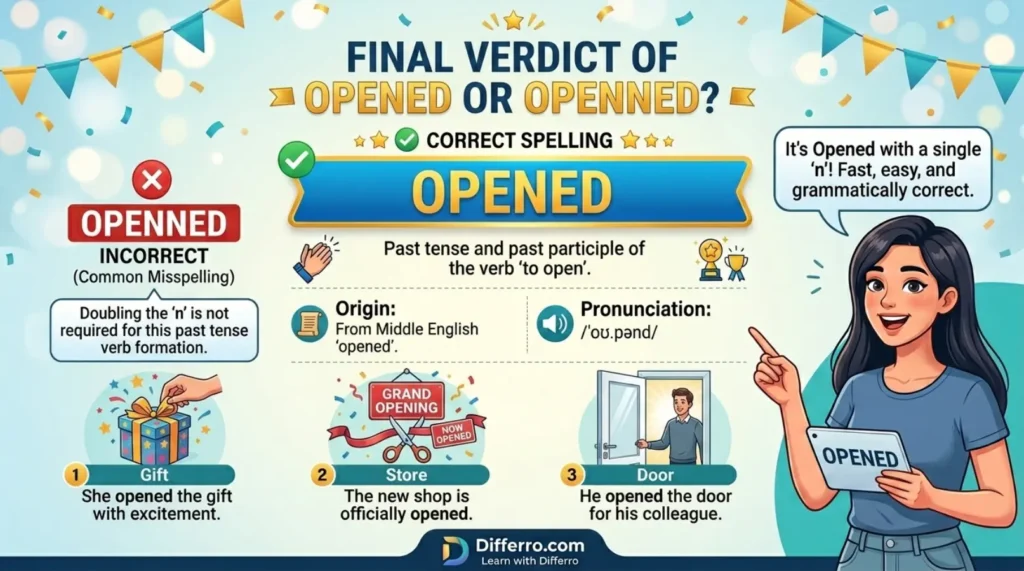
“Opened” is the only correct spelling in English.
Use it in:
- Formal writing
- School assignments
- Emails
- Professional communication
Avoid using “openned” because it is a spelling mistake and may reduce writing quality.
📈 Google Trends & Usage Data
Search data shows that “opened” is far more popular than “openned” in English-speaking countries.
People often search “openned” because of spelling confusion. However, dictionaries and grammar tools only recognize “opened.”
The highest searches for “opened” come from countries where English is widely used in education and business.
Grammar-related keyword searches are also growing in Pakistan and India.
Comparison Table: Keyword Variations
| Country | “Opened” Popularity | “Openned” Popularity |
|---|---|---|
| USA | Very High | Low |
| UK | Very High | Very Low |
| AUS | High | Very Low |
| IND | High | Medium |
| PAK | Medium | Medium |
FAQs ;
Is “openned” correct?
No, “openned” is incorrect.
What is the difference between “opened” and “openned”?
“Opened” is correct English. “Openned” is a spelling mistake.
Which is more common: opened or openned?
“Opened” is much more common worldwide.
Is “opened” formal English?
Yes, “opened” is correct in both formal and informal writing.
Why does this confusion exist?
People think “open” follows the same spelling rule as words like “planned” or “stopped.”
📝 Conclusion
The confusion between openned or opened is common, especially for English learners. Still, the correct spelling is always “opened.” The word “openned” is not accepted in English grammar or dictionaries.
Using the correct spelling improves your writing and makes your communication more professional. Remember that “open” keeps a single “n” when changing to the past tense.
Whether you are writing emails, essays, or social media captions, always use “opened.” Learning these small grammar rules can make a big difference in your English skills.
Discover More Post ;
Congradulations Or Congratulations: Which Spelling Is Correct?
Were or We’re: What’s the Correct Difference?
Semrush Or Moz: Which SEO Tool Is Better in 2026?

Sara Taylor is a passionate writer and language enthusiast. She specializes in creating simple and easy-to-understand articles about English grammar, spelling differences, and commonly confused words. Her writing style focuses on helping students, writers, and English learners improve their language skills with confidence. Through informative guides and practical examples, Sara makes complex grammar topics easier for everyday readers.