

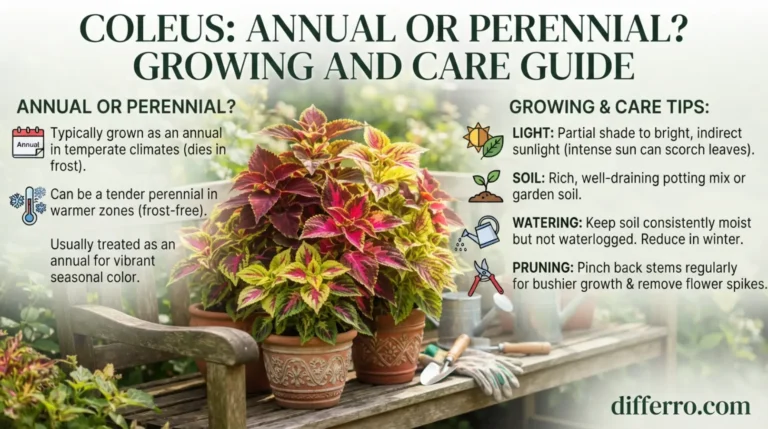
Coleus annual or perennial? The answer depends on your climate and growing conditions. Coleus is a popular ornamental plant known for its colorful leaves and attractive patterns. Many gardeners grow it as an annual, while others keep it alive for several years.
Coleus grows naturally in warm regions and dislikes cold temperatures. In tropical and frost-free climates, it can survive outdoors throughout the year. In colder regions, gardeners usually grow it during the warmer months. They can also bring potted plants indoors before winter arrives.
Understanding whether coleus is an annual or perennial helps you plan your garden. It also helps you choose the right planting time and winter care. This guide explains its lifespan, growing conditions, differences, and practical care tips.
⭐ Quick Answer
Coleus is a tender perennial in warm, frost-free climates, but gardeners often grow it as an annual in colder regions. It cannot tolerate frost and needs protection during cold weather.
Example: Coleus can grow year-round outdoors in tropical climates. In colder areas, gardeners usually replace it each spring or bring it indoors for winter.
🌿 Meaning of Annual
An annual is a plant that completes its life cycle within one growing season. It grows, flowers, produces seeds, and eventually dies.
Gardeners often plant annuals every spring to enjoy seasonal flowers and foliage. Some annuals can survive longer in warm climates, but their classification depends on their natural life cycle.
Examples of Annual Plants
Example 1: Marigolds grow during warm months and usually complete their life cycle within one season.
Example 2: Zinnias produce colorful flowers throughout the growing season and typically die after frost.
Common Features of Annual Plants
- Complete their life cycle in one growing season.
- Often grow quickly.
- Produce flowers and seeds.
- Usually require replanting each year.
- May die when temperatures become too cold.
🌱 Meaning of Perennial
A perennial is a plant that lives for more than two years. It can survive multiple growing seasons under suitable conditions.
Many perennials lose some or all foliage during unfavorable weather. Their roots or stems remain alive and produce new growth when conditions improve.
Coleus belongs to this group in warm climates because it can survive for several years without frost.
Examples of Perennial Plants
Example 1: Lavender can survive for several years and produce flowers during suitable growing seasons.
Example 2: Hostas return each spring in suitable climates and grow fresh leaves.
Common Features of Perennial Plants
- Live for more than two years.
- Return during favorable growing seasons.
- May become dormant during cold or dry periods.
- Usually need less frequent replanting.
- Can grow larger over several years.
🔍 Coleus Annual or Perennial: Key Differences
Coleus can behave like an annual or perennial depending on the local climate. Its natural growth pattern makes it a tender perennial.
| Feature | Annual Plants | Perennial Plants |
|---|---|---|
| Meaning | Complete their life cycle in one season | Live for more than two years |
| Lifespan | Usually one growing season | Multiple years |
| Growth | Often grow quickly | May return each growing season |
| Winter survival | Usually die after their growing season | Survive through suitable winter conditions |
| Usage | Seasonal garden displays | Long-term garden planting |
| Maintenance | Often require yearly replacement | May require seasonal maintenance |
| Popularity | Popular for seasonal color | Popular for permanent gardens |
| Coleus classification | Commonly grown this way in cold regions | Botanical classification in warm climates |
Important: Coleus does not become a true annual simply because gardeners replace it every year. Its ability to survive depends mainly on temperature and growing conditions.
🕰️ Origin and History of Coleus
Coleus plants belong to the mint family, Lamiaceae. The ornamental varieties commonly grown in gardens are associated with Coleus scutellarioides.
The plant originates from tropical regions of Southeast Asia and nearby areas. Gardeners value it for its colorful foliage rather than its flowers.
Over time, plant breeders developed many varieties with different leaf shapes, colors, and patterns. Modern coleus varieties include green, red, purple, pink, yellow, and multicolored leaves.
Similar Plant Classification Examples
- Impatiens: Often grown as an annual in colder climates.
- Begonia: Some varieties grow as annuals, while others are tender perennials.
- Geranium: Often grown as an annual in cold regions but can survive longer indoors.
- Caladium: A tender perennial that grows from tubers.
- Lantana: A perennial in warm climates but often grown as an annual in colder areas.
These examples show how climate can affect gardening practices and plant survival.
🇬🇧 British English vs American English Spelling
The words annual and perennial have the same spelling in British and American English.
The plant name coleus also uses the same spelling in both countries.
The main differences relate to gardening terminology and local growing conditions, not spelling.
British vs American English Comparison
| Feature | British English | American English |
|---|---|---|
| Coleus | Coleus | Coleus |
| Annual | Annual | Annual |
| Perennial | Perennial | Perennial |
| Plant classification | Same meaning | Same meaning |
| Common usage | Gardening and horticulture | Gardening and horticulture |
| Spelling difference | None | None |
🌞 When to Grow Coleus as an Annual
Gardeners commonly grow coleus as an annual in regions with cold winters. Frost can damage or kill the plant, making outdoor survival difficult.
Plant coleus after the danger of frost has passed. Enjoy its colorful leaves throughout the warmer months.
When Is Annual Growing Best?
- Your region experiences freezing winter temperatures.
- You want seasonal color in flower beds.
- You prefer replacing plants every spring.
- You cannot provide indoor winter protection.
- You want to experiment with different coleus varieties each year.
Example of Annual Coleus Growing
A gardener in a cold region plants coleus in May. The plant grows throughout summer and develops colorful foliage. The first hard frost damages it in autumn.
The gardener removes the plant and purchases new coleus plants the following spring.
🌿 When to Grow Coleus as a Perennial
Coleus can grow as a perennial in warm, frost-free regions. Suitable temperatures allow it to continue growing for several years.
Gardeners in tropical and subtropical areas can often maintain coleus outdoors throughout the year.
When Is Perennial Growing Best?
- Your climate stays warm throughout the year.
- Your garden rarely experiences frost.
- You can protect the plant during occasional cold spells.
- You want long-term colorful foliage.
- You can provide suitable sunlight, water, and soil.
Example of Perennial Coleus Growing
A gardener in a tropical region plants coleus in a shaded garden bed. The plant continues producing colorful leaves throughout the year.
The gardener prunes it regularly and protects it during unusual cold weather.
🪴 How to Keep Coleus Alive During Winter
If you live in a cold region, you can protect coleus and enjoy it again next season.
1. Bring Potted Coleus Indoors
Move outdoor containers inside before temperatures become too cold. Choose a bright location with suitable indirect sunlight.
2. Take Stem Cuttings
You can grow new coleus plants from healthy stem cuttings. Place the cuttings in water or a suitable rooting medium.
3. Reduce Watering
Indoor coleus usually grows more slowly during winter. Water when the upper soil begins to dry.
Avoid keeping the soil constantly wet because excess moisture can cause root problems.
4. Maintain Suitable Temperatures
Keep coleus in a warm indoor location. Avoid cold windows, freezing air, and sudden temperature changes.
5. Check for Pests
Indoor plants can attract spider mites, aphids, and whiteflies. Inspect the leaves regularly and treat problems early.
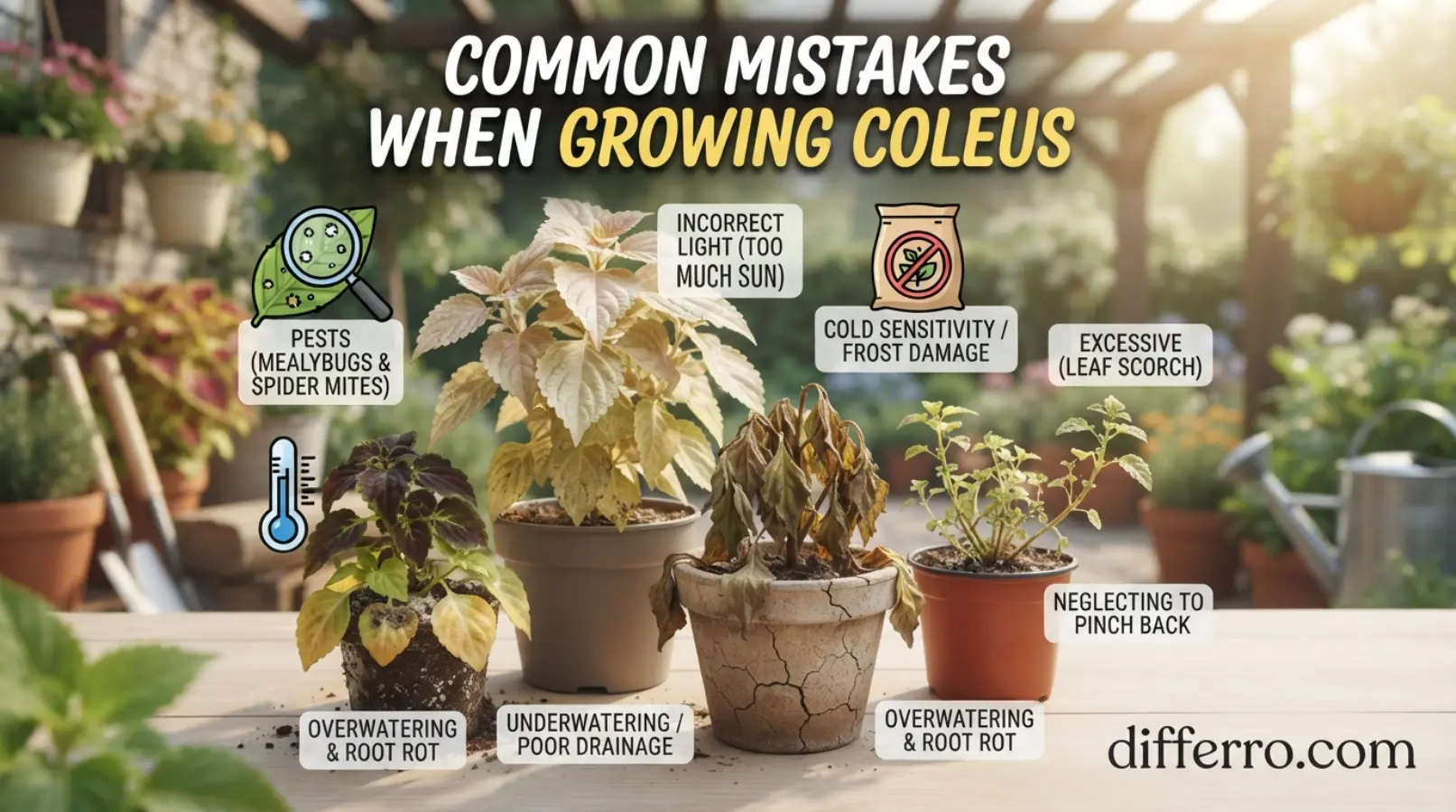
⚠️ Common Mistakes When Growing Coleus
Mistake 1: Assuming Coleus Is Always an Annual
Incorrect: Coleus always dies after one growing season.
Correct: Coleus is a tender perennial that can survive for several years in warm, frost-free conditions.
Mistake 2: Leaving Coleus Outside During Frost
Incorrect: Coleus can tolerate freezing temperatures without protection.
Correct: Coleus is sensitive to frost. Bring containers indoors or protect plants before cold weather arrives.
Mistake 3: Giving Coleus Too Much Direct Sunlight
Incorrect: Every coleus variety needs full, intense sunlight.
Correct: Many varieties prefer partial shade or filtered sunlight. Some newer varieties tolerate more sun.
Mistake 4: Overwatering the Plant
Incorrect: Coleus needs constantly wet soil.
Correct: Coleus prefers moist but well-drained soil. Excess water can damage its roots.
Mistake 5: Ignoring Indoor Light Requirements
Incorrect: Coleus can grow well in a dark room throughout winter.
Correct: Indoor coleus needs sufficient bright light to maintain healthy growth and colorful leaves.
Mistake 6: Confusing Annual Gardening With Botanical Classification
Incorrect: A plant becomes an annual whenever someone grows it for one season.
Correct: Gardening practices do not always reflect a plant’s natural lifespan. Climate often determines how gardeners grow tender perennials.
🧠 Easy Trick to Remember
Use this simple memory tip:
- Annual = One season: The plant completes its life cycle within one growing season.
- Perennial = Many years: The plant survives for more than two years under suitable conditions.
- Coleus = Tender perennial: It survives year-round in warm climates but struggles with frost.
Remember that coleus is naturally a tender perennial, even when gardeners grow it as an annual.
🌺 Everyday-Life Examples: Coleus Annual or Perennial
1. Growing Coleus in a Cold Climate
A gardener plants coleus in an outdoor flower bed during spring. The plant grows beautifully throughout summer.
When winter arrives, frost damages the leaves and stems.
Best classification: Gardeners treat coleus as an annual in this climate.
2. Growing Coleus in a Tropical Garden
A homeowner grows coleus outdoors in a warm tropical region. The plant continues producing colorful leaves throughout the year.
Best classification: Coleus grows as a perennial in these conditions.
3. Keeping Coleus in a Container
A gardener grows coleus in a decorative pot on a patio. Before winter, they move the container indoors.
The plant continues growing with enough warmth and light.
Best classification: Coleus can survive as a perennial with proper winter care.
4. Propagating Coleus for Next Spring
A gardener takes stem cuttings before the first frost. The cuttings develop roots indoors during winter.
The gardener plants them outside when spring temperatures become suitable.
Best classification: This method helps preserve coleus as a tender perennial.
5. Growing Coleus in a Shaded Garden
A homeowner plants coleus beneath a tree where it receives filtered sunlight. The plant develops colorful leaves and grows throughout the warm season.
Best classification: Coleus can grow as a perennial in frost-free conditions or as a seasonal annual elsewhere.
🌍 Google Trends and Usage Insights: Five Countries
Google Trends measures relative search interest rather than exact search volume. The following observations are general gardening-market expectations, not verified live rankings.
- USA: Gardeners may search for coleus winter care, annual planting, and perennial survival.
- UK: Searches may focus on growing coleus indoors and protecting it from cold weather.
- Australia: Warm-region gardeners may explore year-round coleus growing and garden care.
- India: Tropical and subtropical conditions may encourage searches about outdoor coleus cultivation.
- Pakistan: Gardeners may search for coleus planting seasons, sunlight needs, and winter protection.
SEO insight: Compare the exact keyword with related phrases in Google Trends for each country. Use the same time range and search category. Seasonal interest may increase during local planting periods.
Comparison Table: Keyword Variations
| Keyword variation | Search intent | Suggested content use |
|---|---|---|
| Coleus annual or perennial | Direct comparison | Main title and introduction |
| Is coleus a perennial | Plant classification | Quick answer |
| Is coleus an annual | Plant lifespan | Annual section |
| Does coleus come back every year | Gardening question | FAQ section |
| Can coleus survive winter | Winter care | Winter protection section |
| Coleus perennial in warm climates | Climate-based growing | Perennial section |
| How to overwinter coleus | Practical gardening | Care section |
❓ Frequently Asked Questions
1. Is coleus an annual or perennial plant?
Coleus is a tender perennial. Gardeners often grow it as an annual in regions with cold winters because frost can kill it.
2. What is the difference between annual and perennial coleus?
There is no separate annual and perennial species in this comparison. The difference describes how gardeners grow coleus under different climate conditions. It survives for years in warm climates but often lasts one season outdoors in colder areas.
3. Which is more common, annual or perennial coleus?
Gardeners commonly grow coleus as an annual in colder regions. In tropical and frost-free climates, they can maintain it as a perennial.
4. Is coleus considered a perennial in formal gardening terminology?
Yes. Coleus is generally classified as a tender perennial. However, gardeners often treat it as an annual where winter temperatures threaten its survival.
5. Why do people confuse annual and perennial coleus?
People confuse these classifications because coleus does not survive frost. Gardeners in cold climates replace it every year, while gardeners in warm regions can keep the same plant growing for several seasons.
🏆 Final Verdict: Is Coleus Annual or Perennial?
Coleus is a tender perennial, but its growing pattern depends on climate. In warm, frost-free regions, it can survive outdoors for several years. In colder regions, gardeners usually grow it as an annual because frost damages the plant.
If you live in a warm climate, you can enjoy coleus throughout the year. If you experience cold winters, grow it in containers and bring it indoors before frost.
You can also preserve your favorite varieties through stem cuttings. This method helps you grow new plants without buying replacements every spring.
Understanding coleus’s temperature needs makes gardening easier. With proper care, you can enjoy its colorful foliage season after season.
Conclusion
Coleus is a tender perennial that gardeners often grow as an annual. Its lifespan depends mainly on temperature and growing conditions. Warm, frost-free climates allow coleus to survive for several years. Cold climates usually limit outdoor growth to one season.
If you want year-round coleus, protect it from frost and provide suitable indoor conditions. You can also take stem cuttings before winter and grow new plants. Choose well-drained soil, suitable sunlight, and regular watering for healthy foliage.
Remember that coleus does not need yearly replacement in every climate. Understanding its perennial nature helps you plan better gardens and save your favorite plants. With proper winter protection, coleus can bring colorful leaves to your home for years.


2 thoughts on “Coleus Annual or Perennial? Growing and Care Guide”