
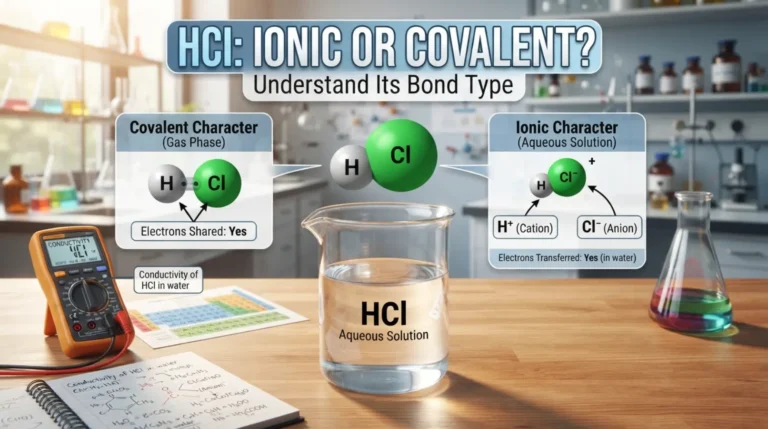
HCl Ionic or Covalent: Understand Its Bond Type is a common chemistry question. Many students wonder whether hydrogen chloride forms an ionic or covalent bond. The confusion comes from hydrogen and chlorine having different electronegativities. Chlorine attracts shared electrons more strongly than hydrogen.
However, this difference does not automatically make every bond ionic. Hydrogen chloride (HCl) forms a polar covalent bond because both atoms share electrons unequally. Hydrogen contributes one electron, while chlorine contributes one electron to their shared pair.
Understanding HCl’s bonding helps explain its molecular structure, polarity, and chemical behavior. It also helps students distinguish covalent compounds from ionic compounds. This guide explains HCl’s bond type through simple definitions, examples, comparisons, and everyday applications.
⭐ Quick Answer
HCl (hydrogen chloride) has a polar covalent bond, not an ionic bond. Hydrogen and chlorine share one pair of electrons unequally because chlorine attracts the shared electrons more strongly.
Example: Hydrogen develops a partial positive charge (δ+), while chlorine develops a partial negative charge (δ−).
🧪 Meaning of Ionic Bond
An ionic bond forms when one atom transfers electrons to another atom. This transfer creates positively and negatively charged ions. Opposite charges attract and hold the ions together.
Ionic bonding usually occurs between metals and nonmetals. Metals tend to lose electrons, while nonmetals tend to gain them.
Examples of Ionic Bonds
Example 1: Sodium Chloride (NaCl)
Sodium transfers one electron to chlorine. Sodium becomes Na⁺, and chlorine becomes Cl⁻. Their opposite charges create an ionic bond.
Example 2: Magnesium Oxide (MgO)
Magnesium transfers two electrons to oxygen. Magnesium forms Mg²⁺, while oxygen forms O²⁻. Their electrical attraction holds the compound together.
Main Characteristics of Ionic Compounds
- They contain positively and negatively charged ions.
- They often form crystalline solids.
- Many have high melting and boiling points.
- They often conduct electricity when molten or dissolved in water.
- They generally do not conduct electricity as solid crystals.
⚛️ Meaning of Covalent Bond
A covalent bond forms when two atoms share one or more pairs of electrons. Both atoms use the shared electrons to achieve greater stability.
Covalent bonds usually form between nonmetal atoms. They can share electrons equally or unequally.
Examples of Covalent Bonds
Example 1: Water (H₂O)
Hydrogen and oxygen share electrons through covalent bonds. Oxygen attracts the shared electrons more strongly, making water a polar molecule.
Example 2: Methane (CH₄)
Carbon shares electrons with four hydrogen atoms. These shared electron pairs form four covalent bonds.
Main Characteristics of Covalent Compounds
- They involve shared electron pairs.
- They commonly form between nonmetals.
- They can be polar or nonpolar.
- Many exist as gases, liquids, or solids.
- Their electrical conductivity depends on their structure and chemical properties.
🔍 HCl Ionic or Covalent: Key Differences
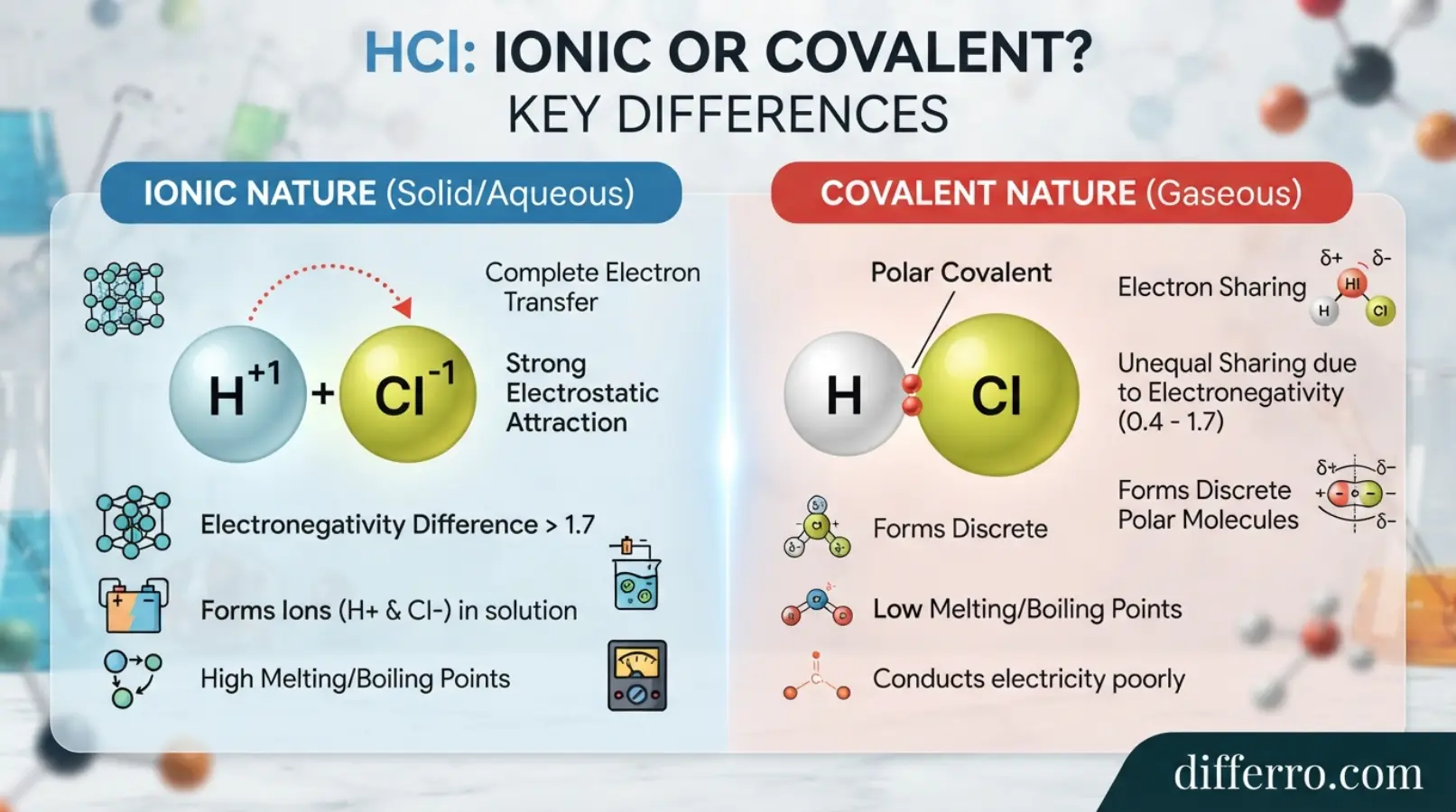
Hydrogen chloride contains a polar covalent bond. Its bonding differs from typical ionic compounds such as sodium chloride.
| Feature | Ionic Bond | Covalent Bond |
|---|---|---|
| Meaning | Electrons transfer between atoms | Atoms share electron pairs |
| Electron behavior | Electron transfer | Electron sharing |
| Common elements | Metal and nonmetal | Usually nonmetal and nonmetal |
| Electrical charges | Forms positive and negative ions | May create partial charges |
| Bond strength | Electrostatic attraction between ions | Attraction involving shared electrons |
| Conductivity | Often conducts when molten or dissolved | Usually poor, with important exceptions |
| Examples | NaCl, MgO | HCl, H₂O, CH₄ |
| Common usage | Ionic compounds and salts | Molecular compounds |
Important: HCl is covalent in its pure molecular form. When it dissolves in water, it ionizes almost completely into H₃O⁺ and Cl⁻ ions.
⚗️ Why Is HCl Covalent?
Hydrogen chloride forms a covalent bond because hydrogen and chlorine share an electron pair.
Hydrogen has one electron in its outer shell. Chlorine has seven valence electrons. Both atoms contribute one electron to a shared pair.
However, chlorine attracts the shared electron pair more strongly. This unequal sharing creates a polar covalent bond.
Electronegativity Difference in HCl
Electronegativity measures how strongly an atom attracts shared electrons.
Approximate Pauling electronegativity values are:
- Hydrogen: 2.20
- Chlorine: 3.16
- Difference: 0.96
This difference makes the H–Cl bond polar.
Hydrogen carries a partial positive charge (δ+). Chlorine carries a partial negative charge (δ−).
The molecule has a dipole because its shared electrons spend more time near chlorine.
Lewis Dot Structure of HCl
The Lewis structure of HCl shows one shared electron pair between hydrogen and chlorine.
       ..
H — Cl :
       ..
Chlorine also has three lone electron pairs. Hydrogen achieves a stable duet, while chlorine completes its octet.
🕰️ Origin and History of Ionic and Covalent Bonding
Scientists developed modern bonding theories to explain how atoms combine and form stable substances.
In 1916, Gilbert N. Lewis introduced an influential explanation of chemical bonding through shared electron pairs. His work helped establish the modern understanding of covalent bonds.
The term ionic describes compounds containing charged particles called ions. The term covalent describes bonds involving shared electrons.
These concepts help chemists explain the structures and properties of many substances.
Similar Chemistry Terms
- Polar covalent bond: A bond with unequal electron sharing.
- Nonpolar covalent bond: A bond with nearly equal electron sharing.
- Ionic bond: An attraction between oppositely charged ions.
- Electronegativity: An atom’s ability to attract shared electrons.
- Ionization: The formation of ions through electron loss, gain, or related processes.
🇬🇧 British English vs American English Spelling
The chemical formula HCl and the word covalent have the same spelling in British and American English.
Both countries use the same chemical terminology for hydrogen chloride and hydrochloric acid.
Some related words may differ, such as ionisation in British English and ionization in American English.
British vs American English Comparison
| Feature | British English | American English |
|---|---|---|
| HCl | HCl | HCl |
| Covalent | Covalent | Covalent |
| Ionic | Ionic | Ionic |
| Ionisation | Ionisation | Ionization |
| Chemical meaning | Same | Same |
| Scientific usage | Same chemical principles | Same chemical principles |
🧪 When to Use the Term Ionic Bond
Use the term ionic bond when atoms transfer electrons and form oppositely charged ions.
This bonding commonly occurs between metals and nonmetals.
Example 1: Sodium Chloride
Sodium transfers one electron to chlorine. The resulting Na⁺ and Cl⁻ ions attract each other.
Example 2: Calcium Chloride
Calcium transfers two electrons. Two chlorine atoms each accept one electron, producing Ca²⁺ and two Cl⁻ ions.
Remember: Ionic bonding involves electron transfer and electrostatic attraction between ions.
⚛️ When to Use the Term Covalent Bond
Use the term covalent bond when atoms share electron pairs.
This type of bonding commonly occurs between nonmetal atoms.
Example 1: Hydrogen Chloride
Hydrogen and chlorine share one electron pair. Chlorine attracts that pair more strongly, creating a polar covalent bond.
Example 2: Water
Oxygen shares electrons with two hydrogen atoms. These bonds create a polar water molecule.
Remember: Covalent bonding involves shared electrons rather than complete electron transfer.
💧 What Happens When HCl Dissolves in Water?
This question often creates confusion about HCl’s bond type.
Pure hydrogen chloride consists of covalently bonded HCl molecules. However, HCl behaves differently when it enters water.
It transfers a proton to a water molecule. This process produces hydronium and chloride ions.
The chemical equation is:
[
HCl + H_2O \rightarrow H_3O^+ + Cl^-
]
This reaction explains why hydrochloric acid conducts electricity in water.
Is Hydrochloric Acid Ionic or Covalent?
Hydrogen chloride itself has a polar covalent bond. Its aqueous solution contains ions.
Therefore, distinguish between the original HCl molecule and the ions present in its water solution.
- Pure HCl: Polar covalent molecular compound.
- HCl in water: Forms hydronium and chloride ions.
- Hydrochloric acid: An aqueous solution of hydrogen chloride.
This distinction is essential for understanding HCl correctly.
⚠️ Common Mistakes About HCl Ionic or Covalent
Mistake 1: Calling HCl an Ionic Compound
Incorrect: HCl is ionic because chlorine attracts electrons more strongly.
Correct: HCl is polar covalent because hydrogen and chlorine share an electron pair unequally.
Mistake 2: Confusing HCl With NaCl
Incorrect: HCl and NaCl have the same type of bond.
Correct: HCl has a polar covalent bond, while NaCl forms an ionic crystal.
Mistake 3: Assuming Polar Means Ionic
Incorrect: Every polar bond is ionic.
Correct: Polar covalent bonds involve unequal electron sharing. Ionic bonds involve charged ions and electrostatic attraction.
Mistake 4: Ignoring HCl’s Behavior in Water
Incorrect: HCl remains entirely as neutral molecules in water.
Correct: HCl transfers protons to water and produces H₃O⁺ and Cl⁻ ions.
Mistake 5: Thinking Electronegativity Alone Determines Every Bond
Incorrect: A specific electronegativity difference always proves ionic bonding.
Correct: Bond classification also depends on electron distribution and chemical structure. Electronegativity provides a useful guide, not an absolute rule.
🧠 Easy Trick to Remember
Use this simple memory trick:
- Ionic = Transfer: One atom transfers electrons to another.
- Covalent = Share: Atoms share electron pairs.
- Polar covalent = Unequal sharing: One atom attracts shared electrons more strongly.
For HCl, hydrogen and chlorine share electrons. Chlorine attracts them more strongly.
Therefore, HCl has a polar covalent bond.
🌍 Everyday-Life Examples: HCl Ionic or Covalent
1. Hydrogen Chloride in Chemical Laboratories
Scientists use hydrogen chloride in laboratories for chemical reactions and research. Its molecules contain polar covalent bonds.
Primary keyword: HCl ionic or covalent.
Secondary keyword: Polar covalent bond in hydrogen chloride.
2. Hydrochloric Acid in the Stomach
The human stomach naturally produces hydrochloric acid. This acid helps break down food and supports digestion.
HCl forms ions when it dissolves in water. This process gives stomach acid its acidic properties.
Primary keyword: HCl ionic or covalent.
Secondary keyword: Hydrochloric acid ionization in water.
3. Cleaning and Industrial Applications
Industries use hydrochloric acid for metal cleaning, processing, and other chemical operations. Its aqueous solution contains hydronium and chloride ions.
Primary keyword: HCl ionic or covalent.
Secondary keyword: Properties and uses of hydrochloric acid.
4. Comparing HCl With Table Salt
Table salt contains sodium chloride (NaCl). Sodium transfers an electron to chlorine, forming oppositely charged ions.
Hydrogen chloride shares electrons instead. This comparison clearly demonstrates ionic and covalent bonding.
Primary keyword: HCl ionic or covalent.
Secondary keyword: Difference between HCl and NaCl bonding.
5. Understanding Electrical Conductivity
Pure hydrogen chloride does not conduct electricity like an ionic solution. However, hydrochloric acid conducts electricity because it contains mobile ions.
This difference helps students understand chemical bonding and electrical conductivity.
Primary keyword: HCl ionic or covalent.
Secondary keyword: Electrical conductivity of hydrochloric acid.
🌍 Google Trends and Usage Insights: USA, UK, Australia, India, and Pakistan
Google Trends measures relative search interest rather than exact search volume. The following observations describe likely educational search intent, not verified live rankings.
- USA: Students may search for HCl bonding, electronegativity, and chemistry homework explanations.
- UK: Searches may focus on hydrogen chloride, polar covalent bonds, and GCSE chemistry.
- Australia: Students may explore HCl bonding through school chemistry and molecular structure topics.
- India: Search interest may involve ionic versus covalent compounds and examination preparation.
- Pakistan: Students may search for HCl bond classification, Lewis structures, and chemistry concepts.
SEO insight: Compare the exact phrase with related queries such as “Is HCl ionic or covalent?” and “HCl bond type.” Use the same date range across all five countries. Verify actual interest before publishing country rankings or numerical search claims.
Comparison Table: Keyword Variations
| Keyword variation | Search intent | Suggested placement |
|---|---|---|
| HCl Ionic or Covalent | Direct chemistry question | Title and introduction |
| Is HCl Ionic or Covalent? | Informational | Quick Answer |
| HCl Bond Type | Technical information | Explanation section |
| Why Is HCl Covalent? | Conceptual learning | Electronegativity section |
| HCl Polar Covalent Bond | Chemistry education | Bond explanation |
| HCl Lewis Dot Structure | Visual learning | Lewis structure section |
| Hydrochloric Acid Ionic or Covalent | Related chemistry question | FAQ and water section |
❓ Frequently Asked Questions
1. Is HCl ionic or covalent?
HCl is a polar covalent compound. Hydrogen and chlorine share one electron pair unequally. Chlorine attracts the shared electrons more strongly.
2. What is the main difference between ionic and covalent bonding?
Ionic bonding involves electron transfer and attraction between oppositely charged ions. Covalent bonding involves shared electron pairs between atoms.
3. Which bond is more common in HCl, ionic or covalent?
Covalent bonding describes HCl’s molecular structure. Its hydrogen and chlorine atoms share electrons, creating a polar covalent bond.
4. Is HCl classified as a covalent compound in formal chemistry?
Yes. Chemists classify pure hydrogen chloride as a molecular compound with a polar covalent bond. Its aqueous solution contains ions.
5. Why do students confuse HCl’s bond type?
Students often confuse HCl because chlorine has much higher electronegativity than hydrogen. However, the atoms still share electrons rather than forming a typical ionic compound through electron transfer.
🏆 Final Verdict: Is HCl Ionic or Covalent?
HCl is covalent, specifically polar covalent. Hydrogen and chlorine share one pair of electrons, but chlorine attracts them more strongly.
This unequal sharing creates partial electrical charges. Hydrogen becomes partially positive, while chlorine becomes partially negative.
HCl differs from ionic compounds such as NaCl. Sodium chloride contains oppositely charged ions held together by electrostatic attraction.
However, HCl behaves differently in water. It transfers protons to water molecules and produces hydronium and chloride ions.
Therefore, the correct classification is simple: pure hydrogen chloride has a polar covalent bond. Its aqueous solution contains ions.
Conclusion
HCl ionic or covalent is a common chemistry question with a clear answer. Hydrogen chloride (HCl) forms a polar covalent bond because hydrogen and chlorine share electrons unequally. Chlorine attracts the shared electron pair more strongly, creating partial charges.
Unlike ionic compounds such as sodium chloride, HCl does not form a typical ionic structure in its pure molecular form. However, HCl ionizes in water and produces hydronium and chloride ions. This distinction explains its behavior in aqueous solutions.
Remember the simple rule: ionic bonding involves electron transfer, while covalent bonding involves electron sharing. HCl follows the covalent bonding pattern.

Imran Lodhra is a comparison-focused content writer at Differro.com.
He specializes in creating clear, simple, and informative comparison articles.
His work helps readers understand key differences, pros and cons, and important details.
Imran focuses on accurate, practical, and easy-to-read content for everyday readers.