
TW meaning slang can be confusing when you see these two letters in a text, caption, comment, or social media post. You may wonder whether TW is a warning, a shortcut for another phrase, or simply a different type of internet slang.
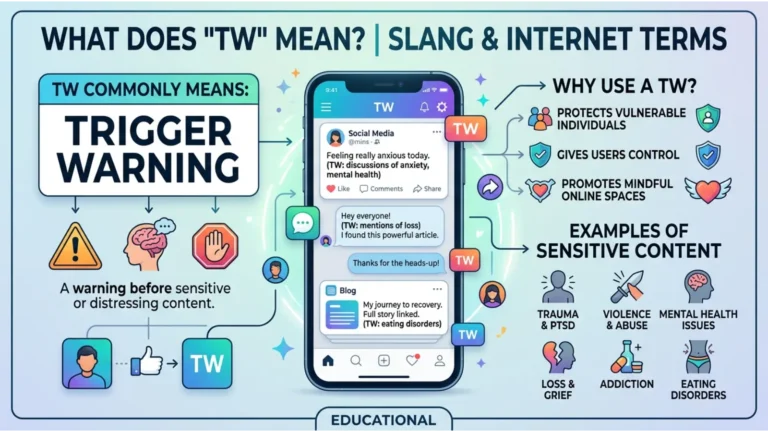
In online communication, TW most commonly means “Trigger Warning.” People usually put it before content that may be upsetting, disturbing, or emotionally difficult. For example, “TW: violence” tells readers that the following content discusses or shows violence.
However, TW can have other meanings depending on the conversation. The surrounding words and platform usually help you understand which meaning is intended.
Quick Answer:
TW meaning slang is most commonly “Trigger Warning.” It is a short notice used before sensitive content so readers can decide whether they want to continue.
What Does TW Mean in Text?
In texting and social media, TW usually stands for “Trigger Warning.” It acts as a quick heads-up before content that some people may find emotionally upsetting or difficult to read.
For example:
TW: discussion of grief
This tells the reader that the upcoming message discusses grief.
You may also see it written in several ways:
- TW: violence
- TW // abuse
- tw: death
- TW — sensitive topic
- TW for graphic content
The capitalization does not normally change the meaning. Both TW and tw can be used online.
TW Full Form and Definition
The most common TW full form in internet slang is Trigger Warning.
A trigger warning is a notice placed before potentially distressing material. It gives people information about what is coming before they read, watch, or listen to it.
Common subjects that may receive a TW include:
- Violence
- Abuse
- Self-harm
- Eating disorders
- Death
- Trauma
- Graphic injuries
- Distressing personal experiences
The purpose is generally to provide advance notice rather than to insult or offend someone.
What Does TW Stand For in Different Contexts?
Although Trigger Warning is the main online meaning, TW can mean different things in different situations.
| Context | Possible meaning |
|---|---|
| Social media post | Trigger Warning |
| Text message | Trigger Warning |
| Reddit or online forum | Trigger Warning |
| Mental-health discussion | Trigger Warning |
| Conversation about Twitter | |
| International context | Taiwan |
| Specific language discussion | Trigger word |
Context is important. For example, “TW: violence” clearly suggests “Trigger Warning,” while a sentence discussing an old Twitter post may use TW as a shortened platform reference. Some online sources also document less-common meanings, so you should not automatically assume every TW means the same thing.
Is TW Rude, Offensive, or Neutral?
TW itself is generally neutral. It is normally used as a warning before sensitive material rather than as an insult or offensive expression.
For example:
“TW: This post discusses domestic violence.”
Here, TW simply alerts readers to the subject.
However, people sometimes use TW jokingly:
“TW: My terrible singing is coming.”
In this case, the person is using the format humorously rather than warning about genuinely traumatic material.
Using a serious trigger warning as a joke can be inappropriate in some communities, particularly when the subject involves serious trauma.
Where Is TW Commonly Used?
You can encounter TW across many forms of digital communication.
TikTok and Instagram
Users may place TW at the beginning of captions, videos, slides, or comments involving sensitive subjects.
TW can appear in post titles or before discussions involving trauma, abuse, self-harm, violence, or other difficult subjects.
Discord and Group Chats
People may use TW before sharing a personal story or discussing a difficult experience.
Text Messages
Friends sometimes use TW before sending a message that contains emotionally heavy information.
Online Forums
Communities may use TW as a quick way to identify potentially distressing material before the main discussion begins.
Real-Life TW Examples
Understanding tw meaning slang becomes easier when you see it in different conversations.
Friendly Example
Friend: “TW: I’m about to tell you about the most embarrassing thing I did today 😂”
Here, TW is being used playfully.
Casual Example
Person A: “TW: This story mentions a hospital visit.”
The person is giving a simple warning before explaining what happened.
Serious Example
Post: “TW: discussion of abuse and trauma.”
This is a more serious use. The writer is identifying sensitive subjects before discussing them.
Argumentative Example
Person A: “TW: This conversation gets pretty heated.”
Here, TW is being used loosely as a warning about the tone of the upcoming conversation.
TW Meaning Slang in Social Media
On social media, TW is particularly useful because users often encounter content without knowing what comes next.
A person may scroll into a post containing disturbing images or a discussion of trauma. Adding TW at the beginning gives the audience a chance to stop before reaching that material.
For example:
TW: graphic accident photos
The warning immediately communicates what type of material follows.
Some people use CW, meaning Content Warning, for a similar purpose.
TW vs. CW: What’s the Difference?
TW and CW are related, but they are not always used in exactly the same way.
| Term | Full Form | General Purpose |
|---|---|---|
| TW | Trigger Warning | Warns about potentially triggering or distressing material |
| CW | Content Warning | Warns about potentially objectionable or sensitive content |
| NSFW | Not Safe For Work | Warns that content may be inappropriate for work or public viewing |
A TW is often associated with trauma-related or emotionally distressing subjects, while CW is a broader warning for potentially difficult content.
Origin and Background of TW
The expression trigger warning became associated with online discussions surrounding trauma and mental health. As internet communities developed their own shorthand, the phrase was naturally shortened to TW.
Online platforms helped spread the abbreviation because short labels are convenient in posts, comments, captions, and messages. Today, TW can be found across social media, forums, messaging platforms, and other online communities.
The exact meaning still depends on context, however. TW is an abbreviation, not a word with only one universal interpretation.
Why Do People Use TW?
People generally use TW for several reasons:
- To give readers advance notice
- To identify sensitive topics
- To let readers decide whether to continue
- To make online discussions more considerate
- To quickly communicate the subject of a difficult post
In simple terms, it works like a heads-up.
When Should You Use TW?
Consider using TW when your post contains material that could reasonably be distressing for some readers.
For example:
“TW: discussion of grief and loss.”
“TW: description of an accident.”
“TW: eating disorder discussion.”
A useful warning should identify the topic clearly enough for readers to make an informed choice.
When Should You Avoid Using TW?
You do not need to place TW before every mildly uncomfortable statement.
For example:
“TW: I have a boring meeting tomorrow.”
This would usually be unnecessary unless you are deliberately using the term as humor.
Also, avoid using TW as a way to mock people who genuinely need warnings. Serious subjects deserve appropriate language and context.
Polite Alternatives to TW
If your audience may not understand slang, you can write the full phrase instead.
Instead of:
“TW: violence”
You could write:
“Content warning: This post discusses violence.”
Other alternatives include:
- Content warning
- Sensitive content
- Warning: graphic material
- Please note: This post discusses trauma
- Sensitive topic ahead
These alternatives can be especially useful in professional or educational settings.
Common Misunderstandings About TW
One common mistake is assuming that TW always means Twitter. Although TW can be used as a shorthand reference to Twitter in some conversations, the trigger-warning meaning is common when it appears immediately before a sensitive subject.
Another misunderstanding is thinking that TW means the content is automatically dangerous. It simply signals that the material may be upsetting or difficult for some people.
Finally, some users assume TW is always serious. Online communities sometimes use it humorously, so tone and context matter.
Variations and Types of TW
You may see several formats:
TW:
TW: violence
TW //
TW // discussion of grief
TW for:
TW for graphic images
tw:
tw: trauma discussion
The format changes, but the basic purpose is usually the same.
How to Respond When Someone Uses TW
You normally do not need a special response.
If you are comfortable with the subject, you can continue reading or chatting.
If you appreciate the warning, you could say:
“Thanks for the warning.”
If the topic is uncomfortable for you, you can simply stop reading, change the subject, or tell the person you would rather not discuss it.
Regional and Cultural Usage
TW is primarily internet-based, so you can encounter it across different English-speaking online communities.
However, individual communities may have different expectations about what deserves a warning. A topic considered sensitive in one group may not receive the same label in another.
This is why understanding the surrounding conversation is important rather than relying only on the abbreviation.
Is TW Safe for Social Media?
TW is simply a warning abbreviation, so using it is generally harmless. The important part is what follows the warning.
If you are posting sensitive material, clearly identifying the subject can help readers understand what they are about to encounter.
For example:
TW: graphic injury photos
is more informative than simply writing:
TW
A specific warning gives readers useful context.
FAQs About TW Meaning Slang
What does TW mean in texting?
TW most commonly means Trigger Warning. It alerts someone that the following message may contain sensitive or distressing material.
What does TW stand for?
The most common TW full form is Trigger Warning. However, the abbreviation can have other meanings depending on context.
Is TW a bad word?
No. TW is generally a neutral abbreviation used to give readers a warning about sensitive content.
What does TW mean on TikTok?
On TikTok, TW commonly means Trigger Warning. It may appear before a video, caption, or discussion involving potentially upsetting content.
Is TW the same as CW?
They are similar, but not identical. TW usually refers to potentially triggering or distressing material, while CW is a broader Content Warning.
Can TW be used as a joke?
Yes, some people use TW humorously before harmless or embarrassing topics. However, serious warnings should be treated respectfully.
Conclusion
The most common tw meaning slang is Trigger Warning. It is used before sensitive, disturbing, or emotionally difficult content to give readers a quick heads-up.
You may see TW in texts, TikTok captions, Instagram posts, Reddit discussions, Discord chats, and other online spaces. While it can have other meanings, the surrounding words usually make the intended meaning clear.
If you see “TW:” followed by a sensitive subject, it most likely means Trigger Warning. Understanding the context, tone, and topic will help you interpret the abbreviation correctly and use it appropriately in your own online communication.

Ali Raza is an M.Phil. scholar and English language expert specializing in English grammar, slang meanings, vocabulary, and everyday expressions. He writes clear, practical, and easy-to-understand content that helps readers master confusing English words, phrases, spelling, and modern slang. His goal is to make English learning simple, useful, and accessible for students, beginners, and everyday readers.
1 thought on “TW Meaning Slang: What Does TW Mean in Text?”