
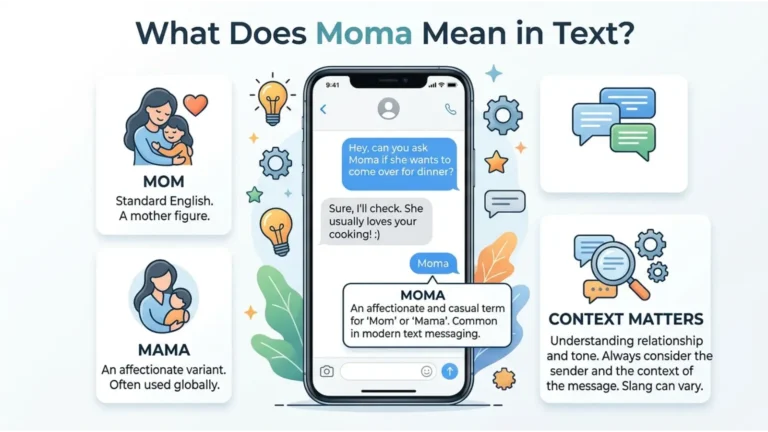
Moma meaning slang can be confusing because the word does not have one universally accepted slang definition.
In online messages, social media, and casual conversations, “moma” may be a stylized spelling of “mom” or “mama,” especially when someone is referring affectionately to their mother.
In some contexts, however, it can be a personal nickname, username, name, or an abbreviation whose meaning depends entirely on the conversation.
People often search for moma meaning slang after seeing the word in a text, comment, caption, or social media post. Understanding the surrounding words is important because “moma” can have different meanings in different communities.
Quick Answer
Moma is often an informal or stylized way of writing “mom” or “mama,” usually referring to a mother. However, its exact meaning depends on context and may sometimes be a nickname or personal term.
What Does Moma Mean in Text?
In texting, moma is commonly understood as a casual variation of mom, mama, or mommy. Someone might use it because they prefer the spelling, because it reflects how they pronounce the word, or simply because it feels more personal.
For example:
“I’m going to call my moma tonight.”
Here, the writer most likely means mother.
Another example is:
“Love you, moma ❤️”
In this sentence, “moma” is an affectionate form of address.
Unlike established texting abbreviations such as “LOL” or “BRB,” moma does not have one fixed slang expansion. The context should therefore be considered before interpreting it.
Moma Full Form and Definition
If you are searching for the moma full form, there is no single standard full form used in everyday texting.
Depending on the conversation, it may represent:
- Mom
- Mama
- An affectionate nickname for a mother
- A personal nickname
- A username or name
- A context-specific abbreviation
This is why asking “what does moma stand for?” does not always have one straightforward answer.
Moma Meaning Slang in Different Contexts
The meaning can change depending on where you see it.
In Text Messages
In private messages, “moma” may simply mean mom or mama.
Example:
“My moma wants me home early.”
The speaker is referring to their mother.
On Social Media
People may use “moma” in captions, comments, or posts as an affectionate name.
Example:
“Happy birthday to my beautiful moma!”
Here, it is being used affectionately.
As a Nickname
Some people may use “Moma” as a personal nickname. In this situation, it does not necessarily mean mother.
In Usernames
“Moma” can also appear as part of a username, brand name, account name, or online identity. In those cases, you should not automatically interpret it as slang.
Is Moma Rude, Offensive, or Neutral?
Moma is generally neutral or affectionate when it is used as a variation of “mom” or “mama.”
It is not normally considered a profanity or offensive slang term.
However, tone matters. A word that sounds affectionate in one conversation could sound unusual or sarcastic in another.
For example:
“My sweet moma is visiting today.”
This sounds affectionate.
But:
“Sure, moma, whatever you say.”
Depending on the conversation, this could be playful or sarcastic.
Where Is Moma Commonly Used?
You may encounter “moma” in informal communication such as:
- Text messages
- Social media comments
- Instagram captions
- TikTok posts
- Family conversations
- Personal messages
- Online communities
- Informal writing
It is much less appropriate in formal documents or professional communication.
In formal writing, use mother or mom, depending on the situation and the preferred style.
Real-Life Moma Examples
Here are examples showing how the word can appear naturally.
Friendly Example
“My moma always knows how to make me smile.”
This expresses affection toward the speaker’s mother.
Casual Example
“I need to ask my moma first.”
The word is being used casually instead of “mom.”
Emotional Example
“I miss you so much, moma.”
Here, the term expresses affection and emotional closeness.
Social Media Example
“Best moma ever! ❤️”
This could be a birthday or appreciation post.
Playful Example
“Okay, moma, I’ll clean my room.”
The speaker may be jokingly responding to someone who is acting like a parent.
Argumentative Example
“You don’t have to treat me like a child, moma.”
The meaning still relates to “mom,” but the tone is frustrated.
Emotional and Psychological Meaning
When “moma” is used to mean “mom” or “mama,” it can carry an emotional meaning beyond the basic definition.
The spelling may make the word feel:
- Affectionate
- Playful
- Personal
- Childlike
- Warm
- Familiar
However, you should not assume that every person who writes “moma” has a particular emotional intention. Online spelling can simply reflect personal preference.
Origin and Background of Moma
There is no single confirmed origin for “moma” as a modern texting slang term.
It is often connected with informal forms of mother, particularly words such as mom, mama, and similar family terms.
People frequently alter spellings online to make words sound more personal, playful, or closer to the way they speak. This can produce forms such as “moma.”
Because “moma” is not a standardized abbreviation, its meaning can vary between individuals and online communities.
Moma vs Mom vs Mama
| Term | Common Meaning | Tone | Typical Use |
|---|---|---|---|
| Moma | Mom/Mama in some contexts | Informal/affectionate | Texting, social media |
| Mom | Mother | Neutral/casual | Everyday English |
| Mama | Mother | Affectionate/familiar | Family and casual speech |
| Mother | Female parent | Formal/neutral | Formal and general writing |
The important difference is that “mom” and “mother” are standard English words, while “moma” is generally an informal or context-dependent spelling.
When Should You Avoid Using Moma?
Although “moma” is usually harmless, it may not be suitable everywhere.
Avoid it when writing:
- Formal emails
- Academic assignments
- Business documents
- Official applications
- Professional reports
- Formal letters
For example, instead of:
“My moma helped me with the application.”
A formal version could be:
“My mother helped me with the application.”
The appropriate choice depends on the audience and purpose.
Why Do People Use Moma?
People may use “moma” for several reasons:
- Affection: It can make the word sound warmer.
- Personal style: Some people simply prefer the spelling.
- Informal communication: Texting encourages creative spellings.
- Pronunciation: The spelling may reflect how someone says the word.
- Playfulness: It can make a message sound cute or humorous.
- Family nickname: Some families develop their own names for relatives.
There is no need to assume that one explanation applies to every user.
Is Moma Safe for Social Media?
Generally, yes. If “moma” is being used as an informal version of “mom” or “mama,” it is not normally offensive.
Still, context is important. Before using unfamiliar slang publicly, consider whether your audience will understand it.
For a broad audience, mom or mama may be clearer than “moma.”
Common Misunderstandings About Moma
One common mistake is assuming that “moma” always has one fixed slang definition.
It does not.
The word could refer to:
- A mother
- A nickname
- A personal expression
- A username
- A name or brand
- Another context-specific term
Another mistake is treating “moma” as a universally recognized texting abbreviation. Unlike common abbreviations such as “OMG” or “IDK,” it does not have one standard interpretation.
How to Respond When Someone Uses Moma
If someone says:
“I’m going to tell my moma.”
You can understand it as “I’m going to tell my mom” if the context clearly refers to their mother.
You could respond naturally:
“Okay, let me know what she says.”
If you are unsure what they mean, simply ask:
“Do you mean your mom?”
Asking for clarification is better than guessing when the context is unclear.
Regional and Cultural Usage
Family terms differ across cultures and English-speaking communities. Mom, mum, mama, mommy, ma, and other forms can all be used to refer to a mother.
“Moma” may therefore reflect an individual’s personal or regional way of writing rather than a widely recognized slang expression.
Online communication also allows people from different regions to create and share informal spellings quickly.
Moma Meaning Slang: Similar Terms
If you encountered “moma” online, these related terms may help you understand the conversation:
| Term | Meaning |
|---|---|
| Mom | Mother |
| Mama | Mother; often affectionate |
| Mommy | Affectionate or childlike form of mother |
| Ma | Informal term for mother |
| Mum | Common British English term for mother |
| Mother | Standard and more formal term |
Remember that these terms are not always interchangeable. Personal preference and regional English can influence which one someone uses.
Common Questions About Moma
What does moma mean in text?
Moma commonly means mom or mama when used in an informal conversation. It may also be a nickname or context-specific term.
What is the moma full form?
There is no universally accepted moma full form in texting. It may simply be a stylized form of “mom” or “mama.”
Is moma a bad word?
No. When used to mean mother, “moma” is generally neutral or affectionate rather than offensive.
What does moma mean on social media?
On social media, “moma” may refer to a person’s mother or be used as an affectionate nickname. The exact meaning depends on the post and surrounding text.
Is moma proper English?
“Moma” is not generally considered a standard formal English spelling for “mother.” In formal writing, use mother or another standard term appropriate to your context.
Should I use moma in a professional message?
Usually, no. In professional communication, clearer standard terms such as mother or mom are more appropriate.
Final Thoughts on Moma Meaning Slang
Understanding moma meaning slang is mainly about looking at context. In many informal conversations, “moma” is a creative or affectionate spelling of mom or mama. It can also function as a nickname or have another meaning depending on the person using it.
The term is generally neutral and non-offensive when it refers to a mother. However, because it is not a standardized slang abbreviation, you should avoid assuming that every use of “moma” means exactly the same thing.
For casual texting and social media, the word may feel natural and personal. For academic, professional, or formal writing, standard terms are clearer.
When you see unfamiliar slang online, always consider the sentence, speaker, audience, and tone before deciding what the word means.
Ali Raza is an M.Phil. scholar and English language expert specializing in English grammar, slang meanings, vocabulary, and everyday expressions. He writes clear, practical, and easy-to-understand content that helps readers master confusing English words, phrases, spelling, and modern slang. His goal is to make English learning simple, useful, and accessible for students, beginners, and everyday readers.
1 thought on “Moma Meaning Slang in Text: What Does “Moma” Mean?”