

Latin Words Used in Modern English appear in everyday speech, writing, science, law, education, and business. Many speakers use these words without knowing their Latin roots.Latin was the language of ancient Rome and later became important across European education and scholarship.
English borrowed thousands of words from Latin directly and through languages such as French. Some Latin terms also became part of English expressions.This can make Latin vocabulary seem difficult at first. However, many examples are already familiar.Words such as agenda, data, versus, formula, status, and minimum appear in modern English every day.Learning their meanings can improve your vocabulary and help you understand academic and formal writing.
⭐ Quick Answer
Latin words used in modern English are English words that come from Latin roots or Latin expressions. Common examples include agenda, versus, status, formula, minimum, maximum, and data.
Example: “The meeting agenda includes three important topics.”
📖 What Are Latin Words Used in Modern English?
Latin words used in modern English are words that English borrowed from Latin or developed from Latin roots.
Some remain close to their original Latin forms. Others changed their spelling, pronunciation, or meaning over time.
Latin influence is especially strong in formal vocabulary. Cambridge notes that formal English often uses longer words with Latin and Greek origins.
Here are some common examples:
- Agenda — a list of things to discuss or do
- Data — facts or information
- Versus — against or compared with
- Status — a person’s position or condition
- Formula — a fixed method, rule, or expression
- Minimum — the smallest amount
- Maximum — the greatest amount
- Manual — related to the hands or done by hand
- Animal — a living creature that is not a plant
- Video — something recorded for viewing
- Audio — sound or sound recording
- Bonus — something extra
- Campus — the grounds of a school or university
- Junior — younger or lower in rank
- Senior — older or higher in rank
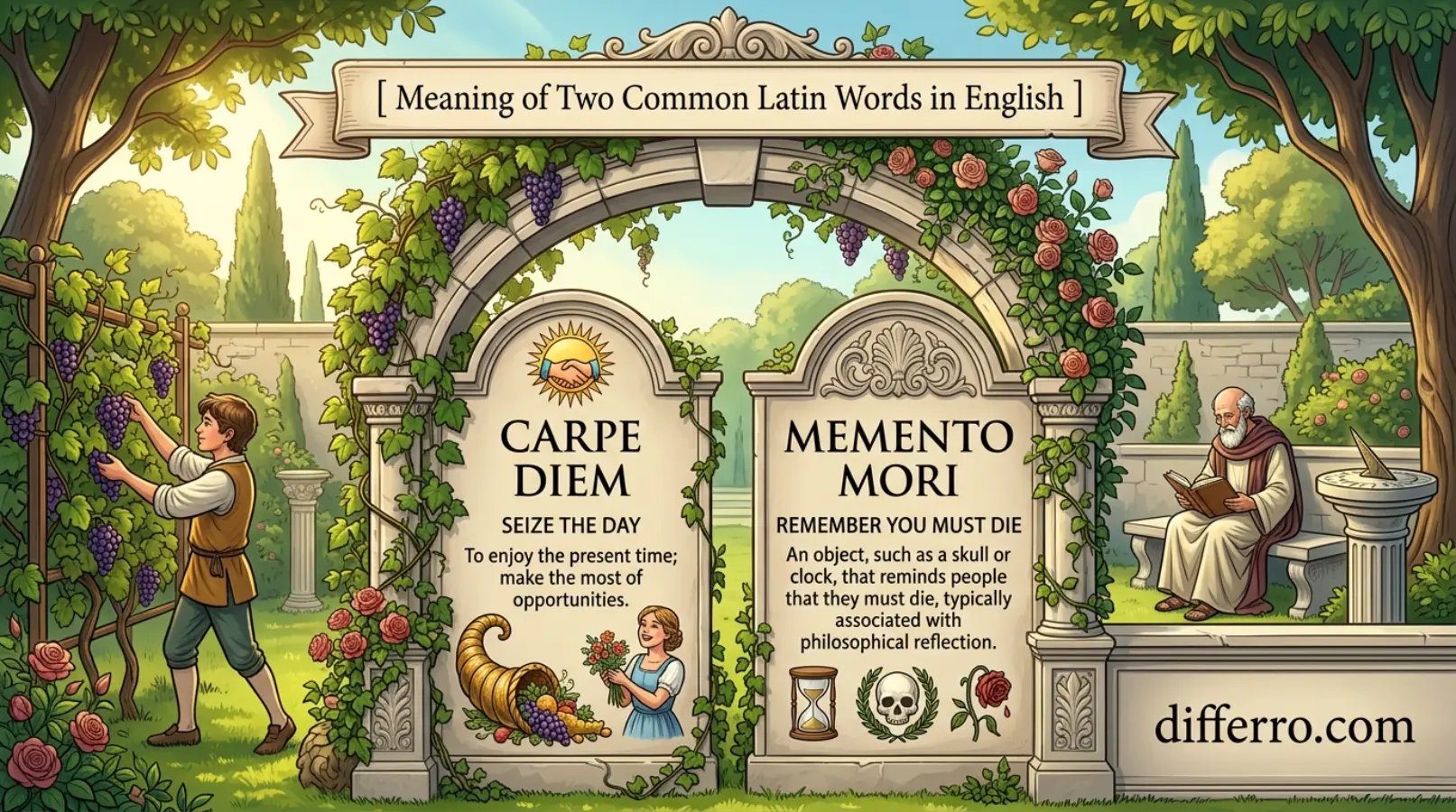
🔤 Meaning of Two Common Latin Words in English
Because the keyword covers a large group of words, there is no single “Word 1” or “Word 2.” Here are two useful examples.
Meaning of Agenda
Agenda means a list of subjects, tasks, or topics for a meeting.
The English word comes from Latin and literally relates to things that need to be done.
Examples:
- The manager shared the meeting agenda.
- Education remained the main item on the agenda.
Meaning of Versus
Versus means “against” or “in comparison with.”
English commonly uses vs. as a shorter form of versus.
Examples:
- The debate focused on quality versus price.
- The court case was listed as Smith versus Jones.
📊 Key Features of Latin Words in Modern English
| Feature | Explanation |
|---|---|
| Meaning | Words often keep or adapt meanings from Latin |
| Tone | Many appear in formal, academic, legal, or scientific writing |
| Usage | They occur in everyday English as well as specialist fields |
| Popularity | Common examples such as data, status, agenda, and bonus are widely understood |
🏛️ Origin and History of Latin Words in English
Latin has influenced English for centuries.
After the Norman Conquest, English received many Latin-derived words through French. Later, scholars introduced or revived many Latin terms in science, medicine, law, education, and philosophy.
Some English words still resemble their Latin ancestors.
Examples include:
- aquatic — related to water
- audible — able to be heard
- annual — happening every year
- benevolent — wishing good for others
- manual — relating to the hand
- portable — easy to carry
- visible — able to be seen
- temporary — lasting for a limited time
- maximum — the greatest amount
- minimum — the smallest amount
English also contains words that passed through other languages before becoming English. Cambridge notes that some French word originated in Latin and later became Latinized in English.
🇬🇧 British English vs American English Spelling
Most Latin-derived English words have the same spelling in British and American English.
Differences can appear in some words influenced by French spelling or regional conventions.
For example, British English often uses -our in words such as “colour,” while American English commonly uses **-or.”
| Word Type | British English | American English |
|---|---|---|
| Colour-related | colour | color |
| Centre-related | centre | center |
| Defence-related | defence | defense |
| Latin-derived vocabulary | often similar | often similar |
| Technical terms | usually similar | usually similar |
These spelling differences do not usually change the Latin origin of the word.
📝 When to Use Latin Words in Modern English
Use Agenda for a List of Meeting Topics
Use agenda when discussing planned meeting subjects or tasks.
Examples:
- The first item on our agenda is school funding.
- Please review the agenda before the meeting.
Use Versus for Comparison
Use versus when contrasting two choices, sides, or ideas.
Examples:
- We discussed quality versus quantity.
- The article compares traditional methods versus modern methods.
Use Status for Position or Condition
Use status when describing a person’s position or the condition of something.
Examples:
- Check the delivery status online.
- His employment status changed recently.
Use Data for Information
Use data when referring to collected facts or information.
Examples:
- Researchers analyzed the data.
- The data supports the conclusion.
Use Formula for a Fixed Method
Use formula for a mathematical expression or established method.
Examples:
- The teacher explained the mathematical formula.
- We need a simple formula for calculating costs.
⚠️ Common Mistakes
Mistake 1: Treating Agenda as a Singular Task
Incorrect: The agenda is three tasks.
Correct: The agenda contains three tasks.
An agenda is normally a list of items.
Mistake 2: Using Versus Incorrectly
Incorrect: I prefer tea versus coffee.
Better: I prefer tea to coffee.
Versus works best when showing opposition or comparison.
Mistake 3: Assuming Data Always Means One Fact
Incorrect: This single number is all the data.
Better: This single number is one piece of data.
In traditional usage, data is the plural of Latin datum. Modern English also commonly uses data as a mass noun.
Mistake 4: Confusing Maximum and Minimum
Incorrect: The minimum temperature was the highest recorded temperature.
Correct: The maximum temperature was the highest recorded temperature.
Maximum means the greatest amount. Minimum means the smallest amount.
Mistake 5: Thinking Latin Words Must Sound Ancient
Incorrect idea: Latin word only belong in old books.
Correct idea: Many Latin-derived words belong to normal modern English.
Words such as bonus, video, status, and agenda appear in ordinary communication.
🧠 Easy Trick to Remember Latin Words
Use this simple rule:
Think “Latin roots hide inside modern English.”
When you see a formal word, look for a familiar Latin root.
For example:
- audio → hearing or sound
- video → seeing
- manual → hand
- aquatic → water
- portable → carry
- visible → see
- minimum → smallest
- maximum → greatest
Learning roots can help you understand unfamiliar vocabulary without memorizing every word separately.
🌍 5 Everyday-Life Examples of Latin Words Used in Modern English
1. At School or University
Students use many Latin-derived terms in education.
Example:
“The professor added the assignment to the agenda.”
The primary keyword is Latin Words Used in Modern English.
A related phrase is Latin word in English vocabulary.
2. At Work
Business communication often uses Latin-derived vocabulary.
Example:
“The team discussed the project status during the meeting.”
This shows how Latin vocabulary works naturally in professional English.
3. In Science
Scientific English contains many Latin roots.
Example:
“The researchers collected data from several experiments.”
The term data is now a normal part of modern scientific English.
4. In Sports
Sports coverage often uses Latin-derived expressions.
Example:
“The final match was Brazil versus Argentina.”
The shorter form vs. also appears frequently.
5. In Daily Conversation
Some Latin-derived words feel completely ordinary.
Example:
“Everyone received a bonus after completing the project.”
Most speakers use such words without thinking about their Latin origins.

🔎 Common Latin Words Used in Modern English
Here are more useful examples:
- Ad hoc — for a particular purpose
- Alibi — a claim of being elsewhere
- Alias — another name
- Bonus — an extra benefit
- Campus — grounds of a college or university
- Data — facts or information
- Et cetera — and other similar things
- Et al. — and other people
- Etc. — shortened form of et cetera
- Extra — additional
- Formula — a fixed method or expression
- Genius — exceptional intellectual ability
- Gratis — free of charge
- Maximum — greatest amount
- Minimum — smallest amount
- Per se — by itself or in itself
- Status — position or condition
- Versus — against
- Vice versa — with the order reversed
- Agenda — planned list of topics or tasks
📈 Google Trends and Usage Data
Google Trends measures relative search interest rather than absolute search volume. Its values are normalized on a 0–100 scale.
For this topic, exact country-by-country values should be checked for a selected date range. Google Trends allows comparisons by country and region.
| Country | Search Usage Insight | Useful Content Angle |
|---|---|---|
| USA | English vocabulary and Latin expressions have broad educational relevance | Everyday Latin words |
| UK | Latin has strong links with formal and academic English | Latin origins |
| Australia | Vocabulary and education searches support language-learning content | Common Latin words |
| India | English education creates interest in vocabulary and word origins | Latin roots in English |
| Pakistan | English learning makes word meanings and origins useful | Easy Latin words in English |
Insight: Educational content should focus on meanings, examples, roots, and everyday usage. Avoid treating Google Trends as a direct measure of dictionary-word usage. Trends measures search interest, not how frequently people use a word in speech or writing.
📊 Comparison Table: Keyword Variations
| Keyword Variation | Search Intent | Main Content Focus |
|---|---|---|
| Latin Words Used in Modern English | Informational | Common examples |
| Latin Words in English | Informational | Word origins |
| Latin Words Used in Everyday English | Informational | Daily vocabulary |
| Common Latin Words in English | Informational | Popular examples |
| Latin Expressions in English | Informational | Latin phrases |
| English Words Derived From Latin | Educational | Etymology |
| Latin Roots in English | Educational | Vocabulary building |
❓ FAQ
Is it correct to say “Latin words used in modern English”?
Yes. The phrase correctly describes Latin word, roots, and expressions that occur in present-day English.
What is the difference between Latin words and Latin expressions?
A Latin word may have entered English as vocabulary. A Latin expression can remain a phrase from Latin.
For example, bonus is a Latin-derived English word. Per se is a Latin expression.
Which Latin word are most common in modern English?
Common examples include agenda, data, status, bonus, formula, minimum, maximum, campus, and versus.
Their frequency varies by context and field.
Are Latin words formal in English?
Some are strongly associated with formal writing. Others are completely ordinary.
Words with Latin or Greek origins often appear in formal vocabulary.
Why does English have so many Latin words?
English developed through contact with several languages. Latin influenced English through religion, education, science, law, French, and scholarly writing.
🎯 Final Verdict
Latin words are an important part of modern English vocabulary.
They appear in casual conversation, education, business, science, medicine, law, and technology.
Use the words according to their modern English meanings and context. You do not need to know Latin grammar to use them correctly.
For everyday communication, words such as bonus, agenda, status, data, and campus work naturally.
For formal writing, terms such as versus, per se, ad hoc, and et cetera may also appear.
The key is simple: learn the meaning, understand the context, and use the word naturally.

Imran Lodhra is a comparison-focused content writer at Differro.com.
He specializes in creating clear, simple, and informative comparison articles.
His work helps readers understand key differences, pros and cons, and important details.
Imran focuses on accurate, practical, and easy-to-read content for everyday readers.