
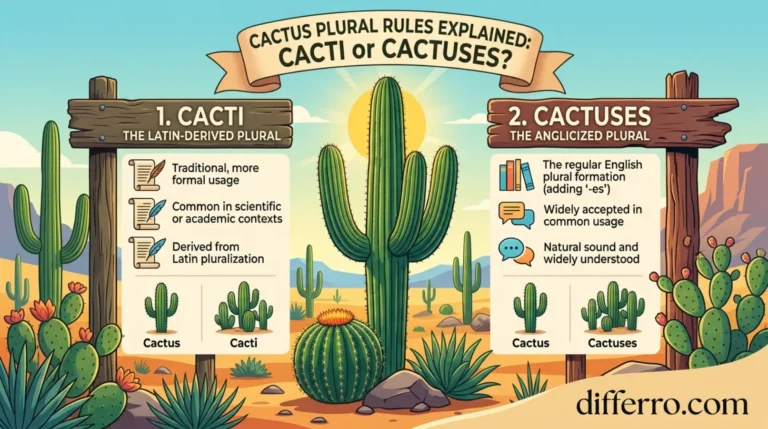
Cactus Plural Rules Explained can help you choose between cacti and cactuses. Many English learners wonder which plural form is correct. Both forms are accepted in standard English.
The word cactus comes from Latin through Greek. Its traditional Latin-style plural is cacti. English also created the regular plural cactuses by adding -es. Both forms refer to more than one cactus.
The choice often depends on context, style, and audience. Cacti appears frequently in formal, academic, botanical, and published writing. Cactuses sounds natural in everyday English. This guide explains the cactus plural rules, common mistakes, regional usage, and easy examples. You will also learn when to use each form with confidence.
⭐ Quick Answer
The plural of cactus is cacti or cactuses. Both forms are grammatically correct and widely accepted. Cacti follows the traditional Latin pattern, while cactuses follows regular English plural rules.
Example:
- We saw several cacti in the desert.
- The nursery sells small cactuses.
Major dictionaries, including Cambridge and Oxford, recognize both forms.
🌵 Meaning of Cactus
Cactus is the singular form.
A cactus is a plant that usually grows in hot, dry regions. It often has a thick stem and sharp spines.
Examples of cactus
- There is a cactus beside my bedroom window.
- The gardener planted a cactus in a clay pot.
Use cactus when you are talking about one plant.
Singular: one cactus
Plural: two or more cacti or cactuses
🌵 Meaning of Cacti
Cacti is a plural form of cactus.
It refers to two or more cactus plants. The form follows the traditional Latin plural pattern.
Examples of cacti
- Several cacti grow across the dry valley.
- The botanical garden contains many rare cacti.
Cambridge and Oxford both list cacti as an accepted plural form.
🌵 Meaning of Cactuses
Cactuses is also a plural form of cactus.
It follows a regular English plural pattern. You add -es to the singular noun.
Examples of cactuses
- The garden center sells colorful cactuses.
- We placed three cactuses near the sunny window.
Oxford’s American English dictionary lists cactuses and cacti as plural forms.
🔎 Key Differences: Cacti vs. Cactuses
| Feature | Cacti | Cactuses |
|---|---|---|
| Meaning | More than one cactus | More than one cactus |
| Tone | Often formal or traditional | Natural and everyday |
| Usage | Common in formal and botanical writing | Common in general English |
| Popularity | Very widely used | Also widely accepted |
| Formation | Traditional Latin-style plural | Regular English plural |
| Singular | Cactus | Cactus |
| Example | Several cacti grow here. | Several cactuses grow here. |
The meaning does not change between cacti and cactuses. Both refer to multiple cactus plants.

📚 Origin and History of Cactus Plurals
The word cactus entered English through Latin from Greek. Oxford traces the word to the early 17th century and the Greek word kaktos.
The traditional plural cacti developed from the Latin-style plural pattern. English speakers later formed cactuses using the normal English plural ending.
This creates two accepted forms today:
- Cactus → cacti
- Cactus → cactuses
Similar Latin-derived words can also have traditional plurals.
Examples include:
- fungus → fungi
- radius → radii
- nucleus → nuclei
- stimulus → stimuli
- alumnus → alumni
However, English does not always keep the original Latin plural. Many words gradually adopt regular English endings.
That is why cactuses is not a spelling mistake. It is a standard English plural.
🇬🇧 British English vs. 🇺🇸 American English
Both cacti and cactuses are accepted in British and American English.
British dictionaries commonly list both forms. Cambridge gives cacti and cactuses, while Oxford also recognizes both.
American English also accepts both forms. Oxford’s American dictionary lists cactuses or cacti.
British vs. American English Comparison
| Point | British English | American English |
|---|---|---|
| Accepted plural | Cacti, cactuses | Cacti, cactuses |
| Traditional form | Cacti | Cacti |
| Regular English form | Cactuses | Cactuses |
| Formal writing | Cacti is common | Cacti is common |
| Everyday writing | Both work | Both work |
The difference is therefore not a strict British-versus-American spelling rule. Both varieties recognize the two main plural forms.
✍️ When to Use Cacti
Use cacti when you want a traditional or formal-sounding plural.
It works especially well in:
- Botanical writing
- Academic articles
- Educational material
- Scientific discussions
- Formal descriptions
- Published writing
Examples
1. Several species of cacti grow in the region.
2. The researcher studied how cacti survive long periods without rain.
3. These cacti have adapted to extreme desert conditions.
4. The greenhouse contains several unusual cacti.
5. Many cacti store water in their thick stems.
✍️ When to Use Cactuses
Use cactuses when you prefer a straightforward English plural.
It works naturally in:
- Everyday conversation
- General writing
- Gardening articles
- Casual descriptions
- Shopping content
- Informal communication
Examples
1. The shop has small cactuses for sale.
2. My grandmother keeps several cactuses indoors.
3. We moved the cactuses closer to the window.
4. These cactuses need very little water.
5. The children enjoyed drawing colorful cactuses.
There is no grammar error in choosing cactuses. Major dictionaries recognize it as a standard plural.
⚠️ Common Mistakes
Mistake 1: Thinking Cacti Is the Only Correct Form
Incorrect idea:
“Cactuses is always wrong.”
Correct:
“Both cacti and cactuses are correct.”
Oxford and Cambridge both recognize the two forms.
Mistake 2: Using Cactus for Every Plural
Incorrect:
“I bought three cactus.”
Correct:
“I bought three cacti.”
Also correct:
“I bought three cactuses.”
Mistake 3: Writing Cacties
Incorrect:
“The desert has many cacties.”
Correct:
“The desert has many cacti.”
Cacties is not the standard plural form.
Mistake 4: Writing Cactuses as Cactus’s
Incorrect:
“There are five cactus’s in the garden.”
Correct:
“There are five cactuses in the garden.”
An apostrophe does not normally create a plural.
Mistake 5: Assuming Cactuses Sounds Uneducated
Incorrect idea:
“Only cacti is suitable for correct English.”
Correct:
“Both cacti and cactuses are accepted.”
The regular English form cactuses is fully established in dictionaries.
🧠 Easy Trick to Remember
Use this simple memory trick:
Cacti = traditional plural
Cactuses = regular English plural
Think of the I in cacti as a reminder of its traditional Latin-style formation.
If you forget which one to use, remember this:
One cactus, many cacti or cactuses.
Both forms are correct, so you do not need to worry about choosing the “wrong” plural.
🌵 5 Everyday Life Examples
1. Cactus Plants at Home
Many people keep cactus plants near bright windows.
Example:
“My sister has three cactuses beside her desk.”
Here, cactuses works naturally in casual writing.
2. Visiting a Botanical Garden
Botanical gardens often display different cactus species.
Example:
“The botanical garden contains many unusual cacti.”
Here, cacti fits the educational context well.
3. Buying Plants
Garden centers often sell small cactus plants.
Example:
“We bought two small cactuses for our balcony.”
The word cactuses sounds natural in everyday conversation.
4. Desert Travel
Travelers may see many cactus plants in dry regions.
Example:
“We photographed several cacti during our desert trip.”
The primary keyword idea, cactus plural rules, helps explain why cacti works here.
5. School Science Projects
Students may study how cactus plants survive drought.
Example:
“Our science project explains how cacti store water.”
The secondary keyword cacti vs. cactuses helps explain the plural choice.
🔤 Cactus Plural Rules at a Glance
Here is the simplest rule:
- One plant: cactus
- Two or more: cacti
- Two or more: cactuses
- Cacti: traditional Latin-style plural
- Cactuses: regular English plural
- Both: grammatically accepted
The safest approach is to choose one form and use it consistently throughout your article.
📊 Google Trends & Usage Insight
Google Trends reports relative search interest rather than exact word counts. It does not by itself prove which grammatical form speakers use most often.
For this topic, dictionary and corpus evidence gives stronger support than unsupported country-by-country search estimates. Major dictionaries recognize both cacti and cactuses.
| Country | Main English Context | Cacti | Cactuses | Usage Insight |
|---|---|---|---|---|
| USA | American English | Widely used | Widely used | Both are standard |
| UK | British English | Widely used | Widely used | Both are standard |
| Australia | Australian English | Used | Used | Context affects preference |
| India | English education and publishing | Used | Used | Both forms are understood |
| Pakistan | English education and general writing | Used | Used | Both forms are understood |
Available language references support the broader conclusion that both forms are valid, rather than showing a strict national spelling divide.
Keyword Variation Comparison
| Keyword Variation | Search Intent | Best Use |
|---|---|---|
| Cactus plural rules explained | Informational | Main article |
| Plural of cactus | Direct answer | Grammar search |
| Cacti vs cactuses | Comparison | Confusion search |
| Cactuses vs cacti | Comparison | Spelling search |
| Plural form of cactus | Informational | Grammar content |
| Is cacti correct? | Question | FAQ/snippet |
| Is cactuses correct? | Question | FAQ/snippet |
⚖️ Final Verdict
Both cacti and cactuses are correct plural forms of cactus.
Choose cacti when you want a traditional form. It is especially common in formal, academic, and botanical writing.
Choose cactuses when you want a regular English plural. It works well in everyday communication and general writing.
There is no need to treat cactuses as an error. Major dictionaries recognize both forms.
For consistency, avoid switching forms without a reason within the same piece of writing.
❓ FAQ: Cactus Plural Rules Explained
1. Is cacti the correct plural of cactus?
Yes. Cacti is a correct and widely accepted plural of cactus. It follows the traditional Latin-style plural pattern.
2. What is the difference between cacti and cactuses?
There is no difference in basic meaning. Both words mean more than one cactus. Cacti uses the traditional plural pattern, while cactuses uses a regular English ending.
3. Which is more common, cacti or cactuses?
Both are widely used. Cacti is especially common in published and botanical contexts. Usage can vary by context and audience.
4. Which plural should I use in formal writing?
Cacti is a strong choice for formal or scientific writing. However, cactuses remains grammatically correct and is recognized by major dictionaries.
5. Why does cactus have two plural forms?
The word entered English through Latin and Greek. English retained the traditional plural cacti. It also developed the regular English plural cactuses.
🎯 Conclusion
Understanding cactus plural rules is easier once you know that two main forms are correct. Cacti follows a traditional Latin-style pattern, while cactuses follows regular English plural rules.
Both forms describe more than one cactus. You can use cacti in academic, botanical, and formal writing. You can use cactuses in everyday speech and general writing.
The key point is simple: one cactus, many cacti or cactuses. Neither accepted form is automatically wrong. Choose the form that suits your audience and writing style. Most importantly, use your chosen form consistently.
Once you remember this rule, the common cacti vs. cactuses confusion becomes much easier to handle.

Imran Lodhra is a comparison-focused content writer at Differro.com.
He specializes in creating clear, simple, and informative comparison articles.
His work helps readers understand key differences, pros and cons, and important details.
Imran focuses on accurate, practical, and easy-to-read content for everyday readers.
1 thought on “Cactus Plural Rules Explained: Cacti or Cactuses?”