
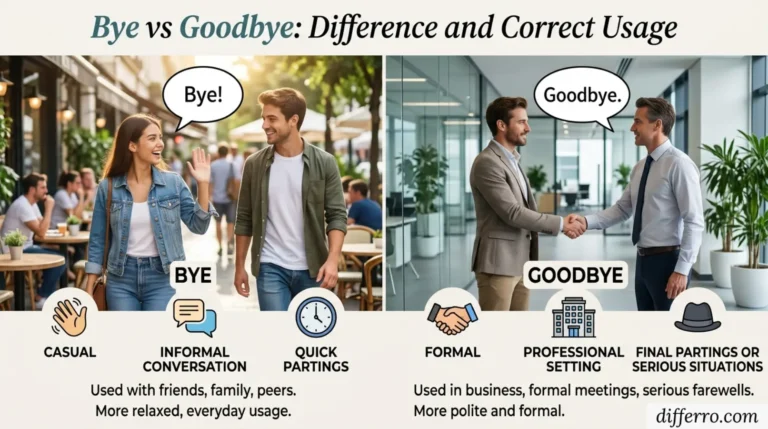
Goodbye vs Bye is a common English word-choice question. Both words are used when someone leaves or ends a conversation. The main difference is their tone and level of formality. Goodbye is the complete and more neutral farewell expression. Bye is its shorter and more casual form. You can use both words correctly in everyday English. However, the situation and relationship can affect which word sounds more natural. For example, you might say “Goodbye, everyone” at the end of a formal event. You might simply say “Bye!” to a friend after school. Understanding this small difference can make your English sound more natural. This guide explains Goodbye vs Bye, their meanings, history, usage, common mistakes, and everyday examples.
⭐ Quick Answer
Goodbye vs Bye: Goodbye is the full, neutral way to say farewell, while bye is a shorter and more informal form. Both are correct.
Example: “Goodbye, Mr. Smith.” is more formal, while “Bye, Sarah!” sounds casual.
Meaning of Goodbye
Goodbye is an expression used when someone leaves or another person leaves. It can also work as a noun referring to a farewell.
It is neutral and works in both casual and more formal situations. Dictionaries define goodbye as a conventional expression used when people part.
Examples of Goodbye
- Goodbye, everyone. Thank you for coming.
- She said goodbye to her parents before leaving.
You can also use goodbye as a noun:
- We said our goodbyes after the meeting.
- His goodbye was short but friendly.
Meaning of Bye
Bye is a short and informal way to say goodbye. It is especially common in everyday conversations with friends, family, classmates, and coworkers.
Cambridge describes bye as an informal short form of goodbye.
Examples of Bye
- Bye! See you tomorrow.
- She waved and said bye before getting into the car.
You may also hear bye-bye, which is even more informal. It is often used with children or in playful speech.

🔍 Goodbye vs Bye: Key Differences
| Feature | Goodbye | Bye |
|---|---|---|
| Meaning | A farewell | A short form of goodbye |
| Tone | Neutral and polite | Casual and friendly |
| Usage | Casual and formal situations | Mostly informal situations |
| Length | Full expression | Short expression |
| Popularity | Very common | Very common in conversation |
| Best use | Events, work, polite situations | Friends, family, quick conversations |
The two words have the same basic purpose. The main difference is the level of informality.
📚 Origin and History
The history of goodbye is surprisingly interesting. The word developed from the older farewell expression “God be with ye.” Historical forms included spellings such as godbwye before the modern form developed.
The word goodbye was recorded in English by the late 16th century. Its first part was influenced by familiar expressions such as “good day” and “good evening.”
Bye later developed as a shortened form of goodbye. Etymological sources record this shortened farewell from the early 18th century.
Similar Shortened Words
English often creates shorter forms for common expressions.
Examples include:
- Goodbye → Bye
- Telephone → Phone
- Advertisement → Ad
- Laboratory → Lab
- Refrigerator → Fridge
These shortened forms can become normal parts of everyday English.
🇬🇧 British English vs American English Spelling
There is generally no spelling difference between British and American English for these words.
Both varieties commonly use goodbye and bye.
Older forms such as good-bye may appear in historical or older writing, but goodbye is the standard modern spelling.
| Variety | Goodbye | Bye |
|---|---|---|
| British English | goodbye | bye |
| American English | goodbye | bye |
| Modern standard | goodbye | bye |
| Older form | good-bye | bye |
👋 When to Use Goodbye
Use goodbye when you want a complete, neutral farewell.
It works well in conversations, emails, speeches, events, and polite interactions.
Example 1
Goodbye, and have a safe journey.
This sounds warm and polite.
Example 2
Thank you for your help. Goodbye.
This works well in a professional setting.
Example 3
The teacher said goodbye to the students.
Here, goodbye sounds natural and neutral.
👋 When to Use Bye
Use bye when the situation is casual and friendly.
It is especially common in short conversations.
Example 1
Bye! See you later.
This sounds natural between friends.
Example 2
Okay, bye! I need to go now.
This is common in everyday speech.
Example 3
Bye, Mom!
This is a natural family expression.
⚠️ Common Mistakes
1. Using “good bye” as the standard spelling
Incorrect: Good bye, everyone.
Correct: Goodbye, everyone.
Goodbye is the standard modern spelling. Historical forms included good-bye and other variants.
2. Thinking “bye” is incorrect
Incorrect idea: Bye is bad English.
Correct: Bye is standard informal English.
It is a legitimate shortened form of goodbye.
3. Using “bye-bye” in every situation
Less suitable: Bye-bye, Professor.
Better: Goodbye, Professor.
Bye-bye is strongly informal and can sound playful or childlike.
4. Thinking goodbye and bye have different meanings
Incorrect idea: Goodbye means permanent separation.
Correct: Both words can simply mean farewell.
The surrounding context determines whether the departure is temporary or permanent.
5. Writing “by” instead of “bye”
Incorrect: By, see you tomorrow!
Correct: Bye, see you tomorrow!
By and bye have different meanings and grammatical functions.
🧠 Easy Trick to Remember
Remember this simple rule:
Goodbye = full farewell
Bye = short farewell
Think of bye as the shorter version of goodbye.
If you need a neutral or more polite farewell, goodbye works well. If you are having a quick, friendly conversation, bye usually sounds natural.
🌟 5 Everyday Life Examples of Goodbye vs Bye
1. Saying Goodbye at School
A student may say:
“Goodbye, teacher. See you tomorrow.”
The full word sounds polite and respectful.
Primary keyword: Goodbye vs Bye
Secondary keyword: goodbye meaning
2. Leaving a Friend’s House
You might say:
“Bye! Thanks for inviting me.”
The shorter form fits this relaxed situation.
Primary keyword: Goodbye vs Bye
Secondary keyword: bye meaning
3. Ending a Phone Call
A casual phone call may end with:
“Okay, bye! Talk to you later.”
Using goodbye would also be correct.
Primary keyword: Goodbye vs Bye
Secondary keyword: difference between goodbye and bye
4. Leaving a Workplace
An employee might say:
“Goodbye, everyone. Have a great evening.”
The full expression sounds natural in a group setting.
Primary keyword: Goodbye vs Bye
Secondary keyword: goodbye or bye
5. Saying Farewell to Family
A child might say:
“Bye, Dad! See you tonight.”
This casual use of bye sounds completely natural.
Primary keyword: Goodbye vs Bye
Secondary keyword: when to use bye
📊 Google Trends & Usage Insight
Search interest can change by country and by search term. Google Trends does not provide a fixed worldwide frequency for everyday word usage.
The five markets below represent useful English-search regions. Exact Trends values also depend on the selected date range and search category.
| Country | Likely Search Focus | Usage Insight |
|---|---|---|
| USA | Goodbye vs Bye | Strong everyday use of both words |
| UK | Goodbye vs Bye | Both forms are standard |
| Australia | Goodbye vs Bye | Both are common in casual English |
| India | Goodbye vs Bye | Both appear frequently in English learning |
| Pakistan | Goodbye vs Bye | Comparison searches can reflect English-learning needs |
For SEO, “Goodbye vs Bye” directly matches comparison intent. Variations such as “difference between goodbye and bye” can capture related searches.
Comparison Table: Keyword Variations
| Keyword Variation | Search Intent | Main Topic |
|---|---|---|
| Goodbye vs Bye | Comparison | Difference between both words |
| Goodbye or Bye | Word choice | Which form fits a situation |
| Difference between Goodbye and Bye | Informational | Meaning and usage |
| Bye vs Goodbye | Comparison | Casual versus neutral usage |
| When to use Goodbye | Informational | Correct situations |
| When to use Bye | Informational | Informal usage |
| Goodbye meaning | Definition | Meaning of goodbye |
📝 Final Verdict
Both goodbye and bye are correct English words.
Use goodbye when you want a complete, neutral, or more polite farewell. Use bye when you want a short, relaxed, and friendly farewell.
For example:
More neutral: “Goodbye, everyone. Thank you for coming.”
More casual: “Bye! See you tomorrow.”
Neither word is grammatically wrong. Your choice mainly depends on the situation, relationship, and tone.
❓ FAQ
Is “bye” a correct word?
Yes. Bye is a correct English word and an informal short form of goodbye.
What is the difference between goodbye and bye?
Goodbye is the full farewell expression. Bye is its shorter and more informal form.
Which is more common, goodbye or bye?
Both are very common. Bye is especially common in quick, informal conversations. Goodbye is useful when you want a complete or neutral farewell.
Is goodbye formal?
Goodbye is generally neutral and polite. It can work in both casual and formal situations.
Why do people confuse goodbye and bye?
People confuse them because they have almost the same meaning. Bye developed as a shortened form of goodbye, so their meanings overlap.
Conclusion
Goodbye vs Bye is mainly a question of tone, length, and context. Goodbye is the complete and neutral farewell expression. Bye is its shorter and more informal form. Both are correct in modern English. Use goodbye for polite conversations, professional situations, speeches, and general farewells. Use bye for quick and friendly conversations with people you know well. You can also use goodbye as a noun, as in “We said our goodbyes.” Bye is usually used as an interjection. Remember the simple rule: goodbye is the full farewell, while bye is the short farewell. Choosing between them becomes easy once you consider the situation and the level of formality.

Imran Lodhra is a comparison-focused content writer at Differro.com.
He specializes in creating clear, simple, and informative comparison articles.
His work helps readers understand key differences, pros and cons, and important details.
Imran focuses on accurate, practical, and easy-to-read content for everyday readers.
1 thought on “Bye vs Goodbye: Difference and Correct Usage”