
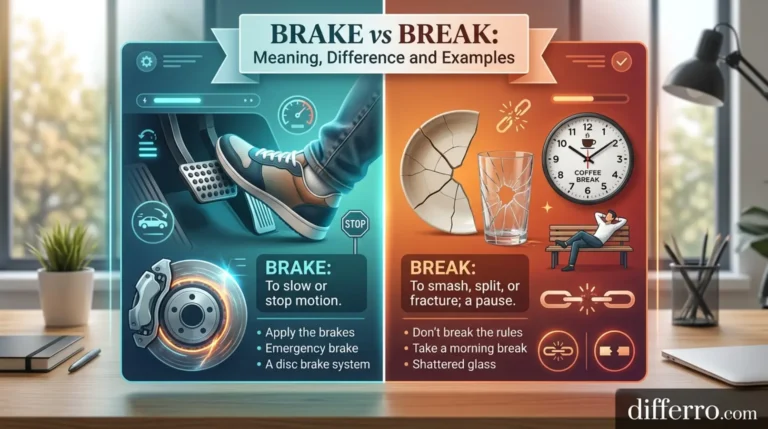
Brak e vs Break is a common spelling and word-choice confusion. The correct comparison is Brake vs Break. These words sound similar, but they have different meanings and uses. Brake relates to stopping or slowing a vehicle or machine. Break usually means to damage, separate, stop, or interrupt something. Knowing the difference helps you write clear English and avoid common spelling mistakes. The word brake often appears in driving and mechanical contexts. The word break has many uses in everyday English. You can break a glass, take a break, or break a promise. You can also break a habit or break a rule. This guide explains Brake vs Break with simple meanings, examples, usage tips, and common mistakes. It also explains why these words confuse English learners.
⭐ Quick Answer
Brake means a device or action used to slow or stop a vehicle. Break means to damage, separate, interrupt, or stop something.
Example: Press the brake to stop the car. Be careful not to break the glass.
📘 Meaning of Brake
Brake refers to a device or action that slows down or stops a vehicle, bicycle, or machine.
As a noun, a brake is a mechanical device that controls movement.
As a verb, brake means to slow down or stop by using a brake.
Examples of Brake
- The driver pressed the brake before the red light.
- Please brake slowly on the wet road.
Brake usually connects with driving, bicycles, machines, and movement.
📗 Meaning of Break
Break has several meanings in English. It can mean to damage something, separate something, interrupt something, or stop temporarily.
It can also describe a short period of rest.
Examples of Break
- Be careful not to break the glass.
- I need a short break after studying.
The word break appears much more often in everyday English.
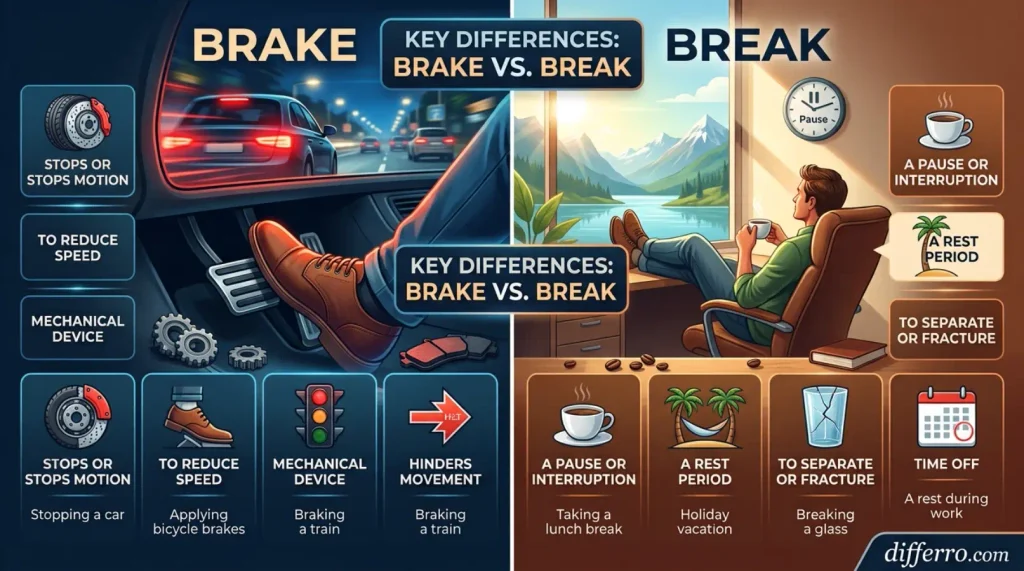
🔎 Key Differences: Brake vs Break
| Feature | Brake | Break |
|---|---|---|
| Meaning | Slows or stops movement | Damages, separates, interrupts, or rests |
| Tone | Practical and mechanical | General and everyday |
| Usage | Vehicles, bicycles, machines | Objects, rules, habits, activities, rest |
| Popularity | Less common | Much more common |
The biggest difference is simple: brake controls movement, while break has many general meanings.
📜 Origin and History
Brake comes from older words connected with controlling or restraining movement. Its modern meaning developed around devices that slow vehicles and machines.
Break has much older Germanic roots. Old English used forms related to the modern word break. Its meaning expanded over centuries.
Several English words share related historical roots or meanings.
Examples include:
- Brake
- Break
- Broken
- Breakable
- Breakdown
- Breakthrough
- Braking
Although brake and break sound alike, their meanings developed differently.
🇬🇧 British English vs 🇺🇸 American English
British and American English use brake and break with the same basic meanings. Their spelling does not change between these varieties. The main difference involves pronunciation and regional vocabulary in some related expressions.
| Word | British English | American English |
|---|---|---|
| Brake | Brake | Brake |
| Break | Break | Break |
| Braking | Braking | Braking |
| Broken | Broken | Broken |
Therefore, Brake vs Break is not a British versus American spelling issue. Both varieties use the same spellings.
🚗 When to Use Brake
Use brake when you discuss stopping or slowing movement.
Common situations include:
- Cars
- Motorcycles
- Bicycles
- Trucks
- Trains
- Machines
Examples
- The driver used the brake quickly.
- Check your bicycle brakes before riding.
- The mechanic replaced the damaged brake.
- You should brake before reaching the sharp turn.
A useful phrase is brake pedal.
For example:
- Press the brake pedal gently.
- The brake pedal feels loose.
✂️ When to Use Break
Use break for many different actions and situations.
Damage something
- I accidentally broke the cup.
- Do not break the window.
Take a rest
- Let’s take a break.
- She took a short lunch break.
Interrupt something
- Please do not break the silence.
- The news broke the meeting’s quiet mood.
Stop a habit or rule
- He wants to break his bad habit.
- They decided to break the old tradition.
Separate something
- The stick may break under pressure.
- The rope broke suddenly.
⚠️ Common Mistakes
1. Using Break for a Car’s Stopping Device
Incorrect: Press the break to stop the car.
Correct: Press the brake to stop the car.
A car uses a brake, not a break.
2. Using Brake When You Mean Damage
Incorrect: Be careful not to brake the glass.
Correct: Be careful not to break the glass.
You break an object when you damage or shatter it.
3. Confusing Brake With Break
Incorrect: I need to break before the corner.
Correct: I need to brake before the corner.
Use brake when you mean slow down or stop a vehicle.
4. Confusing Break With Brake Pedal
Incorrect: The break pedal needs repair.
Correct: The brake pedal needs repair.
The correct driving term is brake pedal.
5. Using Brake for Rest
Incorrect: Let’s take a brake.
Correct: Let’s take a break.
A short period of rest is a break.
🧠 Easy Trick to Remember Brake vs Break
Use this simple memory trick:
Brake = vehicle
Think of a brake pedal when you see brake.
Break = everything else
You can break a glass, rule, promise, habit, record, or silence.
Another easy trick is:
Brake stops. Break damages or interrupts.
This rule works in most everyday situations.
🌟 Everyday Life Examples
1. Driving to Work
The traffic light changed suddenly, so I pressed the brake.
Here, brake means a device or action that slows the car.
2. Dropping a Phone
She dropped her phone and worried that she might break the screen.
Here, break means damage something.
3. Taking a Rest
I worked for two hours before taking a short break.
Here, break means a period of rest.
4. Riding a Bicycle
Always check your brakes before riding down a steep hill.
Here, brakes control the bicycle’s speed.
5. Changing a Habit
He decided to break his habit of staying up late.
Here, break means stop or end a habit.
📊 Google Trends & Usage Insight
Search interest for break is much broader because it has many everyday meanings. Brake attracts more specific searches related to vehicles and driving. The same pattern generally appears across the USA, UK, Australia, India, and Pakistan. Exact search volume changes over time, but break remains the more widely used word.
Comparison Table: Keyword Variations
| Keyword Variation | Main Search Intent | Relative Usage |
|---|---|---|
| Brake vs Break | Spelling and meaning comparison | High |
| Brake or Break | Word-choice confusion | High |
| Break vs Brake | Meaning comparison | High |
| Difference between Brake and Break | Educational | Medium |
| Brake meaning | Definition | Medium |
| Break meaning | Definition | High |
| Brake and Break examples | Learning | Medium |
⚖️ Final Verdict
Brake and break are both correct words, but they have different meanings.
Choose brake when talking about slowing or stopping a vehicle, bicycle, or machine.
Choose break when talking about damaging something, interrupting something, resting, separating something, or ending a habit.
Remember this simple rule:
Brake stops movement. Break describes many other actions.
If you mean the driving device, use brake. If you mean damage or rest, use break.
Also remember that “Brak e” is not the correct spelling. The correct word is brake.
❓ Frequently Asked Questions
Is “brake” the correct spelling?
Yes. Brake is the correct spelling when you mean a device or action that slows or stops movement. For example, “Press the brake.”
What is the difference between brake and break?
Brake relates to slowing or stopping movement. Break usually means damage, separation, interruption, rest, or ending something.
Which word is more common, brake or break?
Break is more common because it has many meanings. Brake mainly appears in driving, cycling, and mechanical contexts.
Is brake used in formal English?
Yes. Brake is standard English and works in formal and informal writing. It commonly appears in technical and transportation contexts.
Why do people confuse brake and break?
People confuse them because brake and break sound alike in standard English. Their spellings and meanings are different.
📝 Conclusion
Understanding Brake vs Break becomes easy when you remember their main meanings. Brake relates to stopping or slowing a vehicle, bicycle, or machine. Break has many broader meanings. It can describe damaging something, taking a rest, interrupting an activity, or ending a habit. These words sound alike, which causes frequent spelling mistakes. However, their meanings give you a simple way to choose the correct word. Use brake for vehicles and movement. Use break for damage, rest, interruption, separation, and similar actions. Also remember that “Brak e” is incorrect. The correct spelling is brake. Learning this small difference can make your writing clearer and more accurate.

Imran Lodhra is a comparison-focused content writer at Differro.com.
He specializes in creating clear, simple, and informative comparison articles.
His work helps readers understand key differences, pros and cons, and important details.
Imran focuses on accurate, practical, and easy-to-read content for everyday readers.
1 thought on “Brake vs Break: Meaning, Difference and Examples”