
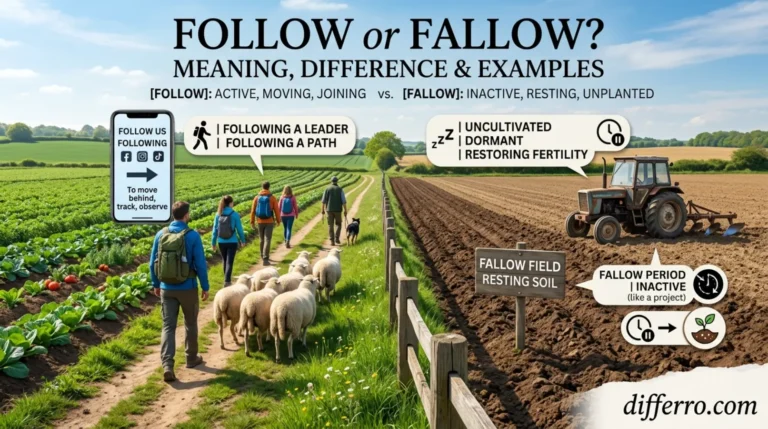
Follow or Fallow can confuse writers because both words look and sound similar. However, they have completely different meanings and uses. Follow usually relates to moving behind someone, obeying instructions, or keeping up with something. Fallow mainly describes land that farmers leave unused for a period. These words belong to different parts of everyday English. You may see follow in conversations, instructions, social media, and writing. You will usually see fallow in farming, agriculture, and discussions about land. Knowing the difference helps you choose the correct word quickly. This guide explains their meanings, origins, uses, common mistakes, and examples. It also provides an easy memory trick. By the end, you will know exactly when to use follow or fallow in your writing.
⭐ Quick Answer
Follow means to go behind, obey, understand, or keep track of something. Fallow describes farmland left uncultivated for a period.
Example: Please follow the teacher’s instructions. The farmer left the field fallow.
📘 Meaning of Follow
Follow is a verb with several common meanings. It can mean going behind someone or something. It can also mean obeying advice, instructions, or rules.
People also use follow when they continue watching or tracking someone. Social media users commonly use the word for subscribing to someone’s updates.
Examples of Follow
- Please follow me to the classroom.
- Always follow the safety instructions.
Other common uses include:
- Follow a rule: obey a rule.
- Follow directions: do what instructions say.
- Follow someone online: subscribe to their updates.
- Follow a conversation: understand what someone says.
- Follow a path: continue along a route.
🌱 Meaning of Fallow
Fallow is mainly an adjective connected with farming and agriculture. It describes land that farmers leave uncultivated for a period.
Farmers may leave land fallow to help manage soil conditions. The land remains unused instead of producing a crop during that period.
Examples of Fallow
- The farmer left the field fallow for one season.
- The fallow land rested before the next crop.
Fallow can also appear as a noun. In this use, it refers to land left uncultivated.
🔍 Key Differences Between Follow and Fallow
| Feature | Follow | Fallow |
|---|---|---|
| Meaning | To go behind, obey, track, or understand | Land left uncultivated |
| Tone | Common and everyday | Agricultural and specialized |
| Usage | Conversations, instructions, media, writing | Farming and land management |
| Popularity | Very common | Much less common |
| Part of speech | Mainly verb | Mainly adjective and sometimes noun |
| Main idea | Movement, obedience, or tracking | Unused agricultural land |
📜 Origin & History
Follow comes from Old English folgian, meaning to accompany, pursue, or go after. Its meaning developed over time and gained several modern uses.
Fallow has Germanic roots and historically described pale or yellowish land. English later used it for agricultural land left uncultivated.
These words developed separately despite their similar spelling.
Similar Word Examples
English contains many confusing word pairs with different meanings:
- Advice / Advise
- Affect / Effect
- Accept / Except
- Loose / Lose
- Principal / Principle
- Stationary / Stationery
- Compliment / Complement
These examples show why spelling alone cannot determine meaning.
🇬🇧 British English vs American English Spelling
British and American English use follow and fallow with the same spelling. Neither word changes between these varieties.
Their meanings also remain the same in British and American English.
The main difference comes from context, not regional spelling.
British vs American English Comparison
| Word | British English | American English |
|---|---|---|
| Follow | Follow | Follow |
| Fallow | Fallow | Fallow |
| Meaning | Same | Same |
| Spelling | Same | Same |
| Common context | Everyday use and farming | Everyday use and farming |
🧭 When to Use Follow
Use follow when you mean moving behind someone or something.
Example:
The children followed their teacher into the room.
Use follow when you mean obeying instructions or rules.
Example:
You must follow the instructions carefully.
Use it when you mean keeping track of a person or topic.
Example:
I follow several educational pages online.
Use it when you mean understanding something.
Example:
I cannot follow his explanation.
🌾 When to Use Fallow
Use fallow when discussing agricultural land that remains uncultivated.
Example:
The farmer kept the field fallow during the dry season.
Use fallow when describing land that is temporarily unused for farming.
Example:
Several acres remained fallow after the harvest.
You should not use fallow when you mean obeying instructions or going behind someone.
⚠️ Common Mistakes
Mistake 1: Using Fallow for Instructions
❌ Please fallow the instructions.
✅ Please follow the instructions.
Why: Instructions require the verb follow.
Mistake 2: Using Follow for Farmland
❌ The farmer left the field follow.
✅ The farmer left the field fallow.
Why: Agricultural land can remain fallow.
Mistake 3: Confusing Social Media Usage
❌ I fallow my favorite writer online.
✅ I follow my favorite writer online.
Why: Social media subscriptions use follow.
Mistake 4: Confusing Land and Movement
❌ The farmer will follow the field this year.
✅ The farmer will leave the field fallow this year.
Why: Fallow describes land that farmers do not cultivate.
🧠 Easy Trick to Remember
Think of follow as following a person.
Think of fallow as farmland.
A simple memory trick is:
Follow = Go or obey.
Fallow = Farm land resting.
The extra a in fallow can remind you of agriculture.
🏠 Everyday Life Examples
1. Following a Friend
I decided to follow my friend to the library.
Here, follow means going behind someone.
2. Following Instructions
Always follow the instructions before using the machine.
Here, follow means obeying directions.
3. Following Someone Online
Many people follow their favorite creators on social media.
Here, follow means keeping track of someone’s updates.
4. Understanding a Conversation
She listened carefully but could not follow the discussion.
Here, follow means understanding the information.
5. Fallow Agricultural Land
The farmer left several fields fallow after the harvest.
Here, fallow describes land that remains uncultivated.
📊 Google Trends & Usage Data
Follow has much broader everyday usage than fallow because it appears in social media, instructions, movement, and communication.
Fallow mainly appears in agricultural, environmental, farming, and land-management contexts.
Search interest for follow is therefore expected to be substantially higher across the USA, UK, Australia, India, and Pakistan.
The table below gives a practical usage comparison rather than exact monthly search-volume figures.
Keyword Variations Comparison
| Country | Follow Usage | Fallow Usage | Main Search Intent |
|---|---|---|---|
| USA | Very High | Low | Meaning, social media, usage |
| UK | Very High | Low | Meaning and grammar |
| Australia | Very High | Low | Everyday and farming usage |
| India | Very High | Low | Spelling and meaning |
| Pakistan | Very High | Low | Spelling and English usage |
SEO insight: Follow or Fallow has strong spelling-confusion intent. The best content should clearly explain both words and provide practical examples.
⚖️ Final Verdict
Follow is the correct word for movement, obedience, tracking, and understanding.
Fallow is the correct word for agricultural land that remains uncultivated.
➤If you mean go behind someone, use follow.
If you mean obey instructions, use follow.
If you mean land left unused for farming, use fallow.
The words may look similar, but their meanings are completely different. Remember Follow = go or obey and Fallow = farmland resting.
❓ FAQ
Is “follow” the correct word?
Yes. Follow is correct when you mean going behind someone, obeying instructions, tracking something, or understanding something.
What is the difference between follow and fallow?
Follow usually means going behind, obeying, tracking, or understanding. Fallow describes agricultural land that remains uncultivated.
Which word is more common, follow or fallow?
Follow is much more common. It appears frequently in everyday conversation, writing, instructions, and social media.
Is fallow used in formal writing?
Yes. Fallow is a standard English word. It commonly appears in formal writing about agriculture, farming, soil, and land management.
Why do people confuse follow and fallow?
People confuse them because their spelling and pronunciation are similar. Their meanings, however, are clearly different.
📝 Conclusion
Follow or Fallow represents a common English spelling confusion. The two words have different meanings and serve different purposes. Follow is the everyday word for going behind someone, obeying instructions, tracking updates, or understanding information. Fallow mainly describes agricultural land that farmers leave uncultivated for a period. You can remember the difference with one simple idea: follow means go or obey, while fallow relates to farmland resting. This distinction makes the correct choice much easier. When writing about people, instructions, paths, or social media, choose follow. When writing about unused agricultural land, choose fallow. Understanding this difference will help you write clearer and more accurate English in everyday and formal situations.

Imran Lodhra is a comparison-focused content writer at Differro.com.
He specializes in creating clear, simple, and informative comparison articles.
His work helps readers understand key differences, pros and cons, and important details.
Imran focuses on accurate, practical, and easy-to-read content for everyday readers.
2 thoughts on “Follow or Fallow: Meaning, Difference and Examples”