
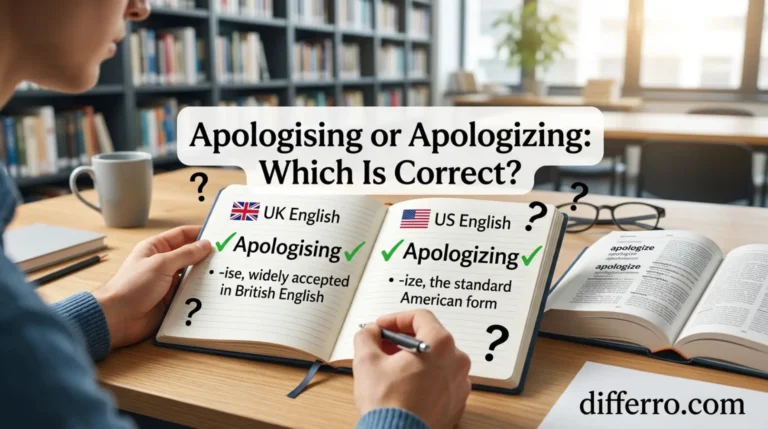
Apologising or Apologizing often confuses English learners because both spellings are correct. The main difference comes from regional English spelling.
Apologising is commonly used in British English. Apologizing is standard in American English. Both words describe the same action of saying sorry or expressing regret.
The difference does not affect meaning, grammar, or pronunciation in normal use. It only changes the spelling of the verb.
This distinction also appears in related forms. British English uses apologise, apologises, apologised, and apologising. American English uses apologize, apologizes, apologized, and apologizing.
Understanding this pattern helps you choose the right spelling for your audience. It also prevents inconsistent spelling in essays, websites, emails, and professional writing.
⭐ Quick Answer
Apologising is the British English spelling, while apologizing is the American English spelling. Both words have the same meaning.
Example: British: “She is apologising for being late.” American: “She is apologizing for being late.”
Meaning of Apologising
Apologising means saying sorry for a mistake, action, or problem. It is the British English spelling of the present participle of apologise.
I➤t can describe an action happening now. It can also work as a gerund in a sentence.
Examples:
- She is apologising for her mistake.
- Apologising sincerely can help repair a damaged relationship.
British English commonly uses apologising in formal and everyday writing.
Meaning of Apologizing
Apologizing means saying sorry or expressing regret for something. It is the American English spelling of the present participle of apologize.
The meaning remains exactly the same as apologising.
Examples:
- He is apologizing for arriving late.
- Apologizing was the right thing to do.
American English normally uses the -ize spelling in this verb family.
🔍 Key Differences Between Apologising and Apologizing
| Feature | Apologising | Apologizing |
|---|---|---|
| Meaning | Saying sorry or expressing regret | Saying sorry or expressing regret |
| Tone | Neutral and standard | Neutral and standard |
| Usage | Mainly British English | Mainly American English |
| Popularity | Strong in UK and some Commonwealth writing | Strong in the USA |
| Base verb | Apologise | Apologize |
| Past form | Apologised | Apologized |
The words have the same meaning and grammatical function. The main difference is regional spelling.
📚 Origin and History
The word apologise/apologize traces back to the Greek word apologia, meaning a defense or explanation.
English later developed both -ise and -ize spelling patterns. British English commonly uses -ise in this word, while American English generally uses -ize.
This difference appears in many related verbs.
Similar examples include:
- organise / organize
- realise / realize
- recognise / recognize
- analyse / analyze
- emphasise / emphasize
The spelling pattern becomes easier when you learn the base verb first.
British pattern:
- apologise → apologising
- organise → organising
- realise → realising
American pattern:
- apologize → apologizing
- organize → organizing
- realize → realizing
The spelling difference developed through English usage traditions rather than different meanings.
🇬🇧 British English vs American English Spelling
British English commonly writes apologise with s. Therefore, its -ing form becomes apologising.
American English generally writes apologize with z. Therefore, its -ing form becomes apologizing.
Both systems are grammatically correct. Writers should choose one system and use it consistently.
British vs American English Comparison
| Feature | British English | American English |
|---|---|---|
| Base verb | apologise | apologize |
| Present form | apologises | apologizes |
| Past form | apologised | apologized |
| -ing form | apologising | apologizing |
| Main spelling | -ise | -ize |
| Example | She is apologising. | She is apologizing. |
✍️ When to Use Apologising
Use apologising when your writing follows British English spelling.
It works well in:
- UK school assignments
- British business writing
- UK websites
- British publications
- Many Commonwealth contexts
Examples:
- I am apologising for the delay.
- She kept apologising for the misunderstanding.
- The company is apologising to its customers.
- He felt better after apologising to his friend.
If you use apologise, keep the same spelling pattern throughout your article or document.
✍️ When to Use Apologizing
Use apologizing when your writing follows American English spelling.
It works well in:
- US school assignments
- American business writing
- US websites
- American publications
- American social media content
Examples:
- I am apologizing for the confusion.
- She kept apologizing for her mistake.
- The company is apologizing to customers.
- He felt better after apologizing to his friend.
If you choose apologize, use apologizing consistently.
⚠️ Common Mistakes
1. Mixing British and American Spelling
Incorrect:
She is apologising for the error and later apologized.
Better:
She is apologising for the error and later apologised.
Or:
She is apologizing for the error and later apologized.
2. Thinking Apologising Is Incorrect
Incorrect idea:
“Apologising” is always wrong.
Correct:
“Apologising” is correct in British English.
3. Thinking Apologizing Is Incorrect
Incorrect idea:
“Apologizing” is always wrong.
Correct:
“Apologizing” is correct in American English.
4. Using the Wrong Base Verb
Incorrect:
I am apologizing if your document consistently uses British spelling.
Better:
I am apologising if your document follows British English.
Consistency matters more than choosing one spelling universally.
5. Changing the Meaning
Incorrect idea:
The two spellings have different meanings.
Correct:
Both forms mean saying sorry or expressing regret.
🧠 Easy Trick to Remember
Use this simple rule:
S = British
Z = American
So:
Apologise → Apologising
Apologize → Apologizing
Think of the base verb first.
If your writing uses apologise, choose apologising.
If your writing uses apologize, choose apologizing.
This trick also works with many similar spelling pairs.
🌍 Everyday Life Examples
1. Apologising or Apologizing for Being Late
British English:
- She is apologising for being late.
American English:
- She is apologizing for being late.
Both sentences have the same meaning.
2. Apologising or Apologizing at Work
British English:
- The manager is apologising for the delay.
American English:
- The manager is apologizing for the delay.
Both forms work in professional communication.
3. Apologising or Apologizing to a Friend
British English:
- He is apologising to his friend.
American English:
- He is apologizing to his friend.
The spelling changes, but the meaning stays the same.
4. Apologising or Apologizing After a Mistake
British English:
- She started apologising after noticing her mistake.
American English:
- She started apologizing after noticing her mistake.
Both versions are grammatically correct.
5. Apologising or Apologizing in Formal Writing
British English:
- We are apologising for any inconvenience caused.
American English:
- We are apologizing for any inconvenience caused.
Choose the form that matches your publication style.
🏆 Final Verdict
Apologising and apologizing are both correct.
Choose apologising for British English writing.
Choose apologizing for American English writing.
Neither spelling is more grammatically correct. The best choice depends on your audience and preferred English style.
➤For a UK audience, apologising usually looks natural. For a US audience, apologizing is the standard choice.
➤For international content, select one spelling system and remain consistent. Avoid switching between -ise and -ize forms without a clear reason.
The simplest rule is easy to remember: British English often uses S, while American English uses Z.
📊 Google Trends & Usage Data
Public usage data strongly shows a regional preference rather than a difference in meaning. Apologizing is dominant in US usage, while apologising is stronger in UK and Australian usage.
Available country-level usage data reports approximately 98% apologizing and 2% apologising in the US.
The UK shows the opposite pattern, with approximately 69% apologising and 31% apologizing. Australia also strongly favors apologising, at about 68%.
Comparable public country data for Pakistan is not provided in that dataset, so a precise percentage would be misleading. Pakistani English can reflect British spelling traditions, but individual usage varies.
Keyword Variations by Country
| Country | More Common Form | Usage Insight |
|---|---|---|
| USA | Apologizing | Strong American preference |
| UK | Apologising | Strong British preference |
| Australia | Apologising | Strong British-style preference |
| India | Apologizing | Available data shows a moderate preference |
| Pakistan | Apologising / Apologizing | No reliable comparable percentage available |
The available data supports a key SEO insight: regional intent matters. US-focused pages can naturally use apologizing, while UK-focused pages can prioritize apologising.
❓ FAQ
Is apologising correct?
Yes. Apologising is a correct spelling in British English. It is the present participle of apologise.
What is the difference between apologising and apologizing?
The difference is spelling and regional usage. Apologising is common in British English, while apologizing is standard in American English.
Which is more common, apologising or apologizing?
The answer depends on the country. Apologizing is stronger in American usage, while apologising is stronger in British and Australian usage.
Is apologising formal English?
Yes. Apologising is suitable for formal and informal British English. You can use it in emails, essays, reports, and professional documents.
Why does the confusion between apologising and apologizing exist?
The confusion exists because British and American English use different spelling traditions. British English commonly uses -ise, while American English generally uses -ize.
Conclusion
Apologising or Apologizing is a spelling question, not a meaning question. Both forms describe the act of saying sorry or expressing regret.
Use apologising when you follow British English spelling. Use apologizing when you follow American English spelling. The two forms have the same grammatical role and meaning.
The easiest way to remember the difference is to check the base verb. Apologise becomes apologising, while apologize becomes apologizing.
Your choice should match your target audience. Most importantly, keep your spelling consistent throughout the same article or document. This approach makes your writing clearer, more professional, and easier for readers to understand.

Imran Lodhra is a comparison-focused content writer at Differro.com.
He specializes in creating clear, simple, and informative comparison articles.
His work helps readers understand key differences, pros and cons, and important details.
Imran focuses on accurate, practical, and easy-to-read content for everyday readers.
1 thought on “Apologising or Apologizing: Which Is Correct?”