
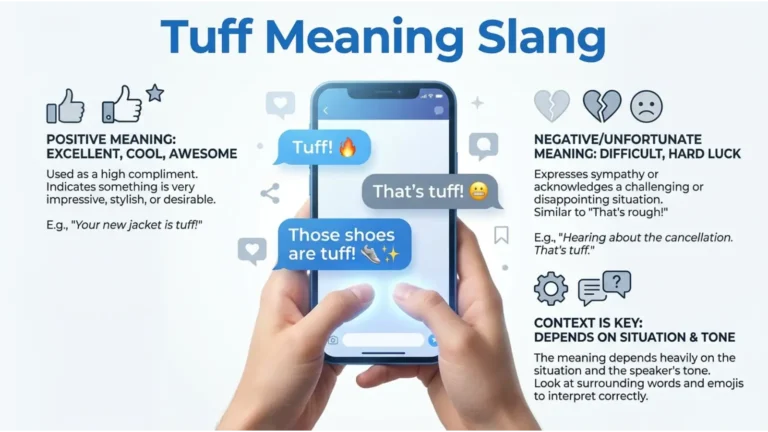
Tuff meaning slang is something many people search for after seeing the word “tuff” in texts, TikTok comments, Instagram posts, gaming chats, or casual conversations.
At first glance, “tuff” may look like a misspelling of “tough,” but online slang can give familiar words a different style or feeling.
Today, tuff is commonly used as an informal spelling of “tough.” Depending on the situation, it can describe someone or something as strong, impressive, cool, difficult, or stylish. It can also be used as a reaction to something that is unfortunate or difficult.
The exact meaning depends heavily on the sentence and tone.
Quick Answer:
In slang, “tuff” usually means cool, impressive, strong, or tough. In some conversations, it can also mean that something is difficult or unfortunate.
What Does Tuff Mean in Text?
When someone writes “tuff” in text, they usually use it as a casual slang spelling of “tough.”
For example:
- “That outfit is tuff.” = That outfit looks really cool.
- “Bro is tuff.” = Bro is strong, impressive, or confident.
- “That game was tuff.” = That game was difficult.
- “Tuff luck.” = Tough luck or bad luck.
The meaning changes according to context.
On social media, “tuff” is often used positively to compliment someone’s appearance, skills, personality, music, artwork, car, outfit, or achievement.
Tuff Meaning Slang: Definition and Full Form
There is no special official tuff full form in standard English.
Instead, tuff is generally an informal spelling or slang form of “tough.” It is mainly used in casual digital communication.
The standard English word tough can mean strong, difficult, durable, or emotionally resilient. Slang “tuff” can carry similar meanings while also developing a stronger sense of cool, impressive, or stylish.
So, if you are asking “what does tuff stand for?”, the simplest answer is:
Tuff = an informal/slang spelling of tough.
It is not normally an acronym.
Tuff Meaning in Different Contexts
The word can have several meanings depending on how it is used.
1. Tuff Means Cool or Impressive
This is one of the most common meanings in modern online slang.
Example:
“Those new shoes are tuff.”
Here, the speaker is saying the shoes look really cool or impressive.
2. Tuff Means Strong
Someone may call a person “tuff” when they seem physically or mentally strong.
Example:
“She handled that situation like a pro. She’s tuff.”
In this context, it means strong, resilient, or capable.
3. Tuff Means Difficult
“Tuff” can also retain the traditional meaning of “tough.”
Example:
“That exam was tuff.”
This means:
“That exam was difficult.”
4. Tuff as a Compliment
On social media, someone might comment:
“That edit is tuff 🔥”
This usually means the edit is very good, impressive, or stylish.
Is Tuff Rude, Offensive, or Neutral?
Generally, tuff is not a rude or offensive word.
It is informal slang, so the main issue is not offensiveness but appropriateness.
Using “tuff” with friends, online communities, or social media is usually fine. However, it may not be the best choice in formal writing.
For example:
Casual:
“Your new car is tuff.”
Formal:
“Your new car looks impressive.”
If you are writing an academic paper, business email, formal report, or professional application, use standard English instead.
Where Is Tuff Commonly Used?
You may see “tuff” in many online spaces, especially:
- TikTok
- Snapchat
- YouTube comments
- Text messages
- Gaming chats
- Discord
- X and other social platforms
- Online communities
- Casual conversations
It is especially common among people who use internet slang and informal digital language.
Real-Life Conversation Examples
Friendly Conversation
Alex: “I got the new sneakers.”
Sam: “Those are tuff!”
Here, “tuff” means cool or impressive.
Casual Conversation
Mike: “I finished the game on the hardest level.”
John: “That’s tuff!”
Here, it can mean impressive or difficult, depending on the surrounding conversation.
Compliment
Person 1: “What do you think of my new artwork?”
Person 2: “That’s tuff 🔥.”
The speaker means the artwork looks really good or impressive.
Difficult Situation
Person 1: “I failed the test again.”
Person 2: “Tuff. You can try again.”
Here, “tuff” can communicate sympathy about an unfortunate situation.
Gaming
Player 1: “That boss fight was tuff.”
Player 2: “Yeah, I barely survived.”
Here, “tuff” means very difficult.
Emotional and Psychological Meaning of Tuff
The emotional meaning of “tuff” depends on tone.
When used as a compliment, it can communicate admiration:
“That performance was tuff.”
The speaker may be expressing excitement or respect.
When used in response to bad news, however, it can sound different:
“I lost my job.”
“Tuff.”
In this case, the speaker might mean “That’s tough” or “That’s unfortunate.”
However, a short response like this can sometimes sound cold or dismissive. Tone matters.
Origin and Background of Tuff
The slang spelling “tuff” is connected to the standard English word “tough.”
“Tough” has a long history in English and can describe something strong, difficult, durable, or challenging.
The spelling “tuff” is not simply a new invention of social media. Informal spellings and stylized forms of words have appeared in different communities and forms of communication over time.
Modern internet culture has helped make “tuff” more visible, especially when people use it to describe something cool, impressive, stylish, or hard.
Social media, music, gaming, and youth culture have all contributed to the spread of this type of informal language.
Tuff vs. Tough
Although they look and sound similar, they are not always used in exactly the same way.
| Word | Meaning | Common Use |
|---|---|---|
| Tough | Strong, difficult, or challenging | Standard English |
| Tuff | Cool, impressive, strong, or difficult | Informal slang |
| Hard | Difficult or impressive, depending on context | Casual slang |
| Cool | Good, attractive, or impressive | Casual English |
The safest choice in formal writing is tough.
Tuff vs. Other Similar Slang
Tuff vs. Hard
Both words can describe something impressive.
“That car is tuff.”
“That car is hard.”
In certain online communities, both may mean the car looks cool or impressive.
Tuff vs. Fire
“Fire” is often used to describe something extremely good, exciting, or impressive.
“That song is fire.”
“Tuff” can also compliment the song, but its meaning may focus more on its style, quality, or impressive nature.
Tuff vs. Cool
“Cool” is a broad and widely understood word.
“Tuff” is more informal and slang-heavy.
When Should You Use Tuff?
Use “tuff” when you are communicating casually and the people reading it understand internet slang.
It works well in:
- Text messages
- Social media comments
- Gaming chats
- Friendly conversations
- Memes
- Casual posts
- Informal online discussions
For example:
“That new haircut is tuff.”
“Your drawing is tuff.”
“That was a tuff match.”
When Should You Avoid Using Tuff?
Avoid “tuff” in formal or professional communication.
For example, don’t normally write:
“The presentation was tuff.”
in a professional report.
Instead, write:
“The presentation was challenging.”
Similarly, instead of:
“Your work is tuff.”
you could write:
“Your work is impressive.”
The slang version is not necessarily wrong; it is simply less appropriate for formal situations.
Polite Alternatives to Tuff
Depending on what you mean, you can replace “tuff” with:
- Tough
- Difficult
- Challenging
- Strong
- Impressive
- Excellent
- Cool
- Stylish
- Amazing
- Great
- Remarkable
Choose the alternative that matches the intended meaning.
Why Do People Use Tuff?
People use slang like “tuff” because it makes online communication feel more casual and expressive.
There are several reasons people choose it:
- It sounds informal.
- It fits social media culture.
- It can express excitement quickly.
- It adds personality to messages.
- It can make compliments feel more natural.
- It connects people through shared internet language.
Slang also changes quickly. A word can develop a slightly different meaning depending on the online community using it.
Is Tuff Safe for Social Media?
Yes. “Tuff” is generally safe for social media.
It is not normally considered offensive or inappropriate. However, the meaning can change depending on the context.
For example:
“That outfit is tuff 🔥”
is clearly a compliment.
But:
“You lost? Tuff.”
could sound insensitive because it may be interpreted as “That’s your problem” or “Too bad.”
Therefore, always consider the situation before using it.
Common Misunderstandings About Tuff
Is Tuff Just a Misspelling?
Not always.
In standard English, “tough” is the correct spelling. But “tuff” can intentionally be used as slang or an informal spelling online.
Does Tuff Always Mean Difficult?
No.
In modern slang, “tuff” can also mean cool, impressive, stylish, or strong.
Does Tuff Have a Full Form?
No official acronym or full form is generally associated with slang “tuff.”
It is primarily a stylized or informal form of “tough.”
Is Tuff a Compliment?
Often, yes.
If someone says:
“That jacket is tuff.”
they are probably complimenting the jacket.
But context determines the exact meaning.
Variations and Types of Tuff
You may see several informal expressions containing “tuff.”
“That’s Tuff”
Usually means:
“That’s tough.”
Depending on the situation, it can express sympathy or simply acknowledge something difficult.
“So Tuff”
Often means:
“Very cool,” “very impressive,” or “very strong.”
“Tuff 🔥”
The fire emoji usually strengthens the positive meaning and suggests that something is cool or impressive.
“Tuff Luck”
This is a slangy version of “tough luck,” meaning someone experienced an unfortunate situation.
How to Respond When Someone Says Tuff
Your response depends on the meaning.
If someone compliments you:
“That’s tuff!”
You can reply:
“Thanks!”
or
“Appreciate it!”
If someone says:
“That game was tuff.”
You might say:
“For real!”
or
“Yeah, it was hard.”
If someone says:
“Tuff” after hearing bad news, you can explain the situation or simply acknowledge the comment.
Regional and Cultural Usage
Slang does not have exactly the same meaning everywhere.
“Tuff” is particularly recognizable in online English-speaking communities, where social media, music, gaming, and internet culture influence language.
However, not every English speaker will interpret it in exactly the same way. Some people may simply see “tuff” as a misspelling of “tough.”
That is why context is extremely important.
Tuff Meaning Slang in Social Media Comments
Social media has helped popularize short expressions that communicate an opinion quickly.
If someone comments:
“Tuff.”
under a photo of a car, outfit, drawing, or sports moment, they may be saying:
“That looks really cool or impressive.”
If someone comments:
“Tuff 💀”
the meaning may depend strongly on the surrounding conversation. Emojis can change the tone and make slang harder to interpret.
FAQs About Tuff Meaning Slang
What does tuff mean in slang?
“Tuff” is an informal slang spelling of “tough.” Depending on context, it can mean cool, impressive, strong, difficult, or unfortunate.
What does tuff mean in text?
In texting, “tuff” often means cool or impressive, but it can also mean difficult or challenging.
Is tuff the same as tough?
They are closely related. Tough is the standard English spelling, while tuff is commonly used as an informal or slang spelling.
What does tuff stand for?
“Tuff” does not normally stand for an acronym. It is mainly a slang or stylized spelling of tough.
Is tuff a bad word?
No. “Tuff” is generally not offensive or vulgar. It is simply informal slang.
Can I use tuff in formal writing?
It is better to avoid it in formal writing. Use tough, difficult, challenging, impressive, or another standard word that expresses your intended meaning.
Conclusion
The tuff meaning slang is usually connected to the word “tough,” but modern online usage can give it additional meanings. Depending on the context, “tuff” may mean cool, impressive, strong, difficult, or unfortunate.
You will commonly see it in texts, social media comments, gaming conversations, and other informal online spaces. When someone says “That’s tuff” about an outfit, car, song, artwork, or achievement, they are often giving a compliment.
Remember that context and tone matter. “Tuff” works well in casual communication, but “tough” or another standard English word is usually better for school, work, and professional writing.

Ali Raza is an M.Phil. scholar and English language expert specializing in English grammar, slang meanings, vocabulary, and everyday expressions. He writes clear, practical, and easy-to-understand content that helps readers master confusing English words, phrases, spelling, and modern slang. His goal is to make English learning simple, useful, and accessible for students, beginners, and everyday readers.
2 thoughts on “Tuff Meaning Slang: What Does Tuff Mean in Text?”