
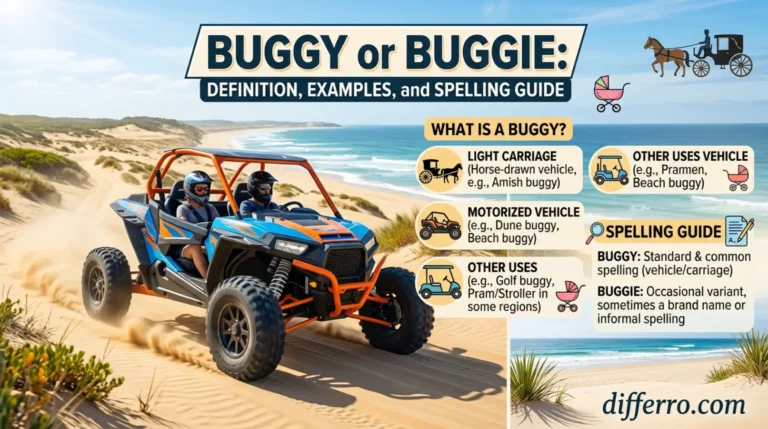
Buggy or Buggie is a common spelling confusion in English. The standard spelling is buggy. It can describe a baby carriage, a small vehicle, or a horse-drawn carriage. It can also describe software that contains errors.
Buggie appears occasionally in informal writing, names, nicknames, and nonstandard usage. However, it is not the normal spelling for the common English word. For school, work, websites, and formal writing, choose buggy.
The confusion often comes from pronunciation. Both spellings may look like they could represent the same sound. English spelling does not always match pronunciation perfectly.
The safest rule is simple: use “buggy” for standard English.
⭐ Quick Answer
Buggy is the standard and widely accepted spelling. Buggie is uncommon and usually appears as an informal or nonstandard spelling.
Example:
✅ The baby is sleeping in her buggy.
❌ The baby is sleeping in her buggie.
📖 Meaning of Buggy
Buggy is the standard spelling.
As a noun, it can mean a small carriage or vehicle. It can also mean a baby carriage or stroller.
As an adjective, buggy can mean full of insects. It can also describe software that has programming errors.
Examples:
- She pushed the baby in a buggy.
- The new app is still buggy.
📖 Meaning of Buggie
Buggie is not the standard spelling of the common English word buggy.
You may see buggie in informal writing, usernames, names, product names, or other specialized contexts. It can also appear when someone spells the word according to how it sounds.
For standard English, buggy remains the better choice.
Examples:
- The company called its product “Buggie.”
- Buggie was used as a nickname for the character.
These examples show special usage. They do not make buggie the standard spelling of the word.
🔍 Buggy vs Buggie: Key Differences
| Feature | Buggy | Buggie |
|---|---|---|
| Meaning | Small carriage, stroller, or vehicle | Usually an informal or nonstandard spelling |
| Tone | Standard and neutral | Informal, unusual, or name-based |
| Usage | Common in everyday English | Rare in standard English |
| Popularity | Very common | Much less common |
| Formal writing | Recommended | Usually avoid |
| Plural | Buggies | Buggies may appear in special usage |
Merriam-Webster lists buggy as a noun and adjective, with buggies as its plural form.
🕰️ Origin and History of Buggy
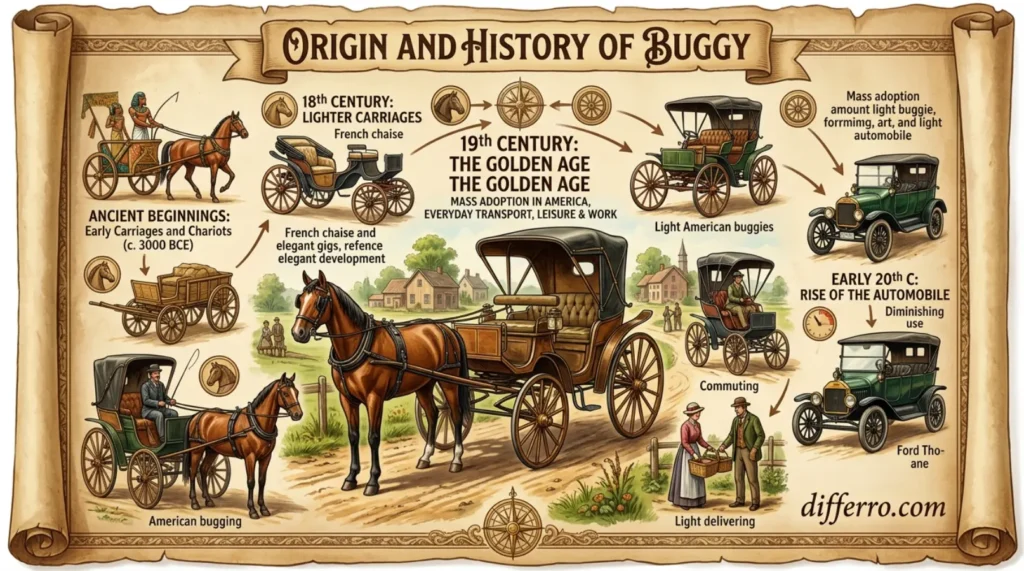
The noun buggy has been used for a small carriage since the 18th century. Merriam-Webster gives a first known use of 1758 for the noun.
The exact origin of the carriage word remains uncertain. Etymonline dates the carriage sense to 1773 and describes its origin as unknown.
The adjective buggy has a different history. It developed from bug + -y and originally described something full of bugs.
Over time, buggy developed several vehicle-related meanings.
Similar words include:
- carriage
- stroller
- pushchair
- cart
- golf buggy
- dune buggy
- horse-drawn carriage
🇬🇧 British English vs 🇺🇸 American English Spelling
Buggy is the standard spelling in both British and American English.
The meaning can differ by region. In Britain, buggy commonly refers to a baby stroller. In America, it can also mean a baby carriage, horse-drawn carriage, or small vehicle.
Buggie is not a standard UK-versus-US spelling difference like colour/color.
British vs American English Comparison
| Feature | British English | American English |
|---|---|---|
| Standard spelling | Buggy | Buggy |
| Baby carriage | Buggy | Buggy |
| Horse-drawn carriage | Buggy | Buggy |
| Small recreational vehicle | Buggy | Buggy |
| Buggie | Rare/nonstandard | Rare/nonstandard |
American Heritage also lists buggy for a baby carriage, horse-drawn carriage, and recreational vehicle.
✍️ When to Use Buggy
Use buggy when you mean the standard English word.
Baby stroller
- The baby is sitting comfortably in the buggy.
- We bought a lightweight buggy for travel.
Small vehicle
- They rented a dune buggy for the trip.
- The golf buggy stopped near the clubhouse.
Horse-drawn carriage
- The farmer traveled into town by horse and buggy.
Software with errors
- The website is still buggy after the update.
✍️ When to Use Buggie
Use buggie only when it is intentionally used as a name, nickname, brand, character name, or special spelling.
For example:
- Buggie is the name of their new toy.
- The character is called Buggie.
Avoid buggie when you simply mean the normal English word.
For example:
❌ She bought a new buggie for her baby.
✅ She bought a new buggy for her baby.
⚠️ Common Mistakes
Mistake 1: Using Buggie as the standard spelling
❌ We need a new buggie.
✅ We need a new buggy.
Mistake 2: Treating Buggie as a UK spelling
❌ Buggie is British English.
✅ Buggy is used in both British and American English.
Mistake 3: Using Buggie in formal writing
❌ The report discusses modern baby buggies.
✅ The report discusses modern baby buggies.
Mistake 4: Confusing the plural form
❌ We bought two buggy.
✅ We bought two buggies.
The standard plural of buggy is buggies.
🧠 Easy Trick to Remember
Think of the word bug.
Bug + y = buggy
The standard spelling ends in -y, not -ie.
A quick memory rule is:
A small vehicle is a buggy, not a buggie.
🌎 Everyday Life Examples
1. Baby Stroller
The parents placed their sleeping baby in the buggy.
Here, buggy means a baby stroller.
2. Golf Course
We used a golf buggy to travel around the course.
Here, buggy means a small golf vehicle.
3. Outdoor Adventure
The tourists drove a dune buggy across the sandy trail.
Here, buggy means a lightweight off-road vehicle.
4. Horse and Carriage
The family arrived in an old horse and buggy.
Here, buggy means a horse-drawn carriage.
5. Computer Software
The new application is buggy and needs more testing.
Here, buggy means the software contains errors.
📊 Google Trends & Usage Data: USA, UK, Australia, India, and Pakistan
Google Trends can show relative search interest, but it does not provide a universal count of searches. Search interest also changes over time.
Across these five markets, buggy is the stronger standard term. Dictionary evidence also supports buggy as the established English form.
The strongest practical SEO choice is buggy, while buggie works mainly as a secondary spelling query.
For content targeting the USA, UK, Australia, India, and Pakistan, use buggy as the primary keyword. Mention buggie naturally to capture spelling-confusion searches.
Keyword Variations Comparison
| Keyword | Recommended Use | Search Intent |
|---|---|---|
| Buggy or Buggie | Primary | Spelling comparison |
| Buggy vs Buggie | Primary | Comparison |
| Is Buggy or Buggie correct | Secondary | Spelling question |
| Buggy meaning | Secondary | Definition |
| Buggie meaning | Secondary | Definition |
| Correct spelling of buggy | Secondary | Grammar/spelling |
| Buggy plural | Secondary | Grammar |
⚖️ Final Verdict: Buggy or Buggie?
Buggy is the correct standard spelling for normal English writing.
Use buggy for baby strollers, small vehicles, horse-drawn carriages, and software containing errors.
Buggie is much less common. It may appear in names, nicknames, brands, or informal writing.
For SEO, education, business writing, and formal content, buggy is the better choice.
If you are unsure, remember this simple rule:
Choose “buggy” unless “Buggie” is intentionally part of a name or special spelling.
❓ FAQ
Is “buggy” or “buggie” correct?
Buggy is the standard spelling in English. Buggie is uncommon and usually does not replace the standard form.
What is the difference between buggy and buggie?
Buggy is the established English word. Buggie is generally an informal, unusual, or name-based spelling.
Which is more common, buggy or buggie?
Buggy is much more common in standard English. Major dictionaries list buggy as the established word.
Is buggy formal English?
Yes. Buggy is suitable for formal and informal writing when the context requires the word.
Why does the buggy or buggie confusion exist?
The confusion mainly comes from pronunciation. The ending can sound similar to spellings ending in -ie. Informal writing can also create alternative spellings.
📝 Conclusion
Buggy or Buggie can cause confusion, but the standard choice is clear. Buggy is the established English spelling. It can describe a baby stroller, horse-drawn carriage, golf vehicle, dune vehicle, or software with errors.
Buggie is much less common in standard English. You may encounter it in names, nicknames, brands, or informal writing. It should not normally replace buggy in formal content.
The spelling is the same in British and American English. Regional differences mainly involve meaning and usage.
For schoolwork, professional writing, websites, and SEO content, choose buggy. If you remember one rule, make it this: use “buggy” as the standard spelling.

Imran Lodhra is a comparison-focused content writer at Differro.com.
He specializes in creating clear, simple, and informative comparison articles.
His work helps readers understand key differences, pros and cons, and important details.
Imran focuses on accurate, practical, and easy-to-read content for everyday readers.