
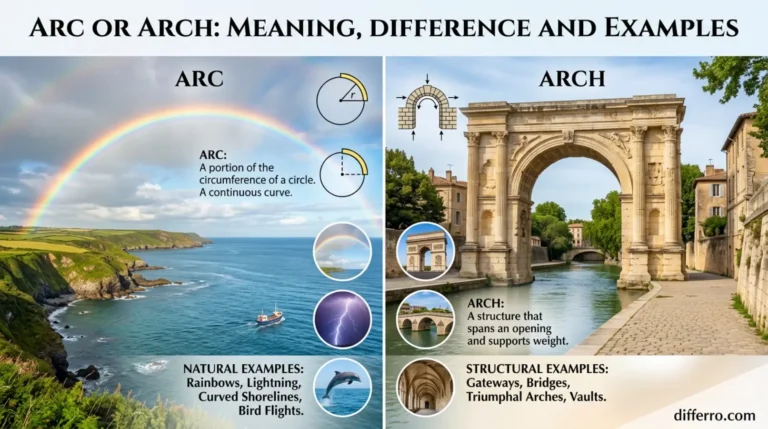
Arc or Arch can be confusing because both words describe something curved. However, they are not interchangeable in standard English. Arc usually means a curved line, part of a circle, curved path, or a story development. Arch usually means a curved structure over an opening or a raised curved shape. (Cambridge Dictionary)
The difference becomes easy once you connect each word with its common uses. You say “a circular arc” in geometry, but “a stone arch” for a structure. You also say “character arc” when discussing a character’s development. Meanwhile, “foot arch” describes the curved part under your foot. This guide explains Arc or Arch, their meanings, history, usage, common mistakes, and easy memory tricks.
⭐ Quick Answer
Arc and arch are both correct words, but they have different meanings.
Use arc for a curved line, circle section, path, or story development. Use arch for a curved structure or raised curved shape.
Example: The rainbow formed an arc, while the old bridge had a stone arch.
📖 Meaning of Arc
Arc is a noun and verb related to a curve or curved path. In geometry, an arc is part of a curved line, especially part of a circle. It can also describe a curved movement, electrical discharge, or story development. (American Heritage Dictionary)
Examples of Arc
- The moon followed a wide arc across the sky.
- The character’s emotional arc changed throughout the movie.
Common phrases:
- circular arc
- arc of a circle
- character arc
- story arc
- narrative arc
- electric arc
📖 Meaning of Arch
Arch usually describes a curved structure that spans an opening. It can also describe a curved shape, the raised part of the foot, or an action that creates a curved shape. (Cambridge Dictionary)
Examples of Arch
- We walked through the stone arch.
- She has a high arch in her foot.
Common phrases:
- stone arch
- arch bridge
- doorway arch
- foot arch
- arched window
- arch your back
🔎 Arc or Arch: Key Differences
| Feature | Arc | Arch |
|---|---|---|
| Meaning | A curve, curved line, or curved path | A curved structure or raised shape |
| Main use | Geometry, movement, stories, electricity | Buildings, feet, shapes, body movement |
| Tone | General and technical | General and structural |
| Common phrase | Character arc | Stone arch |
| Popularity | Very common | Very common |
| Example | An arc of a circle | An arch over a doorway |
📜 Origin & History
Arc comes from Middle English ark, through Old French arc, from Latin arcus, meaning a bow or curved object. (American Heritage Dictionary)
Arch entered English through Middle English and Anglo-French forms. Its history also connects with the Latin word arcus, meaning a bow. Merriam-Webster records its first known English use in the 13th century. (Merriam-Webster)
These related origins help explain why arc and arch have similar meanings in some contexts.
Similar Word Examples
- arc → curved line
- arch → curved structure
- curve → rounded line or shape
- bow → curved shape
- bend → change direction into a curve
🇬🇧 British English vs American English Spelling
There is no major British-American spelling difference between arc and arch.
Both varieties use arc and arch with the same spellings.
The main difference can appear in pronunciation, not spelling. (Cambridge Dictionary)
British vs American English
| Word | British English | American English |
|---|---|---|
| Arc | arc | arc |
| Arch | arch | arch |
| Character arc | character arc | character arc |
| Stone arch | stone arch | stone arch |
| Circular arc | circular arc | circular arc |
✍️ When to Use Arc
✮Use arc when you mean a curved line, part of a circle, curved movement, or development over time.
Use Arc for Geometry
- The angle cuts across the arc of the circle.
- Draw an arc between these two points.
Use Arc for Stories
- The hero has an interesting character arc.
- Her emotional arc drives the story.
✮Use Arc for Movement
- The ball traveled in a high arc.
- The bird flew in a graceful arc.
Use Arc for Electricity
- The damaged wires created an electrical arc.
🏛️ When to Use Arch
♥︎Use arch when you mean a curved structure, curved body shape, or raised part of the foot.
Use Arch for Buildings
- The doorway has a beautiful stone arch.
- Workers repaired the old arch bridge.
Use Arch for Feet
- Running shoes should support your foot arch.
- She has a naturally high arch.
♥︎Use Arch as a Verb
- The cat began to arch its back.
- The trees arched over the pathway.
⚠️ Common Mistakes
1. Saying “character arch”
❌ The hero has a powerful character arch.
✅ The hero has a powerful character arc.
2. Saying “stone arc”
❌ The workers built a stone arc over the entrance.
✅ The workers built a stone arch over the entrance.
3. Saying “foot arc”
❌ These shoes provide excellent foot arc support.
✅ These shoes provide excellent foot arch support.
4. Saying “arc of a doorway”
❌ We walked through the arc.
✅ We walked through the arch.
5. Confusing a curved line with a structure
❌ Draw an arch from one point of the circle to another.
✅ Draw an arc from one point of the circle to another.
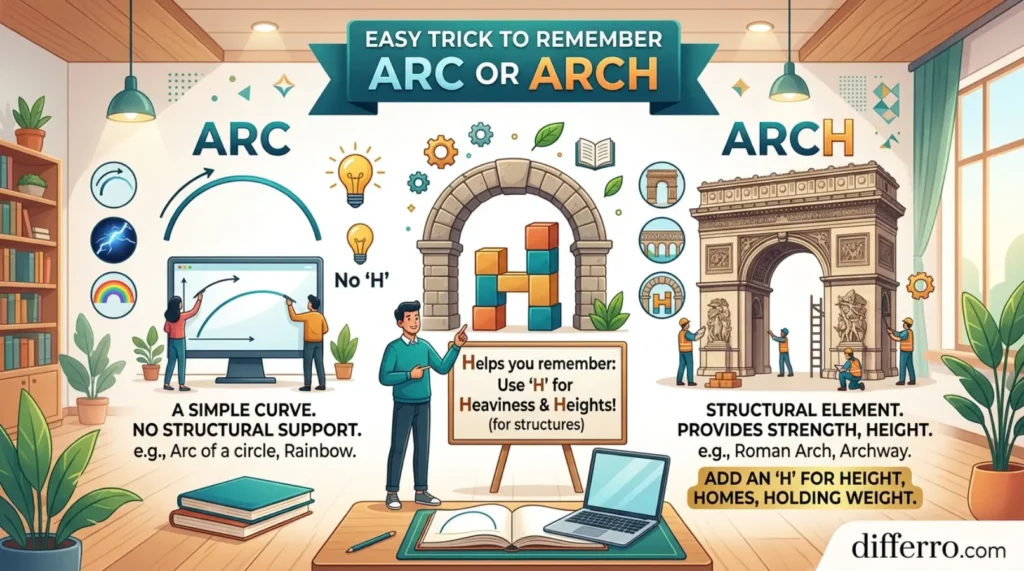
🧠 Easy Trick to Remember Arc or Arch
Use this simple rule:
ARC = Curve
Think of a circle. An arc can be part of that circle.
ARCH = Structure
Think of a doorway or bridge. An arch often supports or spans an opening.
Quick Memory Formula
Arc → Circle, Story, Path
Arch → Doorway, Foot, Structure
This simple distinction will help you choose the right word quickly.
🌎 Everyday Life Examples of Arc or Arch
1. Architecture
The entrance featured a large stone arch.
The word arch fits because the structure spans the doorway.
2. Mathematics
The teacher asked students to measure the arc of the circle.
Here, arc refers to part of a curved line.
3. Movies and Books
The main character has a dramatic arc.
This describes the character’s development throughout the story.
4. Fitness and Shoes
These shoes offer better support for your foot arch.
Here, arch refers to the curved area underneath the foot.
5. Nature and Movement
The rainbow formed a bright arc across the sky.
The word arc describes the curved shape.
📊 Google Trends & Usage Data: USA, UK, Australia, India & Pakistan
Search interest for arc and arch varies because people search these words for different topics.
Arc has broad usage across mathematics, technology, electricity, stories, and science. Arch appears strongly in architecture, anatomy, footwear, and general descriptions of curved structures.
The terms are therefore not direct competitors in everyday language. Search context matters more than spelling preference.
For SEO, targeting “Arc or Arch”, “Arc vs Arch”, and “difference between arc and arch” captures users who are actively confused about the two words.
Country Comparison
| Country | Common Search Context | SEO Insight |
|---|---|---|
| 🇺🇸 USA | Stories, science, geometry, architecture | Strong mixed-intent potential |
| 🇬🇧 UK | Architecture, education, geometry | Useful comparison keyword |
| 🇦🇺 Australia | Construction, education, general English | Good informational intent |
| 🇮🇳 India | English learning, grammar, education | Strong spelling/meaning intent |
| 🇵🇰 Pakistan | English learning, grammar, education | Strong comparison intent |
Important: Google Trends interest changes over time and depends on the exact search term, category, location, and date range. The table above gives an SEO interpretation rather than claiming fixed search-volume numbers.
📋 Comparison Table: Keyword Variations
| Keyword Variation | Search Intent | Best Content Angle |
|---|---|---|
| Arc or Arch | Spelling/meaning confusion | Direct comparison |
| Arc vs Arch | Comparison | Difference guide |
| Difference between Arc and Arch | Educational | Detailed explanation |
| Arc meaning | Definition | Word meaning |
| Arch meaning | Definition | Word meaning |
| Is it Arc or Arch? | Grammar confusion | Quick answer |
| Arc and Arch difference | Educational | Examples and usage |
❓ FAQ: Arc or Arch
Is “arc” correct?
Yes. Arc is a correct English word. It describes a curved line, part of a circle, curved path, or development in a story. (Merriam-Webster)
What is the difference between arc and arch?
An arc usually describes a curve or curved path. An arch usually describes a curved structure or raised curved shape.
Which is more common, arc or arch?
Both are common words. Their frequency depends heavily on context. Arc appears often in mathematics, science, technology, and storytelling. Arch appears often in architecture, anatomy, and construction.
Is arc or arch more formal?
Neither word is simply more formal. Both work in formal and everyday English. The correct choice depends on the meaning.
Why does arc or arch cause confusion?
The words have related historical roots and both describe curved forms. Their similar meanings can make them seem interchangeable, but their modern uses differ.
🏆 Final Verdict: Arc or Arch?
Arc and arch are both correct, but they are used differently.
Choose arc for a curved line, part of a circle, curved path, electrical discharge, or story development.
Choose arch for a curved structure, doorway, bridge, foot shape, or an action that creates an arch shape.
The easiest rule is:
Arc = curve, path, or story development.
Arch = structure, foot shape, or curved form.
So, write “character arc,” “circular arc,” and “arc of movement.” Write “stone arch,” “foot arch,” and “arched doorway.”
📝 Conclusion
Arc or Arch is not really a spelling choice. Both words are correct, but they have different meanings and uses. Arc generally describes a curved line, part of a circle, curved path, electrical discharge, or story development. Arch usually describes a curved structure over an opening or a raised curved shape. The words share related historical roots, which partly explains their similarity. Remember the simple trick: arc means curve, while arch means structure or raised shape. This rule works for most everyday situations. Use character arc for storytelling and stone arch for architecture. Once you connect each word with its common examples, choosing between arc and arch becomes much easier.

Imran Lodhra is a comparison-focused content writer at Differro.com.
He specializes in creating clear, simple, and informative comparison articles.
His work helps readers understand key differences, pros and cons, and important details.
Imran focuses on accurate, practical, and easy-to-read content for everyday readers.