


Lyed or Lied is a common spelling confusion that many English learners face. People often wonder whether the past tense of “lie” is spelled as lyed or lied.
The confusion happens because many English verbs form their past tense by adding “-ed.” However, English has several irregular verbs that follow different rules.
If you have ever written “lyed” in an email, essay, or social media post, you are not alone. Many native and non-native speakers make the same mistake.
Understanding the correct spelling can improve your writing and help you avoid grammar errors.
In this guide, you will learn the meaning of both words, their differences, correct usage, history, common mistakes, and easy memory tricks.
⭐ Quick Answer
“Lied” is the correct past tense of the verb “lie” (to tell an untruth). “Lyed” is not a standard English word and is considered incorrect.
Example:
✅ He lied about his age.
❌ He lyed about his age.
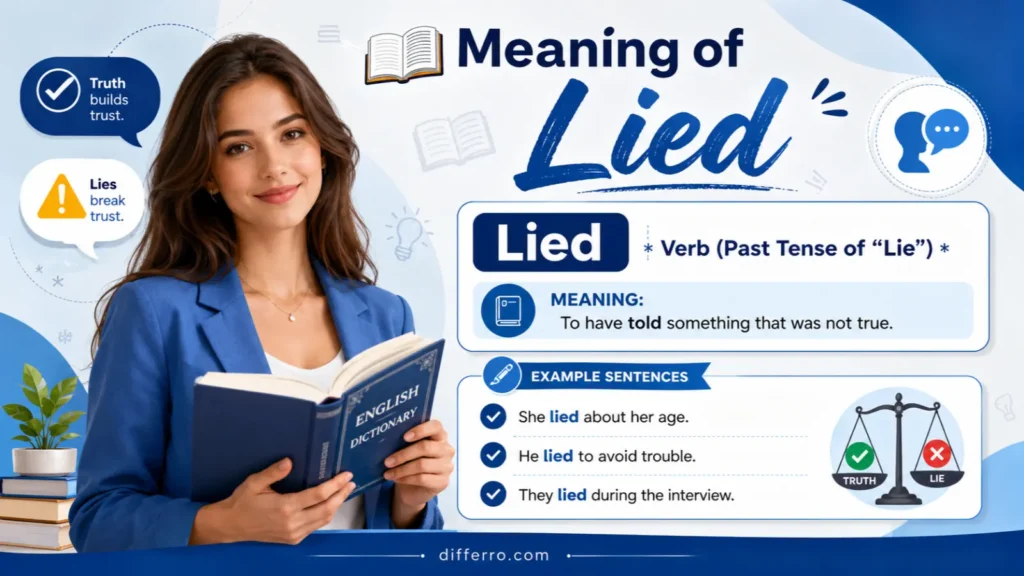
Meaning of Lied
Lied is the past tense and past participle of the verb lie, meaning to say something that is not true.
Examples:
- She lied to her parents about where she went.
- The witness lied during the interview.

Meaning of Lyed
Lyed is not recognized as a correct English word in modern standard English.
Examples:
- ❌ He lyed about the accident.
- ❌ They lyed to avoid trouble.
Key Differences Between Lyed and Lied
| Feature | Lyed | Lied |
|---|---|---|
| Meaning | No accepted meaning | Past tense of lie |
| Correct Spelling | No | Yes |
| Usage | Incorrect | Correct |
| Tone | Grammatical error | Standard English |
| Popularity | Rare mistake | Widely used |
Origin & History
The verb lie comes from Old English lēogan, meaning “to speak falsely.”
Over time, English developed irregular verb forms. Instead of becoming “lyed,” the word evolved into lied.
Similar Examples:
- Lie → Lied
- Cry → Cried
- Tie → Tied
- Fry → Fried
British English vs American English Spelling
There is no spelling difference between British English and American English for the word lied.
Both use:
✔ Lied
✘ Lyed
| English Version | Correct Form |
|---|---|
| British English | Lied |
| American English | Lied |
| Australian English | Lied |
| Canadian English | Lied |
When to Use Lied
Use lied when talking about someone telling something untrue in the past.
Examples:
- He lied about his qualifications.
- They lied to the police.
- She lied to protect her friend.
When to Use Lyed
Do not use lyed in any writing.
Incorrect:
- She lyed to me.
- They lyed yesterday.
Correct:
- She lied to me.
- They lied yesterday.
Common Mistakes
Mistake 1
Incorrect: He lyed about his job.
Correct: He lied about his job.
Mistake 2
Incorrect: She has lyed before.
Correct: She has lied before.
Mistake 3
Incorrect: They lyed during the meeting.
Correct: They lied during the meeting.
Mistake 4
Incorrect: I lyed to avoid trouble.
Correct: I lied to avoid trouble.
Easy Trick to Remember
“Lie becomes Lied, just like Tie becomes Tied.”
Write 5 Examples
Example 1
The student lied about homework.
Example 2
An employee lied about arriving late.
Example 3
She lied about the gift.
Example 4
He lied on social media.
Example 5
The player lied about the rules.
Related Keywords
- lied meaning
- lyed or lied
- lie past tense
- is lyed a word
- correct spelling of lied
- lied definition
Final Verdict
Lied is correct.
Lyed is incorrect and should never be used.
FAQ
Is it correct to write “lyed”?
No, it is incorrect.
What is the difference between lyed and lied?
“Lied” is correct; “lyed” is wrong.
Which is more common?
Lied is far more common.
Is lied formal?
Yes, it is standard English.
Why is there confusion?
Because many think it follows regular “-ed” rules.
Conclusion
The confusion between lyed or lied is common, but the correct answer is simple. Lied is the only correct form used in English grammar. It is the past tense of the verb lie, meaning to tell an untruth. The spelling lyed is incorrect and should be avoided in all writing. Learning this difference improves grammar accuracy and helps you write more confidently. Always remember the pattern “tie → tied” and “lie → lied” to avoid mistakes in the future.

