

Lies or Lyes is a common spelling confusion that many English learners and writers face. At first glance, both words may seem correct because they sound similar. However, only one of them is commonly accepted in standard English.
Understanding the difference between lies and lyes can help you avoid spelling mistakes in writing, school assignments, emails, and professional communication. While lies is a widely used English word with multiple meanings, lyes is much less common and appears only in specific contexts.
In this guide, you’ll learn the meaning of each word, their differences, usage examples, history, and when to use the correct spelling. By the end, you’ll know exactly which word fits your sentence and why.
⭐ Quick Answer
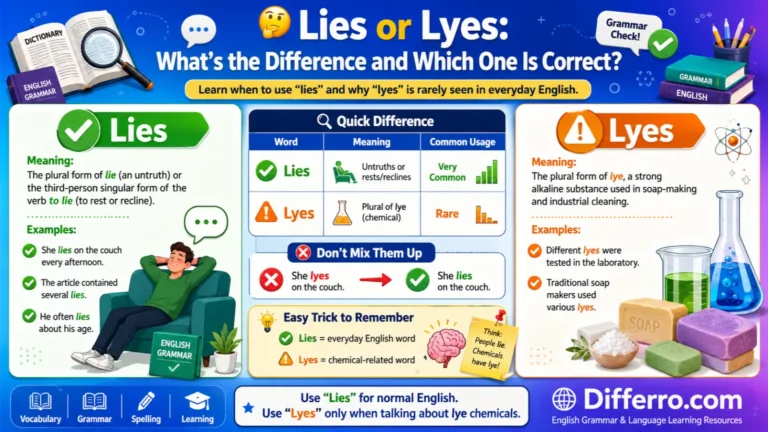
“Lies” is the correct and commonly used English word. It can mean false statements or the third-person form of “lie” (to rest). “Lyes” is the plural form of lye, a strong alkaline chemical used in cleaning and soap-making.
Example:
- She lies about her age. ✅
- The soap contains different lyes. ✅
Meaning of Lies
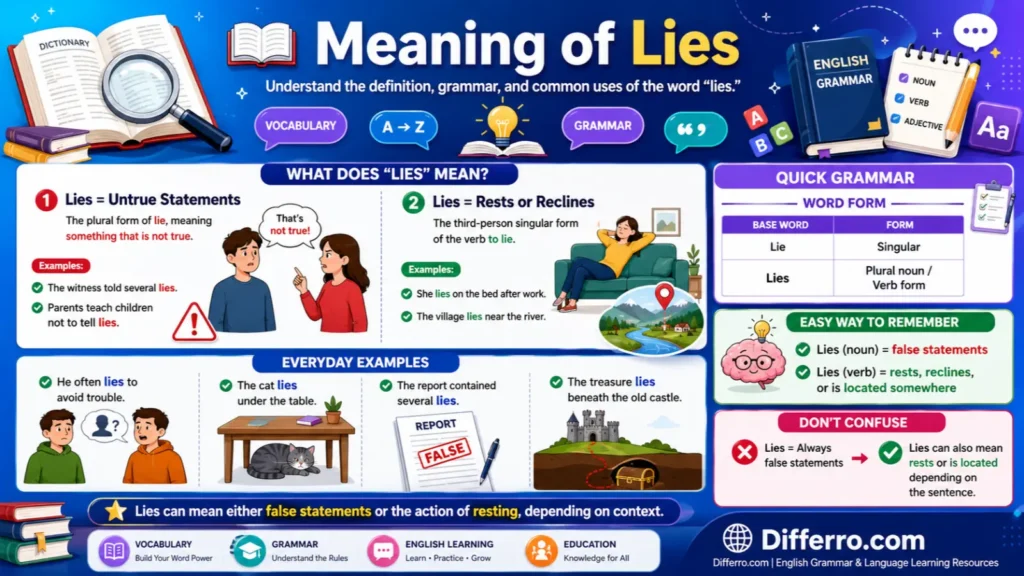
Lies has two common meanings:
- False statements or untruths.
- The third-person singular form of the verb lie (to recline or rest).
Examples
- He told several lies during the interview.
- The cat lies on the sofa every afternoon.
Meaning of Lyes
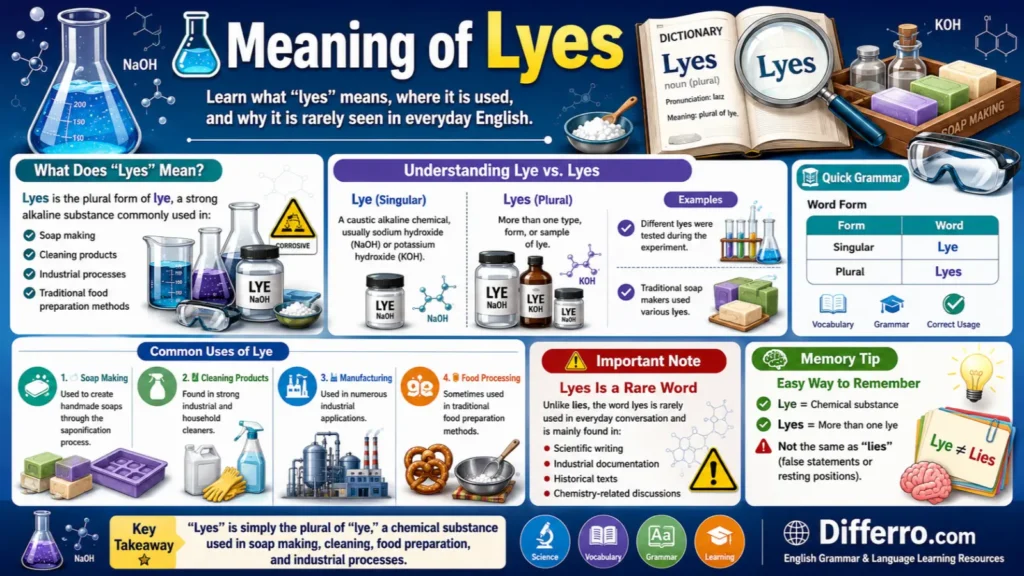
Lyes is the plural form of lye, a chemical substance used in cleaning products and soap production.
Examples
- Different lyes are used in industrial manufacturing.
- Chemists study various types of lyes for specific applications.
Key Differences Between Lies and Lyes
| Feature | Lies | Lyes |
|---|---|---|
| Meaning | False statements or rests/reclines | Plural of lye (chemical) |
| Tone | Everyday English | Technical or scientific |
| Usage | Very common | Rare |
| Popularity | Extremely high | Very low |
| Context | Communication, behavior, actions | Chemistry, manufacturing |
📜 Origin & History
The word lies comes from Old English and has been used for centuries to describe untruths or a resting position.
The word lye comes from ancient Germanic languages and refers to alkaline solutions made from ashes and water.
Similar Word Examples
- Dye → Dyes
- Fly → Flies
- Cry → Cries
- Lye → Lyes
British English vs American English Spelling
Unlike many English words, lies and lyes are not British versus American spelling variations. Both British and American English use lies in the same way. The word lyes remains a specialized plural noun in both versions of English.
Comparison Table: British vs American English
| Feature | British English | American English |
|---|---|---|
| Lies | Correct | Correct |
| Lyes | Correct (chemical plural) | Correct (chemical plural) |
| Everyday Usage | Lies | Lies |
| Preferred Form | Lies | Lies |
When to Use Each Word
Use “Lies”
Use lies when talking about:
- False statements
- Deception
- Someone resting or reclining
Examples
- She lies whenever she gets nervous.
- The book lies on the table.
- His story was full of lies.
Use “Lyes”
Use lyes only when discussing:
- Chemistry
- Soap making
- Industrial cleaning substances
Examples
- Manufacturers use different lyes in production.
- The laboratory tested several lyes.
❌ Common Mistakes
Mistake 1
Incorrect: He tells many lyes.
Correct: He tells many lies.
Mistake 2
Incorrect: The dog lyes near the fireplace.
Correct: The dog lies near the fireplace.
Mistake 3
Incorrect: She always lyes to her parents.
Correct: She always lies to her parents.
Mistake 4
Incorrect: These lies are used in soap making.
Correct: These lyes are used in soap making.
🧠 Easy Trick to Remember
Remember this simple tip:
Lies = Life and Language
If you’re talking about people, stories, truth, or resting, use lies.
Lyes = Laboratory
If you’re talking about chemicals or soap making, use lyes.
✍️ Write 5 Examples
1. Everyday Conversation
She often lies when she feels embarrassed.
2. At School
Teachers encourage students to avoid telling lies.
3. At Home
The dog lies beside the door every evening.
4. In Manufacturing
Factories use different lyes for cleaning processes.
5. In Chemistry Labs
Scientists compare various lyes for industrial applications.
🔍 Related Keywords
- lies meaning
- lyes meaning
- lies vs lyes
- difference between lies and lyes
- correct spelling lies or lyes
- lies definition
- lyes chemical meaning
📈 Google Trends & Usage Data (USA, UK, AUS, IND, PAK)
Across the USA, UK, Australia, India, and Pakistan, lies receives significantly more searches than lyes. Most searches involve grammar, spelling, and word meanings. The term lyes appears mainly in chemistry-related searches. This shows that lies is the dominant and more relevant keyword for everyday English users.
Comparison Table: Keyword Variations
| Keyword Variation | Usage Level |
|---|---|
| Lies | Very High |
| Lies Meaning | High |
| Lies vs Lyes | Medium |
| Difference Between Lies and Lyes | Medium |
| Lyes Meaning | Low |
| Lyes Chemical Definition | Low |
| Correct Spelling Lies or Lyes | Medium |
✅ Final Verdict
Lies is the correct word for most situations. Use it when talking about false statements or someone resting. Lyes is only correct when referring to multiple forms of the chemical lye. For everyday writing and communication, lies is almost always the word you need.
❓ FAQ
1. Is “lyes” a correct word?
Yes. It is the plural form of lye, a chemical substance.
2. What is the difference between lies and lyes?
Lies relates to untruths or resting. Lyes refers to chemical compounds.
3. Which is more common, lies or lyes?
Lies is far more common in everyday English.
4. Which word is used in formal writing?
Lies is commonly used in formal and informal writing. Lyes appears mainly in technical documents.
5. Why does the confusion exist?
The confusion exists because the words look and sound similar but have completely different meanings.
Conclusion
The confusion between lies or lyes is easy to understand because the words look similar. However, their meanings are very different. Lies is a common English word used for false statements or describing someone resting. Lyes, on the other hand, is the plural form of lye, a chemical used in soap making and industrial processes. In everyday conversations, emails, schoolwork, and professional writing, lies is usually the correct choice. Understanding this distinction helps improve spelling accuracy and communication clarity. Whenever you encounter these words, think about the context. If it involves truth, stories, or resting, use lies. If it involves chemicals, use lyes.

