

Wintry or wintery is a common spelling confusion that many English learners and writers face. Both words look similar and seem to describe cold winter weather.
Because they appear in books, blogs, and online content, people often wonder which spelling is correct.
The confusion happens because English contains many words with spelling variations. Some words have accepted alternatives, while others have one preferred spelling.
When it comes to wintry or wintery, understanding the difference can help you write more accurately.
Many people search for this topic when writing essays, articles, weather reports, or social media posts.
They want to know which spelling sounds more natural and which one dictionaries recommend.
In this guide, you’ll learn the meanings of both words, their history, usage differences, common mistakes, and the correct spelling to use in modern English.
⭐ Quick Answer
Wintry is the standard and preferred spelling in modern English. It means having characteristics of winter, such as cold temperatures, snow, or icy conditions.
Wintery is an alternative spelling that is less common but still recognized by some dictionaries.
Examples:
✅ The mountains looked wintry after the snowfall.
✅ A wintry wind swept across the town.
Meaning of Wintry
Wintry means relating to winter or having the characteristics of winter.
Examples:
- The forecast predicts wintry weather tomorrow.
- A wintry landscape covered the countryside.
Meaning of Wintery
Wintery has the same meaning as wintry. However, it is simply a less common spelling variant.
Examples:
- The air felt wintery and cold.
- The hills appeared wintery after the storm.
Key Differences Table
| Feature | Wintry | Wintery |
|---|---|---|
| Meaning | Like winter | Like winter |
| Tone | Standard | Alternative |
| Usage | Most common | Less common |
| Popularity | Very high | Lower |
| Preferred by dictionaries | Yes | Sometimes |
Origin & History
The word comes from winter, which has roots in Old English winter. Over time, the adjective wintry developed by adding the suffix -y and simplifying the spelling.
Many English adjectives follow similar patterns:
- Mist → Misty
- Frost → Frosty
- Cloud → Cloudy
Unlike those words, winter became wintry rather than keeping all its letters.
British English vs American English Spelling
Both British English and American English generally prefer wintry. There is no major regional spelling difference. However, wintery occasionally appears in informal writing.
Comparison Table: British vs American English
| Usage | British English | American English |
|---|---|---|
| Preferred spelling | Wintry | Wintry |
| Alternative spelling | Wintery | Wintery |
| Formal writing | Wintry | Wintry |
| Dictionaries | Mostly wintry | Mostly wintry |
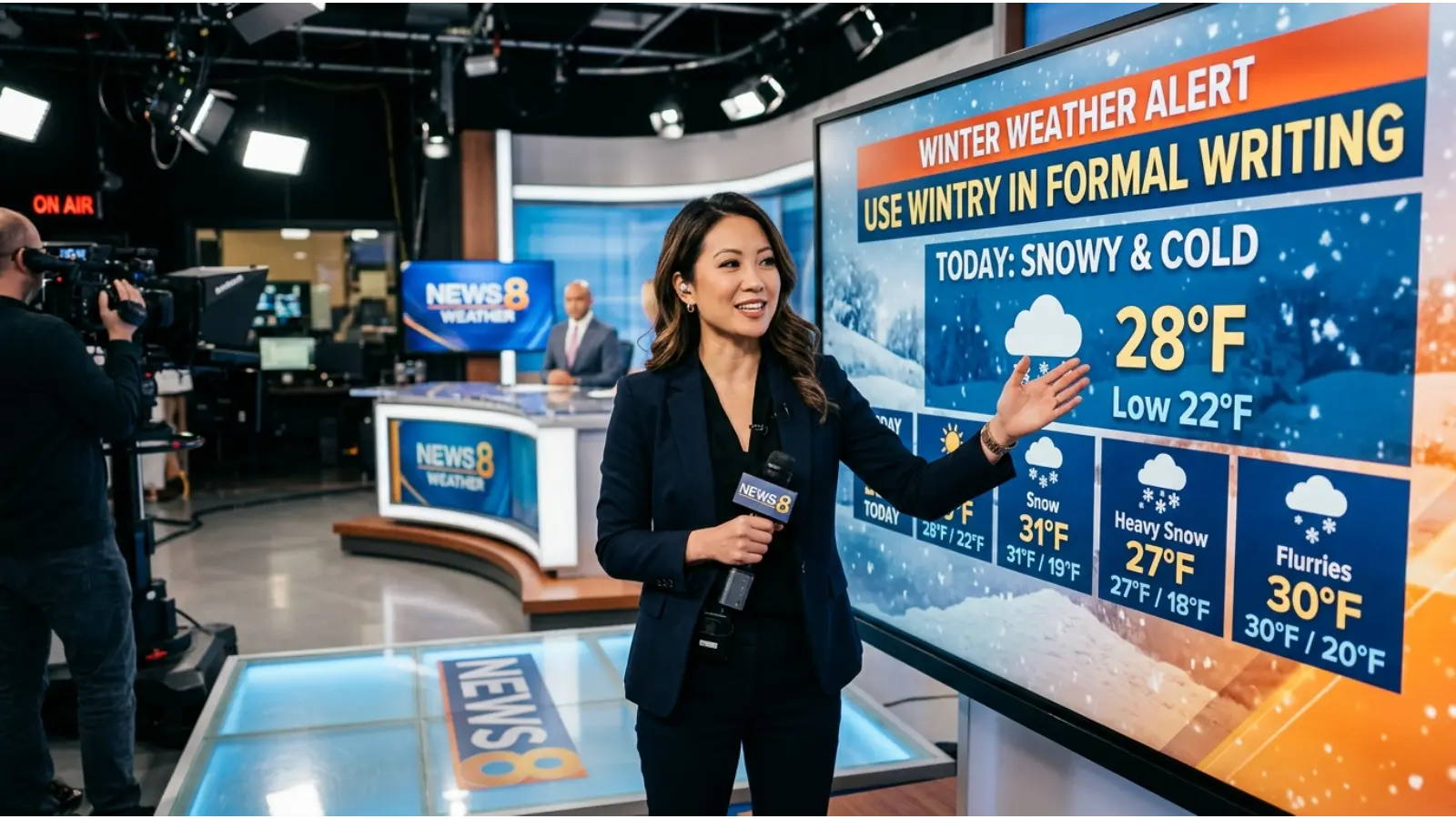
When to Use Wintry
Use wintry in:
- Formal writing
- Academic content
- News articles
- Weather reports
- Professional communication
Examples
- A wintry storm is approaching.
- The city experienced wintry conditions.
When to Use Wintery
Use wintery only when following a specific style guide or personal preference.
Examples
- The evening felt wintery despite being autumn.
- Some writers prefer the spelling wintery.
Common Mistakes
❌ Incorrect:
The weather looks wintery according to most dictionaries.
✔ Correct:
The weather looks wintry according to most dictionaries.
❌ Incorrect:
Wintry and wintery are always equally preferred.
✔ Correct:
Wintry is generally preferred.
❌ Incorrect:
Wintery is the only correct spelling.
✔ Correct:
Wintry is the standard spelling.
❌ Incorrect:
Use wintery in all formal documents.
✔ Correct:
Use wintry in formal documents.
Easy Trick to Remember
Think of the phrase:
“Wintry wins.”
The shorter spelling is the one most dictionaries and writers prefer.
Write 5 Examples
1. Weather Forecast
The forecast predicts wintry conditions this weekend.
2. Travel Report
Drivers should prepare for wintry roads.
3. School Essay
The author described a beautiful wintry scene.
4. Social Media Post
The mountains look so wintery today.
5. News Headline
A powerful wintry storm affected several states.
Final Verdict
If you are unsure which spelling to choose, use wintry. It is the standard, more common, and widely accepted form in modern English. While wintery is not necessarily wrong, it appears less frequently and is usually considered an alternative spelling.
Google Trends & Usage Data
Google search data consistently shows that wintry is searched and used more often than wintery. Most dictionaries, publishers, and educational websites prefer the shorter spelling.
Usage Insights
USA: Wintry dominates weather reporting.
UK: Wintry is the preferred form.
Australia: Wintry appears more often in publications.
India: Wintry is favored in educational content.
Pakistan: Wintry is more commonly taught and used.
Comparison Table: Keyword Variations
| Variation | Usage |
|---|---|
| Wintry | Standard |
| Wintery | Alternative |
| Wintry weather | Common |
| Wintry conditions | Common |
| Wintery weather | Less common |
FAQs
Is wintry or wintery correct?
Both exist, but wintry is the preferred spelling.
What is the difference between wintry and wintery?
There is no meaning difference. The main difference is usage frequency.
Which spelling is more common?
Wintry is much more common.
Which spelling should I use in formal writing?
Use wintry.
Why does the confusion exist?
Because both spellings appear in dictionaries and online content.
Conclusion
The confusion between wintry or wintery comes from the fact that both spellings exist and share the same meaning. However, modern English strongly favors wintry. It appears more often in dictionaries, educational resources, weather reports, and professional writing.
While wintery is still recognized as an alternative spelling, it is much less common. If your goal is clear and correct writing, choosing wintry is the safest option. It looks more natural to readers and aligns with standard English usage.
A simple rule to remember is: Wintry wins. Whenever you describe cold, snowy, or winter-like conditions, use wintry for the best results.

Sara Taylor is a passionate writer and language enthusiast. She specializes in creating simple and easy-to-understand articles about English grammar, spelling differences, and commonly confused words. Her writing style focuses on helping students, writers, and English learners improve their language skills with confidence. Through informative guides and practical examples, Sara makes complex grammar topics easier for everyday readers.