
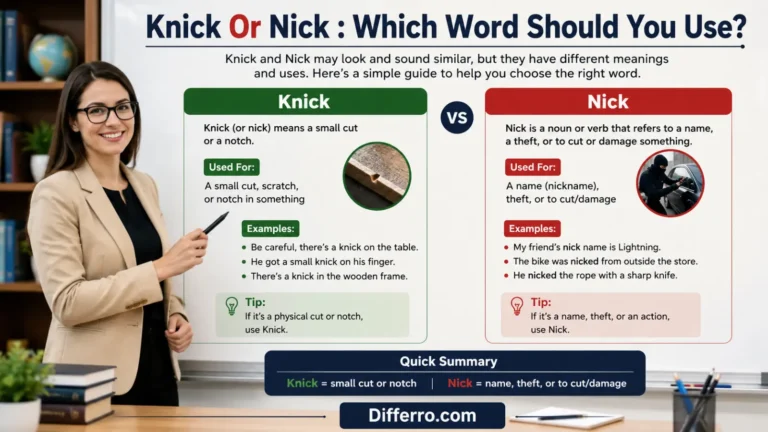
Knick Or Nick is a common word confusion in English. Many people think both words mean the same thing because they sound similar. However, they have different meanings and uses.
“Nick” is a common English word. It usually means a small cut, notch, or a nickname. “Knick” is much less common and mainly appears in special phrases like “knick-knack.”
Writers, students, and English learners often mix these words up. This happens because English spelling can be tricky. Knowing the difference helps improve writing and speaking skills.
In this guide, you will learn the meanings, examples, history, and correct usage of both words. You will also discover easy tricks to remember which spelling fits each situation.
⭐ Quick Answer
“Nick” is the correct and commonly used word in most situations. It means a small cut, notch, or nickname.
“Knick” is rare and mostly appears in words like “knick-knack.”
Example:
- Correct: I got a small nick on my finger.
- Correct: She collects old knick-knacks.
📖 Meaning of Knick
“Knick” is an uncommon English word. It usually appears in compound words like “knick-knack.”
Examples:
- My grandmother loves collecting knick-knacks.
- The shelf was full of colorful knick-knacks.
📖 Meaning of Nick
“Nick” is a common English word with several meanings.
It can mean:
- A small cut or scratch
- A notch or mark
- A short nickname
Examples:
- He got a nick while shaving.
- Nick is short for Nicholas.
📊 Key Differences Between Knick And Nick
| Feature | Knick | Nick |
|---|---|---|
| Meaning | Rare word, often in “knick-knack” | Small cut, notch, or nickname |
| Usage | Very limited | Very common |
| Tone | Decorative or old-fashioned | Everyday English |
| Popularity | Rare | Highly popular |
| Grammar Role | Noun | Noun and verb |
🏛️ Origin & History
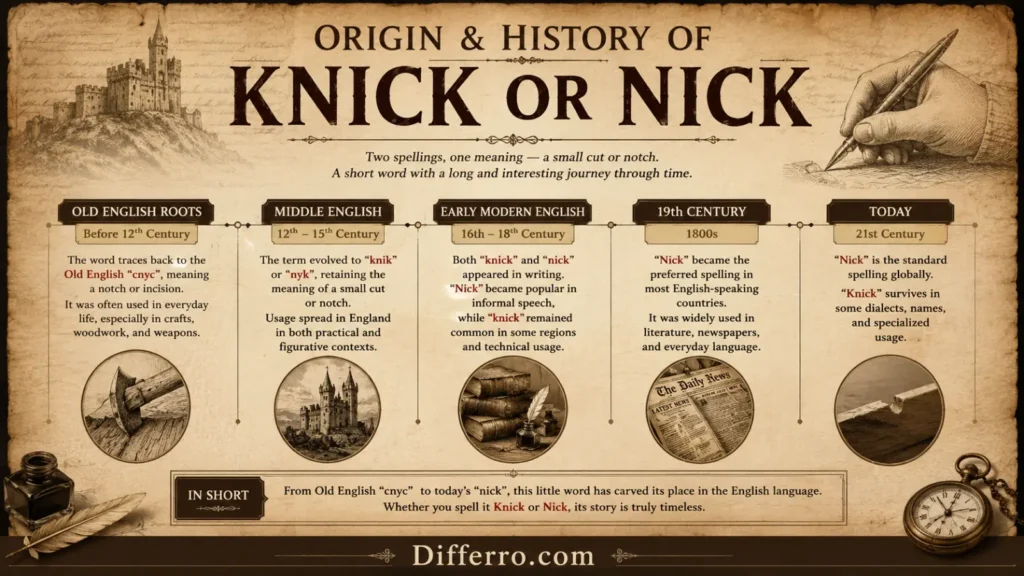
“Nick” comes from Old English and has existed for centuries. Over time, it developed several meanings related to cuts, marks, and names.
“Knick” likely developed as a variation used in decorative expressions like “knick-knack.”
Similar Word Examples:
- Tick vs Trick
- Knot vs Not
- Knight vs Night
These examples show how English contains many confusing sound-alike words.
🇬🇧 British English vs American English Spelling
Both British and American English commonly use “nick.” The spelling stays the same in both regions.
“Knick” is also spelled the same in both styles, but it appears far less often.
People in the UK sometimes use “nick” informally to mean “steal” or even “prison.”
📋 British vs American English Comparison Table
| Usage | British English | American English |
|---|---|---|
| Nick | Common | Common |
| Knick | Rare | Rare |
| Informal meaning of “nick” | Can mean steal or prison | Mostly small cut or nickname |
| Spelling difference | None | None |
✍️ When to Use “Knick”
Use “knick” mainly in decorative expressions like “knick-knack.”
Examples:
- The market sold antique knick-knacks.
- She decorated the room with tiny knick-knacks.
✍️ When to Use “Nick”
Use “nick” for:
- Small cuts
- Notches
- Nicknames
- Informal British expressions
Examples:
- I nicked my hand on the metal edge.
- His nick is Johnny.
❌ Common Mistakes
| Incorrect | Correct |
|---|---|
| I got a knick on my arm. | I got a nick on my arm. |
| Her knick is Sam. | Her nick is Sam. |
| He bought many nicks for decoration. | He bought many knick-knacks for decoration. |
| The knife left a knick in the wood. | The knife left a nick in the wood. |
🧠 Easy Trick to Remember
Remember this simple trick:
- Nick = cut or nickname
- Knick = knick-knack decoration
Think of the extra “K” in “knick” as standing for “keepsakes.”
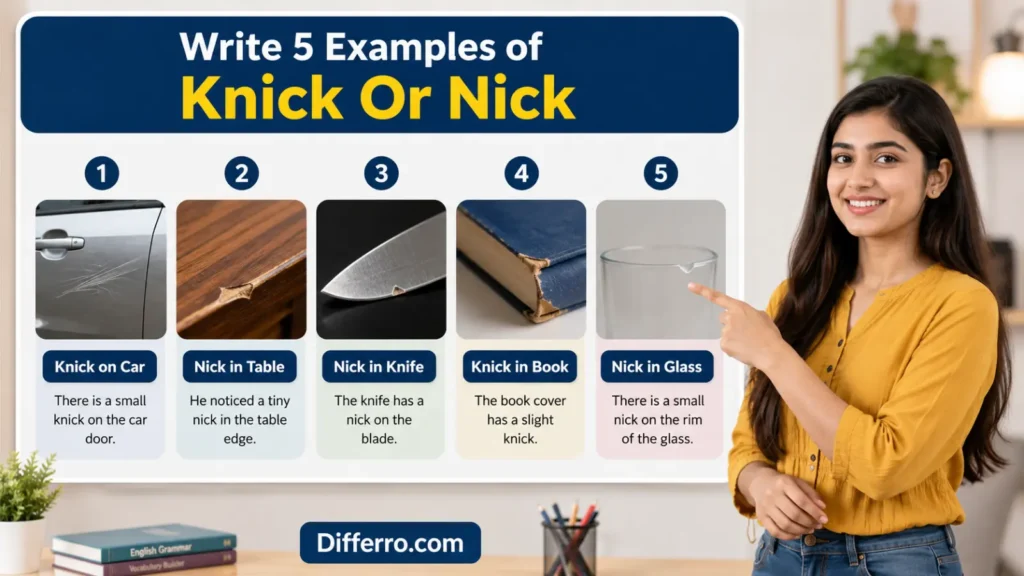
📝 Write 5 Examples
1. Small Injury Example
I got a small nick while cooking dinner.
Secondary keyword usage:
The tiny nick healed quickly.
2. Decoration Example
Her room was filled with vintage knick-knacks.
Secondary keyword usage:
The colorful knick-knacks looked beautiful.
3. Nickname Example
His friends call him Nick instead of Nicholas.
Secondary keyword usage:
That nick became popular at school.
4. Woodworking Example
The hammer left a nick on the table edge.
Secondary keyword usage:
The nick was easy to repair.
5. Antique Shop Example
The shop sold old knick-knacks from Europe.
Secondary keyword usage:
Many collectors love rare knick-knacks.
🔍 Related Keywords
- Knick vs Nick
- Nick meaning
- Knick meaning
- Nick or knick difference
- Knick-knack meaning
- Nick spelling
- Common English spelling mistakes
📈 Google Trends & Usage Data
In the USA, “nick” receives far more searches because it is widely used in daily English.
In the UK, “nick” is also popular due to informal slang meanings.
Australia follows similar usage trends to the UK.
In India and Pakistan, many learners search both words to understand the spelling confusion.
Overall, “nick” is much more common worldwide.
📊 Comparison Table: Keyword Variations
| Keyword Variation | Popularity |
|---|---|
| Nick | Very High |
| Knick | Low |
| Knick-knack | Medium |
| Nick meaning | High |
| Nick vs Knick | Medium |
| Small nick meaning | Medium |
FAQs ,
Is “nick” correct?
Yes, “nick” is the correct and common spelling in most situations.
What is the difference between knick and nick?
“Nick” means a cut, notch, or nickname. “Knick” is mainly used in “knick-knack.”
Which is more common?
“Nick” is much more common worldwide.
Is “knick” formal?
“Knick” is not usually used alone in formal writing.
Why does the confusion exist?
The confusion happens because both words sound similar.
✅ Final Verdict
Use “nick” in almost all everyday situations. It is the correct word for cuts, marks, and nicknames.
Use “knick” only in special decorative phrases like “knick-knack.”
If you are unsure, “nick” is usually the safer and more correct choice.
📝 Conclusion
Understanding the difference between Knick Or Nick is simple once you know their meanings. “Nick” is the common word used for small cuts, marks, or nicknames. It appears regularly in daily English conversations and writing.
“Knick” is much rarer and mainly appears in the phrase “knick-knack,” which describes small decorative objects.
Because the words sound alike, many people confuse them. However, their usage is very different. Learning these spelling differences helps improve grammar, writing accuracy, and communication skills.
When in doubt, choose “nick” unless you are talking about decorative collectibles or ornaments.
Discover More Post ,
Carrys Or Carries : Which Spelling Is Correct?
Honour Or Honor : Which Spelling Is Correct?
Blankey Or Blankie : Which Spelling Is Correct?

Sara Taylor is a passionate writer and language enthusiast. She specializes in creating simple and easy-to-understand articles about English grammar, spelling differences, and commonly confused words. Her writing style focuses on helping students, writers, and English learners improve their language skills with confidence. Through informative guides and practical examples, Sara makes complex grammar topics easier for everyday readers.