
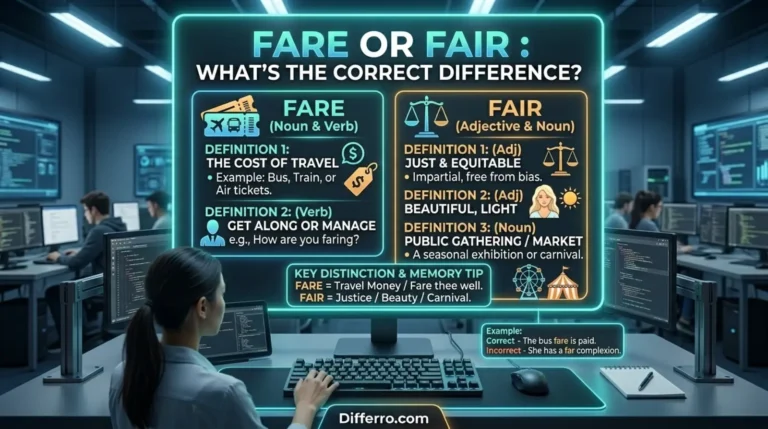
Fare or Fair is a common English confusion because both words sound the same but have different meanings. These words are examples of homophones, which are words that share pronunciation but differ in spelling and meaning.
Many writers mix them up in daily conversations, school assignments, and online content. Using the wrong word can change the meaning of a sentence completely. For example, “bus fair” is incorrect because the correct term is “bus fare.”
Understanding the difference between fare and fair improves your grammar and writing accuracy. It also helps you communicate more clearly in formal and casual situations.
In this guide, you will learn the meanings, examples, differences, usage tips, origin, and easy tricks to remember these confusing words.
⭐ Quick Answer
Fare usually relates to travel costs, food, or how someone performs.
Fair means just, reasonable, light-colored, or an event like a carnival.
Example:
- ✅ The taxi fare was expensive.
- ✅ The teacher made a fair decision.
📖 Meaning of Fare
The word fare has several meanings in English.
Simple Definition
Fare usually refers to:
- The money paid for transport
- Food or meals
- How someone performs in a situation
Examples
- The train fare increased this year.
- The athletes fared well in the competition.
📖 Meaning of Fair
The word fair mainly means something that is just, equal, or reasonable.
It can also describe:
- Light skin or hair color
- A public event or exhibition
Examples
- The judge gave a fair decision.
- We visited a book fair last weekend.
📊 Key Differences Table
| Feature | Fare | Fair |
|---|---|---|
| Meaning | Travel cost, food, performance | Just, equal, event |
| Tone | Practical | Positive or descriptive |
| Usage | Transport and outcomes | Justice, appearance, festivals |
| Part of Speech | Noun/Verb | Adjective/Noun |
| Popularity | Common in travel | Common in daily English |
🕰️ Origin & History
The word fare comes from Old English faran, meaning “to travel” or “to journey.”
The word fair comes from Old English fæger, meaning “beautiful” or “pleasant.”
These words evolved differently over time but kept similar pronunciation. That is why many English learners confuse them today.
Similar Confusing Words
- Their vs There
- Principal vs Principle
- Stationary vs Stationery
- Affect vs Effect
🇬🇧 British English vs American English Spelling
Both fare and fair use the same spelling in British and American English. There is no spelling difference between the two versions of English.
However, usage may vary slightly depending on regional phrases and expressions.
Comparison Table: British vs American English
| Word | British English | American English |
|---|---|---|
| Fare | Fare | Fare |
| Fair | Fair | Fair |
| Usage Difference | Minor phrase variations | Minor phrase variations |
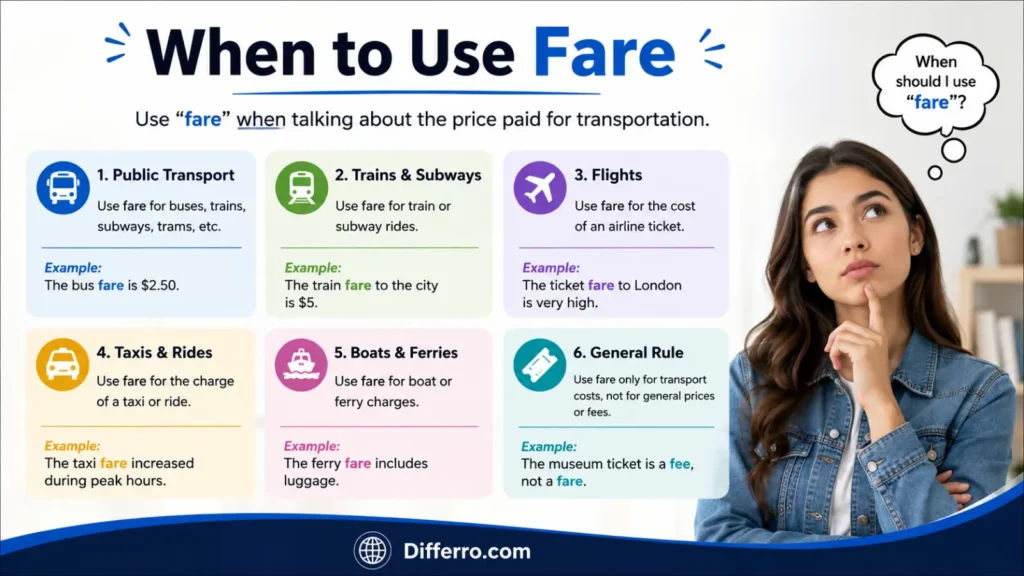
📝 When to Use Fare
Use fare when talking about transportation costs, food, or performance.
Examples
- The airline fare was affordable.
- School cafeteria fare improved this year.
- She will fare better next time.
Common Situations
- Bus fare
- Taxi fare
- Airfare
- Performance results
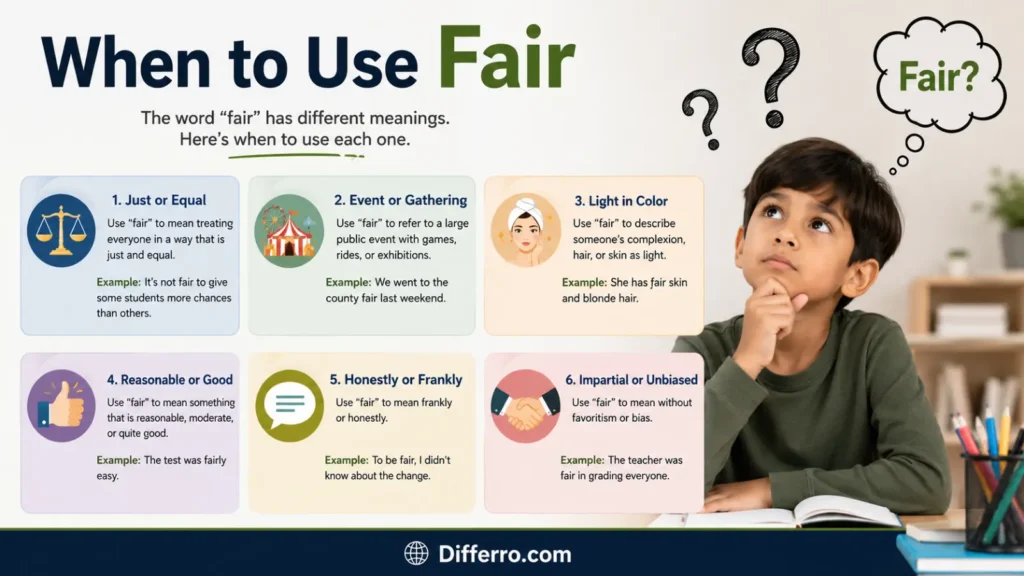
📝 When to Use Fair
Use fair when describing equality, honesty, beauty, or public events.
Examples
- That was a fair punishment.
- She has fair skin.
- We attended a science fair.
Common Situations
- Fair treatment
- Fair competition
- Job fair
- County fair
❌ Common Mistakes
| Incorrect Usage | Correct Usage |
|---|---|
| The bus fair is high. | The bus fare is high. |
| She gave a fare decision. | She gave a fair decision. |
| We went to the county fare. | We went to the county fair. |
| The taxi fair was cheap. | The taxi fare was cheap. |
🧠 Easy Trick to Remember
Remember This Simple Tip:
- Fare = Transportation or Travel
Think of “airfare.” - Fair = Equal or Nice
Think of “fair play.”
🌍 Everyday Life Examples
1. Transportation Example
The bus fare increased during the holidays.
2. School Example
The teacher gave every student a fair chance.
3. Event Example
We visited a local book fair yesterday.
4. Travel Budget Example
Cheap airline fare helps travelers save money.
5. Competition Example
A fair game follows equal rules for everyone.
✍️ Write 5 Examples
- The taxi fare was lower than expected.
- Sarah believes in fair treatment for all workers.
- We enjoyed delicious traditional fare at the festival.
- The referee made a fair decision.
- Air fare prices rise during vacations.
🔍 Related Keywords
- Fare vs Fair
- Difference between fare and fair
- Fair meaning
- Fare meaning
- Homophones in English
- Common spelling mistakes
- Fair or fare examples
📈 Google Trends & Usage Data
In countries like the USA, UK, Australia, India, and Pakistan, the word fair is searched more often because it has wider usage in education, justice, and events.
The term fare gets higher searches in travel-related topics such as bus fare, taxi fare, and airfare.
India and Pakistan show strong search interest in grammar comparison keywords because many users learn English as a second language.
The USA and UK show balanced search trends due to broader usage in media and daily communication.
Comparison Table: Keyword Variations
| Keyword Variation | Search Intent |
|---|---|
| Fare or Fair | Grammar confusion |
| Fair vs Fare | Word comparison |
| Fare meaning | Definition |
| Fair meaning | Definition |
| Bus fare or bus fair | Correct usage |
| Fair examples | Learning grammar |
FAQs ;
1. Is it correct to say bus fair?
No. The correct phrase is bus fare because it refers to travel cost.
2. What is the difference between fare and fair?
Fare relates to cost, food, or performance.
Fair means just, equal, or pleasant.
3. Which word is more common?
Fair is more common because it has more meanings and broader usage.
4. Is fair used in formal writing?
Yes. Words like “fair decision” and “fair policy” are common in formal English.
5. Why does confusion exist?
The confusion exists because both words sound identical but have different meanings and spellings.
🏁 Final Verdict
Choose fare when discussing transportation costs, food, or performance outcomes.
Choose fair when describing equality, honesty, beauty, or public events.
Both words are correct, but they work in completely different contexts. Understanding their meanings helps you avoid grammar mistakes and write more confidently.
📌 Conclusion
Fare or Fair may sound the same, but they carry very different meanings. Fare usually connects to travel costs, meals, or performance. Fair relates to equality, honesty, beauty, or events.
Learning the difference between these homophones improves grammar, communication, and writing clarity. The easiest way to remember them is to connect fare with travel and fair with fairness.
These words appear often in everyday English, so mastering them will help you avoid common mistakes in school, work, and conversation.
Practice using both words in sentences regularly. Over time, choosing the correct spelling will become natural and effortless.
Discover More Post ;
URL Or Keywords Explained for Beginners
Blankey or Blankie : Which Spelling Is Correct?
Openned Or Opened: Which Spelling Is Correct?

Sara Taylor is a passionate writer and language enthusiast. She specializes in creating simple and easy-to-understand articles about English grammar, spelling differences, and commonly confused words. Her writing style focuses on helping students, writers, and English learners improve their language skills with confidence. Through informative guides and practical examples, Sara makes complex grammar topics easier for everyday readers.