
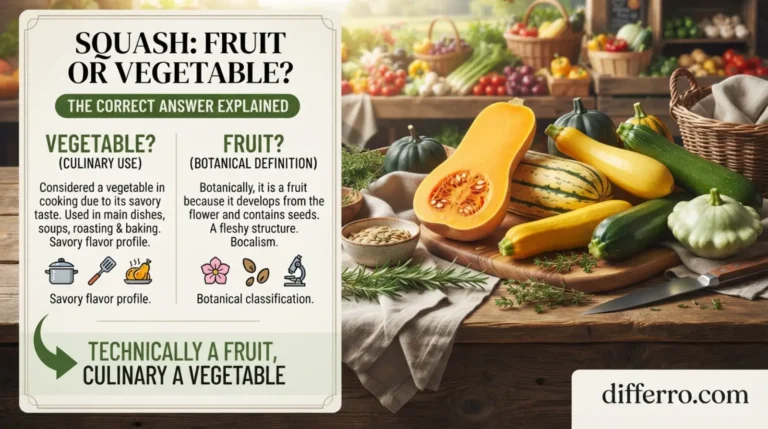
Squash fruit or vegetable? This question often confuses people because squash grows on a plant and appears in many Savory dishes. Most people consider squash a vegetable because they cook it in soups, curries, and side dishes. However, botanically, squash is a fruit because it develops from a flower and contains seeds.
This difference comes from two ways of classifying food. Botanists classify plants by their structure and growth. Cooks classify foods by their taste and use in meals. Both classifications make sense, but they serve different purposes. Understanding the difference helps explain why squash belongs to two food categories. This guide explores squash, its botanical classification, common varieties, nutritional value, and everyday uses. You will also learn why people often mistake this fruit for a vegetable.
⭐ Quick Answer
Squash is botanically a fruit, but people commonly use it as a vegetable in cooking. It develops from a flower and contains seeds, which makes it a fruit. Its mild or savory flavor makes it suitable for vegetable dishes.
Example: Butternut squash is botanically a fruit, but people commonly roast it or add it to vegetable soup.
🍈 Meaning of Squash Fruit
A squash is a fleshy plant structure that develops from the flower of a squash plant. It contains seeds and belongs to the gourd family, Cucurbitaceae.
Botanically, squash qualifies as a fruit because it develops from the flower’s ovary. It also protects the seeds inside its flesh.
Common squash varieties include:
- Butternut squash
- Acorn squash
- Spaghetti squash
- Zucchini
- Yellow summer squash
- Kabocha squash
Squash varieties differ in shape, color, texture, and taste. Some have sweet, dense flesh, while others taste mild and fresh.
Examples of Squash as a Fruit
Example 1: A butternut squash develops from a flower and contains seeds inside its thick flesh.
Example 2: A zucchini grows from a squash plant’s flower and contains small edible seeds.
Both examples qualify as fruits under botanical classification.
🥗 Meaning of Squash as a Vegetable
A vegetable is a culinary term for edible plant parts that people commonly use in savory meals.
People often call squash a vegetable because they prepare it like other vegetables. They roast it, boil it, steam it, and add it to soups or curries.
In cooking, squash works well in:
- Vegetable soups
- Curries and stews
- Roasted vegetable dishes
- Salads
- Pasta recipes
- Casseroles
Its mild flavor makes squash a useful ingredient in many meals.
Examples of Squash as a Vegetable
Example 1: A family adds diced butternut squash to a vegetable curry for a naturally sweet flavor.
Example 2: A restaurant serves roasted zucchini alongside carrots, potatoes, and other vegetables.
These examples show how people classify squash according to its culinary use.
🔎 Squash Fruit or Vegetable: Key Differences
The answer depends on whether you use botanical or culinary classification.
| Feature | Squash as a Fruit | Squash as a Vegetable |
|---|---|---|
| Meaning | A seed-containing structure that develops from a flower | An edible plant food used in savory cooking |
| Classification | Botanical | Culinary |
| Taste | Can be mild or sweet | Usually treated as savory |
| Usage | Botanical studies and plant science | Cooking and meal preparation |
| Seeds | Contains seeds | Seeds may be removed or eaten |
| Examples | Zucchini, butternut squash, acorn squash | Roasted squash, squash soup, squash curry |
| Popularity | Scientific classification | Common everyday classification |
Key point: Squash is a fruit botanically and a vegetable in everyday cooking. Neither description is incorrect.
🕰️ Origin and History of Squash
Squash has a long history in the Americas. Indigenous communities cultivated different squash varieties thousands of years ago.
Squash became an important food because people could prepare its flesh and seeds in many ways. Different varieties also provided useful food sources across different seasons.
The word squash comes from a Native American word recorded through early English colonial contact. It traces back to the Narragansett word askutasquash, referring to an edible vegetable.
Over time, people introduced squash varieties to different parts of the world. Today, farmers grow squash in many countries.
Similar Fruits Commonly Called Vegetables
Squash is not the only botanical fruit that people commonly call a vegetable.
- Tomato: Botanically a fruit, commonly used as a vegetable.
- Cucumber: A fruit that people often use in salads.
- Eggplant: A botanical fruit used in savory dishes.
- Bell pepper: A fruit commonly treated as a vegetable.
- Pumpkin: A fruit often used in savory and sweet recipes.
These examples demonstrate the difference between scientific and culinary classifications.
🇬🇧 British English vs American English Spelling
The word squash has the same spelling in British and American English.
Both countries use the word for different edible varieties of the squash plant.
The main differences involve food names and regional usage, not the spelling of squash.
British vs American English Comparison
| Feature | British English | American English |
|---|---|---|
| Squash | Squash | Squash |
| Butternut squash | Butternut squash | Butternut squash |
| Courgette | Common term for zucchini | Zucchini |
| Marrow | Common term for a mature courgette | Less common as a general food term |
| Meaning of squash | Same botanical meaning | Same botanical meaning |
| Spelling | Squash | Squash |
🍽️ When to Use Squash as a Fruit
Use the term fruit when discussing squash from a botanical or scientific perspective.
Squash develops from a flower and contains seeds. These features make it a botanical fruit.
1. When Discussing Plant Science
Botanists classify squash as a fruit because of its growth structure.
Example: Squash is a fruit because it develops from the ovary of a flower.
2. When Studying Plant Reproduction
Squash contains seeds that can grow into new plants under suitable conditions.
Example: A farmer collects squash seeds to grow another crop.
3. When Explaining Fruit Classification
Squash belongs to the same botanical category as cucumbers and pumpkins.
Example: Botanists classify cucumber and squash as fruits because both contain seeds and develop from flowers.
🥘 When to Use Squash as a Vegetable
Use the term vegetable when discussing squash in everyday cooking, recipes, and meal planning.
Its mild flavor and texture make it suitable for savory dishes.
1. When Preparing Meals
People commonly add squash to soups, curries, and vegetable dishes.
Example: I added butternut squash to today’s vegetable soup.
2. When Discussing Nutrition
People often group squash with vegetables when planning balanced meals.
Example: Squash provides fiber, vitamins, and other useful nutrients.
3. When Shopping for Groceries
Grocery stores commonly place squash alongside other vegetables.
Example: I bought zucchini and yellow squash from the vegetable section.
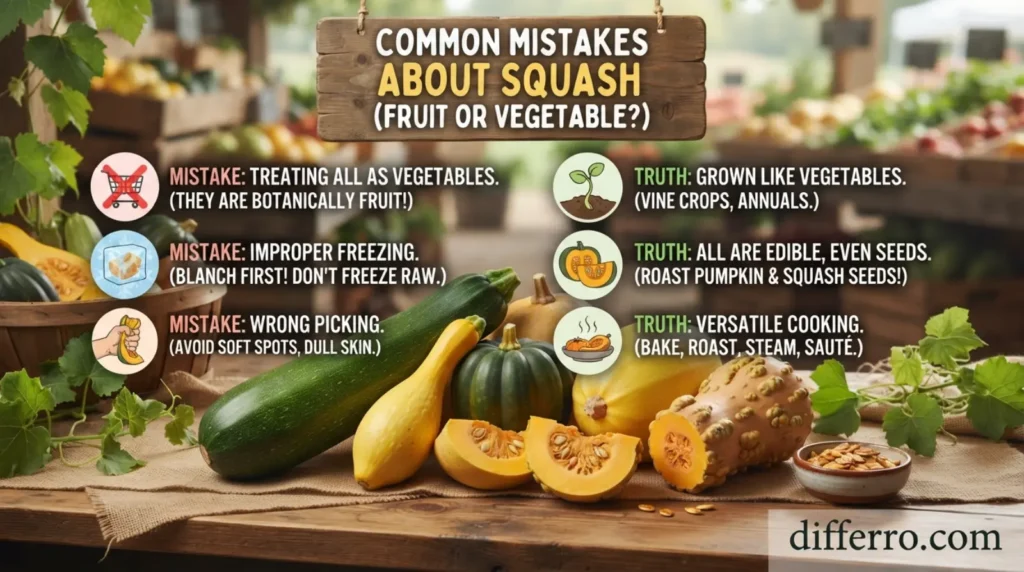
⚠️ Common Mistakes About Squash Fruit or Vegetable
Mistake 1: Assuming Every Sweet Food Is a Fruit
Incorrect: Squash is a vegetable because some varieties taste savory.
Correct: Squash is botanically a fruit regardless of its taste.
Mistake 2: Assuming All Fruits Taste Sweet
Incorrect: Squash cannot be a fruit because it does not taste like an apple.
Correct: Botanical fruits do not need to taste sweet. Tomatoes, cucumbers, and squash are also fruits.
Mistake 3: Confusing Botanical and Culinary Definitions
Incorrect: Calling squash a vegetable in a recipe is scientifically wrong.
Correct: Squash is a botanical fruit and a culinary vegetable. Both terms work in their proper contexts.
Mistake 4: Assuming Squash and Pumpkin Are Completely Different
Incorrect: Squash and pumpkin belong to unrelated plant groups.
Correct: Pumpkins are types of squash within the gourd family.
Mistake 5: Thinking All Squash Varieties Have the Same Taste
Incorrect: Every squash tastes sweet and has the same texture.
Correct: Squash varieties have different flavors, textures, and cooking uses.
🧠 Easy Trick to Remember
Use this simple memory trick:
- Fruit = Flower and seeds: Squash develops from a flower and contains seeds.
- Vegetable = Kitchen use: People commonly prepare squash in savory meals.
Remember this sentence:
“Squash is a fruit in science but a vegetable in the kitchen.”
This simple rule explains why both classifications are correct.
🌿 Everyday-Life Examples: Squash Fruit or Vegetable?
1. Buying Squash at a Grocery Store
A shopper visits a grocery store and finds butternut squash beside carrots, potatoes, and other produce.
The shopper buys it for a vegetable soup.
Classification: People treat squash as a vegetable in grocery shopping and cooking.
2. Studying Squash in Biology Class
A student studies how squash plants produce flowers and develop seed-containing structures.
The teacher explains its botanical classification.
Classification: Squash is a fruit because it develops from a flower’s ovary.
3. Preparing a Healthy Dinner
A family roasts zucchini, yellow squash, and carrots for dinner.
They serve these foods as a vegetable side dish.
Classification: Squash is a culinary vegetable in this meal.
4. Collecting Squash Seeds
A gardener cuts open a mature squash and collects its seeds.
The gardener dries the seeds and saves them for planting.
Classification: Squash is a fruit because it contains seeds and develops from a flower.
5. Comparing Squash With Other Foods
A student compares squash, tomatoes, cucumbers, and eggplants.
The student discovers that botanists classify all these foods as fruits.
Classification: Squash is botanically a fruit, although cooks commonly use it as a vegetable.
🌍 Google Trends and Usage Insights: Five Countries
Google Trends measures relative search interest rather than exact search volume. The following observations are general search-intent expectations, not verified live rankings.
- USA: Searches may focus on squash varieties, recipes, nutrition, and fruit classification.
- UK: Users may search for squash varieties, courgettes, cooking methods, and botanical differences.
- Australia: Search interest may involve growing squash, seasonal produce, and healthy recipes.
- India: Users may search for squash varieties, vegetable classification, nutrition, and cooking ideas.
- Pakistan: Searches may relate to squash identification, vegetable uses, nutrition, and fruit classification.
SEO insight: The phrase “is squash a fruit or vegetable” directly matches informational search intent. Compare it with “squash fruit or vegetable” and “is zucchini a fruit or vegetable” in Google Trends. Use the same date range and country filters for reliable comparisons.
Comparison Table: Keyword Variations
| Keyword variation | Search intent | Suggested content use |
|---|---|---|
| Squash fruit or vegetable | Direct question | Main title and introduction |
| Is squash a fruit or vegetable | Informational | Featured snippet and FAQ |
| Is butternut squash a fruit or vegetable | Specific variety | Squash fruit section |
| Is zucchini a fruit or vegetable | Related question | Related content |
| Why is squash a fruit | Scientific explanation | Botanical classification |
| Squash botanical classification | Educational | Meaning section |
| Squash vegetable nutrition | Health and food research | Related article |
❓ Frequently Asked Questions
1. Is squash a fruit or vegetable?
Squash is botanically a fruit because it develops from a flower and contains seeds. However, people commonly classify it as a vegetable in cooking.
2. What is the difference between squash as a fruit and a vegetable?
The difference comes from classification. Botanists classify squash by its plant structure, while cooks classify it by taste and culinary use.
3. Which classification is more common?
People more commonly call squash a vegetable in everyday conversation. Botanists and plant scientists classify it as a fruit.
4. Is squash a fruit or vegetable in formal scientific writing?
In formal botanical writing, squash is a fruit. In recipes, nutrition discussions, and everyday food descriptions, vegetable is an acceptable culinary term.
5. Why do people confuse squash with other vegetables?
Squash has a mild or savory flavor and commonly appears in vegetable dishes. Its culinary use makes people overlook its botanical classification.
🏆 Final Verdict: Is Squash a Fruit or Vegetable?
Squash is both a fruit and a vegetable, depending on how you classify it.
From a botanical perspective, squash is a fruit. It develops from a flower and contains seeds inside its flesh.
From a culinary perspective, people commonly treat squash as a vegetable. They roast it, cook it in soups, and add it to savory meals.
Neither classification is wrong. Each describes squash from a different perspective.
If you are studying biology, call squash a fruit. If you are discussing recipes or everyday cooking, calling it a vegetable makes perfect sense.
The simplest answer is that squash is botanically a fruit but commonly used as a vegetable.
Conclusion
Squash fruit or vegetable is a common question because its scientific classification differs from its everyday use. Botanically, squash is a fruit because it develops from a flower and contains seeds. However, people commonly prepare it as a vegetable in soups, curries, salads, and roasted dishes.
This difference explains why both descriptions are correct. Botanists classify squash by its structure, while cooks classify it by its flavor and use. Other foods, including tomatoes, cucumbers, and eggplants, follow the same pattern.
Remember the simple rule: squash is a fruit in botanical terms but a vegetable in culinary terms. Understanding this distinction makes food classification easier and clears up common confusion.

Imran Lodhra is a comparison-focused content writer at Differro.com.
He specializes in creating clear, simple, and informative comparison articles.
His work helps readers understand key differences, pros and cons, and important details.
Imran focuses on accurate, practical, and easy-to-read content for everyday readers.