

CH3F polar or nonpolar is a common chemistry question about molecular polarity. CH₃F stands for fluoromethane, a chemical compound containing carbon, hydrogen, and fluorine. To determine its polarity, we must examine its bonds and molecular shape.
Some molecules contain polar bonds but remain nonpolar overall. This happens when their bond dipoles cancel each other. However, CH₃F has an uneven distribution of electrical charge. Fluorine attracts shared electrons more strongly than carbon and hydrogen. This creates an uneven charge distribution within the molecule.
Understanding molecular polarity helps explain how substances interact, dissolve, and behave in chemical reactions. It also helps students answer chemistry questions about electronegativity, bond dipoles, and molecular geometry. In this guide, you will learn why CH₃F is polar, how its structure determines polarity, and how it compares with other molecules. Simple examples and explanations will make the concept easier to understand.
⭐ Quick Answer
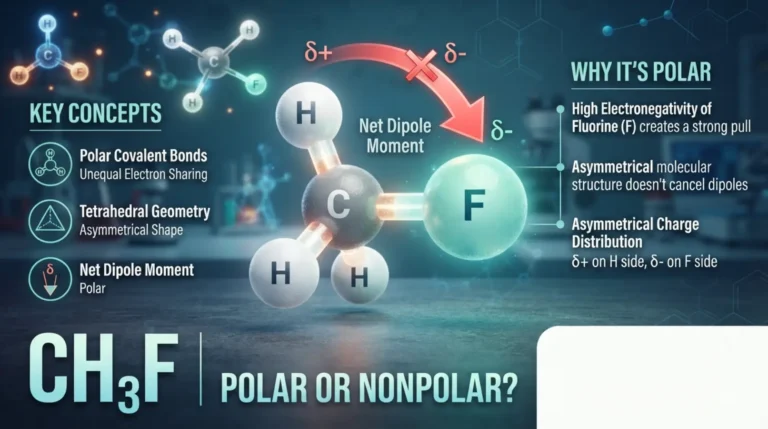
CH3F Polar or Nonpolar. Fluorine attracts bonding electrons strongly, creating an uneven charge distribution. The molecule’s tetrahedral shape does not cancel the bond dipoles.
Example: The carbon–fluorine bond creates a strong dipole toward fluorine, giving CH₃F a net molecular dipole.
🧪 Meaning of CH₃F
CH₃F is the chemical formula for fluoromethane, also called methyl fluoride. It contains one carbon atom, three hydrogen atoms, and one fluorine atom.
Carbon forms four single bonds: three with hydrogen and one with fluorine. These bonds create a roughly tetrahedral arrangement around carbon.
Fluorine attracts shared electrons much more strongly than carbon or hydrogen. This unequal attraction creates a polar carbon–fluorine bond.
Examples of CH₃F in Chemistry
Example 1: A chemistry student examines CH₃F’s Lewis structure and identifies the carbon–fluorine bond as strongly polar.
Example 2: A student compares CH₃F with CH₄. CH₃F is polar, while CH₄ is nonpolar because its symmetrical structure cancels the bond dipoles.
⚡ Meaning of Polar and Nonpolar Molecules
What Is a Polar Molecule?
A polar molecule has an uneven distribution of electrical charge. It has a net molecular dipole, meaning its bond dipoles do not cancel completely.
Polar molecules often contain bonds between atoms with different electronegativities. However, molecular geometry also determines whether the molecule has an overall dipole.
Examples include:
- CH₃F: Polar because its bond dipoles do not cancel.
- H₂O: Polar because its bent shape produces a net dipole.
What Is a Nonpolar Molecule?
A nonpolar molecule has no net molecular dipole. Its charge distribution may be balanced by symmetrical geometry, even when individual bonds are polar.
Examples include:
- CH₄: Nonpolar because its symmetrical tetrahedral structure cancels the bond dipoles.
- CO₂: Nonpolar because its two equal C=O bond dipoles point in opposite directions and cancel.
A molecule can contain polar bonds without being polar overall. Always consider both bond polarity and molecular geometry.
🔍 CH₃F Polar or Nonpolar: Key Differences
| Feature | CH₃F | Nonpolar Molecules |
|---|---|---|
| Molecular polarity | Polar | No net molecular dipole |
| Charge distribution | Uneven | Balanced overall |
| Bond polarity | Contains a strongly polar C–F bond | Depends on the molecule |
| Molecular shape | Tetrahedral around carbon | Varies by molecule |
| Dipole cancellation | Incomplete | Complete or absent |
| Example | CH₃F | CH₄, CO₂ |
| Electrical behavior | Has a permanent molecular dipole | Has no permanent net molecular dipole |
| Chemistry applications | Useful in studying molecular polarity | Useful in comparing molecular symmetry and interactions |
Key point: CH₃F is polar because its bond dipoles do not cancel. Its molecular geometry leaves a net dipole directed generally toward the fluorine end.
🕰️ Origin and Chemical Background
The formula CH₃F represents fluoromethane, a simple organic compound in the haloalkane family. Chemists classify it as a halogenated derivative of methane.
Methane, CH₄, contains four hydrogen atoms bonded to carbon. In fluoromethane, one hydrogen atom is replaced by fluorine. This substitution changes the molecule’s electrical charge distribution.
Fluorine has a much higher electronegativity than carbon and hydrogen. It attracts bonding electrons strongly, making the C–F bond highly polar.
Similar Chemical Formulas
- CH₄: Methane, a nonpolar molecule.
- CH₃F: Fluoromethane, a polar molecule.
- CH₃Cl: Chloromethane, a polar molecule.
- CH₂F₂: Difluoromethane, a polar molecule.
- CF₄: Carbon tetrafluoride, a nonpolar molecule because its symmetrical tetrahedral structure cancels its bond dipoles.
These examples show how replacing hydrogen atoms with halogens can change molecular polarity.
🇬🇧 British English vs American English
The chemical formula CH₃F and the term fluoromethane have the same spelling in British and American English.
Both varieties use the same scientific principles to explain molecular polarity.
Some chemistry terms may have regional spelling differences, but the formula and polarity classification remain unchanged.
British vs American English Comparison
| Feature | British English | American English |
|---|---|---|
| Chemical formula | CH₃F | CH₃F |
| Compound name | Fluoromethane | Fluoromethane |
| Polarity classification | Polar | Polar |
| Scientific meaning | Same | Same |
| Chemical notation | Same | Same |
🧬 Why Is CH₃F Polar?
Three important factors explain why CH₃F is polar.
1. Electronegativity Difference
Electronegativity measures an atom’s ability to attract shared electrons in a chemical bond.
Fluorine has an electronegativity of approximately 3.98 on the Pauling scale. Carbon has a value near 2.55, while hydrogen has a value near 2.20.
The carbon–fluorine bond therefore has a substantial electronegativity difference. Fluorine pulls the shared electrons closer to itself.
This creates a partial negative charge near fluorine and a partial positive charge toward the carbon end.
2. Molecular Geometry
CH₃F has a roughly tetrahedral molecular geometry around its central carbon atom. Three C–H bonds and one C–F bond extend in different directions.
The molecule is not symmetrical in the same way as CH₄. One fluorine atom replaces one hydrogen atom, creating an uneven distribution of bond dipoles.
As a result, the bond dipoles do not cancel.
3. Net Dipole Moment
A molecule’s net dipole moment represents its overall separation of positive and negative charge.
In CH₃F, the strong C–F bond dipole dominates the molecular dipole. The smaller C–H bond contributions do not cancel it.
Therefore, CH₃F has a permanent molecular dipole and is classified as polar.
📚 When to Classify a Molecule as Polar
Use bond polarity and molecular geometry together when deciding if a molecule is polar.
Step 1: Draw the Lewis Structure
Identify the central atom and determine how the surrounding atoms connect.
For CH₃F, carbon bonds to three hydrogen atoms and one fluorine atom.
Step 2: Compare Electronegativity Values
Check whether the bonded atoms attract electrons equally.
In CH₃F, fluorine attracts electrons more strongly than carbon. Therefore, the C–F bond is polar.
Step 3: Identify Molecular Geometry
Determine the three-dimensional shape of the molecule.
CH₃F has a roughly tetrahedral shape around carbon. However, its different surrounding atoms prevent complete dipole cancellation.
Step 4: Check the Net Dipole
Consider the direction and size of every bond dipole.
If the bond dipoles cancel completely, the molecule is nonpolar. If they leave a net dipole, the molecule is polar.
Result: CH₃F is polar.
⚠️ Common Mistakes When Determining CH₃F Polarity
Mistake 1: Assuming Every Tetrahedral Molecule Is Nonpolar
Incorrect: CH3F Polar or Nonpolar is nonpolar because it has a tetrahedral shape.
Correct: Molecular symmetry matters. CH₃F has different surrounding atoms, so its bond dipoles do not cancel.
Mistake 2: Ignoring Electronegativity
Incorrect: Carbon and fluorine share electrons equally.
Correct: Fluorine attracts bonding electrons much more strongly than carbon. This makes the C–F bond strongly polar.
Mistake 3: Confusing Bond Polarity With Molecular Polarity
Incorrect: A polar bond always makes the entire molecule polar.
Correct: Molecular geometry determines whether bond dipoles cancel. CO₂ contains polar bonds but is nonpolar overall.
Mistake 4: Treating CH₃F Like CH₄
Incorrect: CH₃F and CH₄ have the same polarity because both contain four bonds around carbon.
Correct: CH₄ has four identical surrounding hydrogen atoms. CH₃F has three hydrogen atoms and one fluorine atom, creating an uneven charge distribution.
Mistake 5: Assuming Partial Charges Determine Polarity Alone
Incorrect: A molecule is polar whenever it contains partial positive and negative charges.
Correct: Many molecules contain partial charges. The molecule is polar only when its overall charge distribution produces a nonzero net dipole.
🧠 Easy Trick to Remember
Use this simple memory trick:
Fluorine pulls strongly, so CH₃F is polar.
Remember these points:
- Fluorine attracts bonding electrons strongly.
- The C–F bond creates a strong dipole.
- The tetrahedral arrangement does not cancel all bond dipoles.
- CH₃F therefore has a net molecular dipole.
Compare CH₃F with CH₄. Methane has four identical surrounding hydrogen atoms, so its bond dipoles cancel because of its symmetrical structure.
🌍 Everyday Chemistry Examples: CH₃F Polar or Nonpolar
1. Comparing CH₃F With CH₄
A student compares fluoromethane with methane during a chemistry lesson.
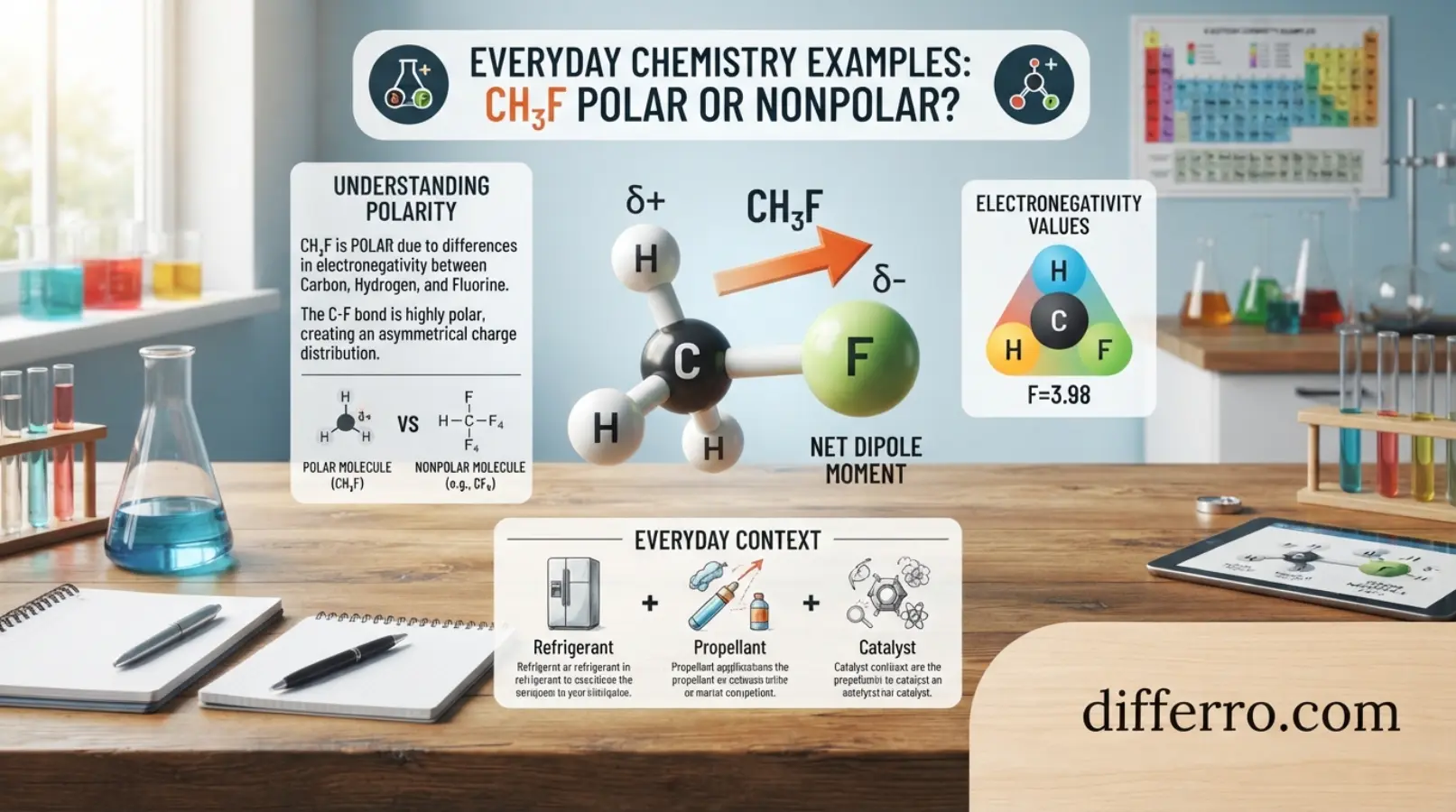
CH₃F is polar because fluorine creates an uneven charge distribution. CH₄ is nonpolar because its symmetrical tetrahedral geometry cancels the bond dipoles.
This comparison shows why molecular shape and atom identity both matter.
2. Comparing CH₃F With CO₂
A chemistry student examines the polarity of fluoromethane and carbon dioxide.
CH₃F has a net molecular dipole. CO₂ has two equal bond dipoles pointing in opposite directions, so they cancel.
Both molecules contain polar bonds, but their overall polarity differs.
3. Studying the Effect of Fluorine
A student replaces one hydrogen atom in methane with fluorine on a molecular model.
This substitution changes the electron distribution and molecular polarity. CH₃F becomes polar, while CH₄ remains nonpolar.
The example demonstrates how a single atom can affect molecular properties.
4. Drawing a Lewis Structure
A student draws CH₃F with carbon in the center, three hydrogen atoms, and one fluorine atom.
The student then marks the C–F bond dipole toward fluorine. The bond dipoles do not cancel, confirming that CH₃F is polar.
A Lewis structure helps identify connectivity, while a three-dimensional model helps explain dipole cancellation.
5. Preparing for a Chemistry Exam
A student must classify CH₃F as polar or nonpolar on a test.
The student checks electronegativity, identifies the tetrahedral geometry, and evaluates the bond dipoles.
The final answer is polar because the molecule has a net dipole moment.
🌐 Google Trends and Search Insights: Five Countries
Google Trends measures relative search interest rather than exact search volume. The following observations are general expectations, not verified live rankings.
- USA: Students may search for CH₃F polarity, molecular geometry, and chemistry homework help.
- UK: Searches may focus on fluoromethane, electronegativity, and molecular dipoles.
- Australia: Chemistry students may look for simple explanations of polar and nonpolar molecules.
- India: Searches may relate to school chemistry, molecular structures, and exam preparation.
- Pakistan: Students may search for molecular polarity, Lewis structures, and short chemistry answers.
SEO insight: Compare “CH3F polar or nonpolar,” “is CH3F polar,” and “CH3F dipole moment” in Google Trends. Use the same date range and country settings for a fair comparison. Search interest may be too low for reliable country-level comparisons because CH₃F is a specialized chemistry term.
Comparison Table: Keyword Variations
| Keyword variation | Search intent | Suggested placement |
|---|---|---|
| CH3F polar or nonpolar | Direct chemistry question | Title and introduction |
| Is CH₃F polar? | Quick factual answer | Featured snippet and FAQ |
| CH₃F molecular polarity | Scientific explanation | Polarity section |
| Fluoromethane polar or nonpolar | Compound identification | Meaning section |
| CH₃F dipole moment | Technical information | Net dipole section |
| CH₃F Lewis structure | Structural explanation | Lewis structure section |
| CH₃F molecular geometry | Shape and polarity | Geometry section |
❓ Frequently Asked Questions
1. Is CH3F Polar or Nonpolar?
CH₃F is polar. Fluorine attracts bonding electrons strongly, and the molecule’s bond dipoles do not cancel. This produces a permanent net molecular dipole.
2. What is the difference between polar and nonpolar molecules?
Polar molecules have a net molecular dipole caused by an uneven charge distribution. Nonpolar molecules have no net molecular dipole. Their bond dipoles may cancel because of molecular symmetry.
3. Is CH₃F more commonly classified as polar or nonpolar?
Chemistry textbooks and standard molecular polarity rules classify CH₃F as polar. This classification follows from its strongly polar C–F bond and its unsymmetrical charge distribution.
4. How should you describe CH₃F in formal chemistry writing?
Describe CH₃F as a polar molecule with a permanent dipole moment. You can explain that fluorine attracts bonding electrons strongly and the molecular bond dipoles do not cancel.
5. Why do students confuse CH₃F polarity?
Students may assume every tetrahedral molecule is nonpolar. However, tetrahedral geometry alone does not determine polarity. The identities of the surrounding atoms and the direction of bond dipoles also matter.
🏆 Final Verdict: Is CH3F Polar or Nonpolar?
CH₃F is polar. Its carbon–fluorine bond has a substantial electronegativity difference, which creates a strong bond dipole. The molecule has a roughly tetrahedral shape, but its bond dipoles do not cancel.
This leaves a net molecular dipole directed generally toward the fluorine end. Therefore, chemistry students should classify fluoromethane as a polar molecule.
Remember the essential rule: molecular polarity depends on both bond polarity and molecular geometry. A molecule may contain polar bonds yet remain nonpolar if those dipoles cancel. CH₃F does not meet that condition, so its final classification is polar.
Conclusion
CH₃F is a polar molecule because fluorine attracts bonding electrons more strongly than carbon and hydrogen. This creates an uneven distribution of electrical charge.
Its tetrahedral geometry does not cancel the bond dipoles. Instead, the strong carbon–fluorine bond contributes to a net molecular dipole directed toward fluorine.
When determining whether a molecule is polar or nonpolar, always examine electronegativity, molecular geometry, and dipole cancellation. Do not classify a molecule by its shape alone.
Comparing CH₃F with CH₄ and CO₂ helps explain the difference. Methane is nonpolar because its bond dipoles cancel, while carbon dioxide is nonpolar because its two bond dipoles oppose each other. The correct answer is clear: CH₃F is polar.


1 thought on “CH3F Polar or Nonpolar? Molecular Polarity Explained”