
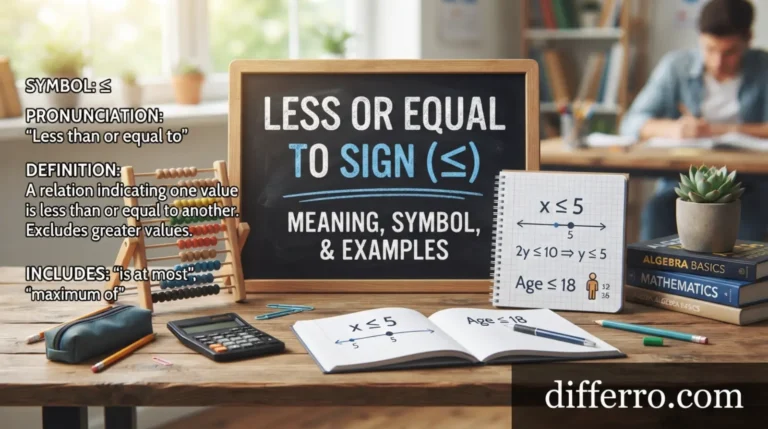
Less or equal to sign (≤) is a mathematical symbol that compares two Numbers or values. It means one number is smaller than or equal to another number. However, many students confuse this symbol with the less than sign (less than) or equal to sign (=).
Understanding the less or equal to sign makes mathematics easier. You can use it in algebra, inequalities, equations, statistics, and everyday calculations. It helps describe values that stay below a specific limit or reach that limit exactly.
For example, the expression (x \leq 10) means x can equal 10 or any number below 10. It cannot represent a number greater than 10. This guide explains the symbol, its meaning, correct usage, differences, and practical examples.
⭐ Quick Answer
The less than or equal to sign (≤) means a number is smaller than or equal to another number. It includes both possibilities: a smaller value and an equal value.
Example: (5 \leq 10) is true, and (10 \leq 10) is also true.
📘 Meaning of the Less Than or Equal To Sign (≤)
The less than or equal to sign (≤) is a mathematical comparison symbol. It shows that the number on the left does not exceed the number on the right.
In simple words, the left-side value can be smaller than or exactly equal to the right-side value.
The symbol combines two mathematical ideas:
- Less than (<)
- Equal to (=)
Together, they form the less than or equal to symbol (≤).
Examples of the Less Than or Equal To Sign
Example 1:
3 ≤ 7
This statement means three is less than seven.
Example 2:
6 ≤ 6
This statement means six equals six. Therefore, the comparison is also correct.
📗 Meaning of the Greater Than or Equal To Sign (≥)
The greater than or equal to sign (≥) represents the opposite comparison. It means one value is larger than or equal to another value.
The left-side number can be greater than the right-side number or exactly equal to it.
This symbol also combines two mathematical ideas:
- Greater than (>)
- Equal to (=)
Examples of the Greater Than or Equal To Sign
Example 1:
12 ≥ 8
This statement means twelve is greater than eight.
Example 2:
9 ≥ 9
This statement means both numbers are equal.
🔎 Less or Equal To Sign (≤): Key Differences
The less than or equal to sign and the less than sign look similar. However, they communicate different mathematical conditions.
| Feature | Less Than or Equal To (≤) | Less Than (<) |
|---|---|---|
| Meaning | Smaller than or equal to | Strictly smaller than |
| Symbol | ≤ | < |
| Equality allowed | Yes | No |
| Usage | Inclusive inequalities | Strict inequalities |
| Tone | Includes the boundary value | Excludes the boundary value |
| Example | 5 ≤ 10 | 5 < 10 |
| Equality example | 10 ≤ 10 is true | 10 < 10 is false |
| Mathematical use | Equations, limits, and inequalities | Comparisons and inequalities |
What Is the Difference Between ≤ and =?
The less than or equal to sign (≤) allows a smaller value or an equal value. The equal sign (=) means both sides must have exactly the same value.
For example:
- (4 \leq 8) is true.
- (8 \leq 8) is true.
- (4 = 8) is false.
- (8 = 8) is true.

🕰️ Origin and History of the Less Than or Equal To Sign
Mathematicians developed comparison symbols to make mathematical expressions shorter and easier to understand.
The less than sign (<) and greater than sign (>) became widely associated with the work of English mathematician Thomas Harriot. His mathematical writings appeared in print in the 1630s.
Later, mathematicians developed combined symbols to express inclusive comparisons. The less than or equal to sign (≤) became a standard notation in mathematics.
Today, students and professionals use these symbols in algebra, computer science, statistics, and engineering.
Similar Mathematical Symbols
- Less than (<): Shows that one value is smaller.
- Greater than (>): Shows that one value is larger.
- Less than or equal to (≤): Shows a smaller or equal value.
- Greater than or equal to (≥): Shows a larger or equal value.
- Equal to (=): Shows that two values have the same value.
- Not equal to (≠): Shows that two values differ.
🇬🇧 British English vs American English
The less than or equal to sign (≤) has the same mathematical meaning in British and American English.
Both countries use the same symbol in mathematics, science, education, and technical writing.
The spoken wording may vary slightly, but the mathematical notation remains unchanged.
British vs American English Comparison
| Feature | British English | American English |
|---|---|---|
| Symbol | ≤ | ≤ |
| Written name | Less than or equal to | Less than or equal to |
| Meaning | Smaller than or equal to | Smaller than or equal to |
| Mathematical usage | Same | Same |
| Spelling | Equal | Equal |
| Pronunciation in speech | Same basic wording | Same basic wording |
✏️ When to Use the Less Than or Equal To Sign (≤)
Use the less than or equal to sign when a value must remain below a specific number or match it.
It is especially useful when a mathematical condition allows equality.
1. Use It in Mathematical Inequalities
An inequality compares two values instead of stating that they must be equal.
Example:
x ≤ 10
This means x can be 10 or any smaller number.
Possible values include:
- 2
- 5
- 8
- 10
2. Use It When Showing Maximum Limits
The symbol helps describe maximum quantities, limits, or allowed values.
Example:
Age ≤ 18
This means the age must be 18 or younger.
3. Use It in Algebra
Students use this symbol to solve mathematical inequalities.
Example:
x + 3 ≤ 9
Subtract 3 from both sides:
x ≤ 6
Therefore, x can equal six or any smaller number.
4. Use It in Science and Statistics
Scientists use inequalities to describe acceptable ranges and measurement limits.
Example:
Temperature ≤ 25°C
This means the temperature must not exceed 25°C.
➕ When to Use the Greater Than or Equal To Sign (≥)
Use the greater than or equal to sign when a value must reach or exceed a specific number.
1. Use It for Minimum Requirements
Example:
Age ≥ 18
This means a person must be at least 18 years old.
2. Use It in Mathematical Inequalities
Example:
x ≥ 5
This means x can equal five or any larger number.
3. Use It for Minimum Scores
Example:
Marks ≥ 50
This means a student needs at least 50 marks.
4. Use It in Science
Example:
Temperature ≥ 100°C
This means the temperature must reach 100°C or higher.
⚠️ Common Mistakes When Using the Less or Equal To Sign
Mistake 1: Confusing ≤ With <
Incorrect: (8 < 8) when equality is allowed.
Correct: (8 \leq 8)
The less than or equal to sign includes equal values.
Mistake 2: Confusing ≤ With =
Incorrect: (5 = 9) when describing a value below or equal to 9.
Correct: (5 \leq 9)
The correct symbol allows both smaller and equal values.
Mistake 3: Reversing the Symbol
Incorrect: (10 \leq 5)
Correct: (5 \leq 10)
The smaller or equal value must appear on the left for this statement to be true.
Mistake 4: Ignoring the Equality Condition
Incorrect: Assuming (x \leq 10) excludes 10.
Correct: (x \leq 10) includes 10.
The equality line underneath the less than symbol makes this important difference.
Mistake 5: Confusing ≤ With ≥
Incorrect: Using (x \geq 5) to mean x is smaller than or equal to 5.
Correct: (x \leq 5)
Remember that the direction of the symbol changes the comparison.
Mistake 6: Forgetting the Boundary Value in a Number Line
Incorrect: Drawing an open circle at 10 for (x \leq 10).
Correct: Draw a closed circle at 10 and shade to the left.
A closed circle shows that the boundary value belongs to the solution.
🧠 Easy Trick to Remember the Less Than or Equal To Sign
Use this simple memory trick:
The extra line means equality is allowed.
- < means smaller only.
- ≤ means smaller or equal.
- > means larger only.
- ≥ means larger or equal.
Remember that the open side of the symbol faces the larger number. The pointed side faces the smaller number.
For example:
[
4 \leq 9
]
The pointed side faces 4, the smaller number.
🏠 Everyday-Life Examples of the Less Than or Equal To Sign
1. Age Limit for Children
A children’s event allows participants aged 12 or younger.
[
Age \leq 12
]
This includes children who are exactly 12 years old and younger.
Related keyword: Less than or equal to symbol examples.
2. Shopping Budget
A person has a shopping budget of $100. They cannot spend more than that amount.
[
Spending \leq 100
]
Spending $80 or exactly $100 meets the budget.
Related keyword: Less than or equal to sign in real life.
3. Maximum Classroom Capacity
A classroom can hold a maximum of 30 students.
[
Students \leq 30
]
The classroom can contain 30 students or fewer.
Related keyword: Less than or equal to mathematical symbol.
4. Daily Temperature Limit
A weather report describes temperatures of 25 degrees Celsius or lower.
[
Temperature \leq 25^\circ C
]
This includes temperatures of exactly 25 degrees and below.
Related keyword: Less than or equal to sign meaning.
5. Examination Passing Requirements
A teacher sets a maximum score limit of 50 for a particular category.
[
Score \leq 50
]
This includes scores of 50 or lower.
Related keyword: How to use the less than or equal to sign.
🌍 Google Trends and Usage Insights: Five Countries
Google Trends measures relative search interest rather than exact search volume. The following observations are general SEO expectations, not verified live rankings.
- USA: Searches may focus on the less than or equal to symbol, algebra, and mathematical notation.
- UK: Students may search for inequality symbols, mathematics examples, and comparison rules.
- Australia: Educational searches may include mathematical symbols and inequality explanations.
- India: Students may search for symbol meanings, exam examples, and algebra lessons.
- Pakistan: Searches may focus on mathematical notation, school mathematics, and symbol identification.
SEO insight: Compare the exact phrase “less or equal to sign” with “less than or equal to symbol” and “≤ symbol meaning.” Check each country separately using the same date range. These variations can help identify the language people use when searching.
Comparison Table: Keyword Variations
| Keyword variation | Search intent | Suggested usage |
|---|---|---|
| Less or equal to sign | Symbol identification | Main title and introduction |
| Less than or equal to sign | Mathematical definition | Meaning section |
| Less than or equal to symbol | Symbol lookup | Main heading |
| ≤ meaning | Quick information | Featured snippet |
| Less than or equal to vs less than | Comparison | Differences section |
| How to type ≤ | Practical instruction | Related article |
| Less than or equal to examples | Educational | Examples section |
❓ Frequently Asked Questions
1. Is the less or equal to sign (≤) correct?
Yes. The symbol ≤ is mathematically correct. Its full name is the less than or equal to sign. It means the first value is smaller than or equal to the second value.
2. What is the difference between ≤ and <?
The symbol ≤ includes equality, while < does not. For example, (5 \leq 5) is true, but (5 < 5) is false.
3. Which symbol is more commonly used, ≤ or <?
Both symbols are common in mathematics. The less than sign appears in strict comparisons, while the less than or equal to sign appears in inclusive inequalities. Their usage depends on the mathematical condition.
4. Is the less than or equal to sign formal mathematical notation?
Yes. The symbol ≤ is standard mathematical notation. Students, teachers, scientists, engineers, and researchers use it in formal calculations and technical documents.
5. Why do people confuse the less than and less than or equal to signs?
Both symbols look similar. However, ≤ includes an additional line underneath the less than symbol. That line indicates that equal values also qualify.
🏆 Final Verdict: Which Symbol Should You Use?
The less than or equal to sign (≤) and the less than sign (<) serve different mathematical purposes. Neither symbol is better in every situation.
Use ≤ when the first value can be smaller than or equal to the second value. Use < when the first value must be strictly smaller.
For example, (6 \leq 10) and (10 \leq 10) are both true. However, (10 < 10) is false.
Always check whether your mathematical condition includes equality. This simple step helps you choose the correct symbol and avoid mistakes in equations, inequalities, and everyday calculations.
Conclusion
The less or equal to sign (≤) is an important Mathematical symbol. It shows that one value is smaller than or equal to another value. Unlike the less than sign (<), it also includes equal values.
You can use this symbol in algebra, equations, inequalities, statistics, and everyday calculations. For example, (x \leq 10) means x can equal 10 or any smaller number. Remember the simple rule: the extra line underneath the symbol allows equality.
Understanding this difference helps you solve mathematical problems accurately. Always check whether equality is allowed before choosing a comparison symbol. With regular practice, you can easily recognize and use the less than or equal to sign correctly.

Imran Lodhra is a comparison-focused content writer at Differro.com.
He specializes in creating clear, simple, and informative comparison articles.
His work helps readers understand key differences, pros and cons, and important details.
Imran focuses on accurate, practical, and easy-to-read content for everyday readers.