
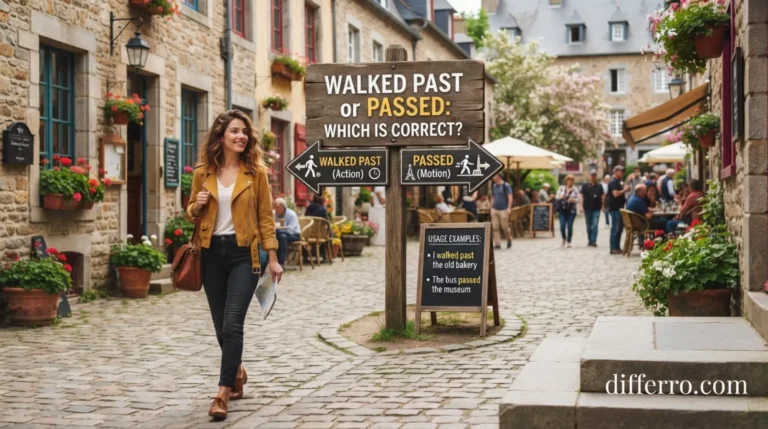
Walked past or passed? Both expressions are correct, but they have different meanings and uses. Many English learners confuse them because they describe similar actions involving movement. However, grammar and context determine which expression fits a sentence.
“Walked past” describes moving on foot beyond someone or something. “Passed” is the past tense of “pass” and has several meanings. It can describe moving beyond something, succeeding in an exam, or giving something to another person.
Understanding this difference helps you write clearer sentences and avoid common grammar mistakes. Both expressions appear in everyday conversations, stories, and formal writing. This guide explains their meanings, grammar, examples, and correct usage. You will also learn an easy trick to remember when to use each expression.
⭐ Quick Answer
“Walked past” describes someone moving on foot beyond a person or place. “Passed” is the past tense of “pass” and has several meanings.
Example: “I walked past the school” describes movement, while “I passed my exam” means I succeeded.
📖 Meaning of Walked Past
“Walked past” means moving on foot beyond someone or something without stopping. It combines the past tense of “walk” with the preposition “past.”
Use this expression when someone physically walks by a person, building, object, or location.
Examples of Walked Past
- I walked past the library on my way home.
- She walked past her old friend without saying hello.
More Uses of Walked Past
- He walked past the restaurant yesterday.
- We walked past several shops during our evening stroll.
- The teacher walked past my desk without noticing me.
📖 Meaning of Passed
“Passed” is the simple past tense and past participle of the verb “pass.” It describes several actions, including moving beyond something, succeeding in an examination, or transferring something.
Its meaning depends on the surrounding words.
Examples of Passed
- She passed her driving test last week.
- He passed the ball to his teammate.
More Uses of Passed
- The car passed our house quickly.
- Time passed very quickly during the holidays.
- My grandfather passed away peacefully.
🔍 Walked Past or Passed: Key Differences
Both expressions can describe movement, but they do not always communicate the same action.
| Feature | Walked Past | Passed |
|---|---|---|
| Meaning | Walked beyond someone or something | Moved beyond, succeeded, transferred, or completed |
| Grammar | Past tense of walk + preposition past | Past tense and past participle of pass |
| Part of speech | Verb phrase | Verb form |
| Tone | Descriptive and specific | General and flexible |
| Usage | Physical movement on foot | Movement, exams, time, objects, and other actions |
| Examples | I walked past the bank. | I passed the bank. |
| Popularity | Common in everyday English | Very common in everyday English |
| Main purpose | Describes how someone moved | Describes different actions and results |
Important: “Walked past” specifically describes walking. “Passed” does not necessarily mean walking.
🕰️ Origin and History
The words “walk” and “pass” have different linguistic histories.
“Walk” comes from Old English wealcan, which originally referred to rolling or moving. Its meaning developed into the modern sense of moving on foot.
“Pass” entered English through Old French passer, which came from Late Latin passare. It developed several meanings related to movement, progress, and crossing.
“Past” developed from an older form of “pass” and now functions as a noun, adjective, adverb, and preposition.
Similar Word Examples
- Walked by or passed by
- Went past or passed
- Walked around or passed around
- Walked through or passed through
- Walked ahead or passed ahead
These expressions may describe related actions, but their grammar and meanings differ.
🇬🇧 British English vs American English
“Walked past” and “passed” have the same spelling and meaning in British and American English.
Neither expression requires a different spelling across these English varieties.
Both forms appear in everyday conversations, academic writing, newspapers, and professional communication.
British vs American English Comparison
| Feature | British English | American English |
|---|---|---|
| Walked past | Walked past | Walked past |
| Passed | Passed | Passed |
| Meaning | Same | Same |
| Grammar | Same | Same |
| Usage | Everyday and formal writing | Everyday and formal writing |
| Spelling variation | None | None |
✍️ When to Use Walked Past
Use “walked past” when you want to describe someone moving on foot beyond a person, place, or object.
It emphasizes the physical action of walking.
1. Walking Beyond a Person
Use this expression when someone walks by another person.
Examples:
- I walked past my neighbor this morning.
- She walked past her teacher without noticing him.
2. Walking Beyond a Building
Use it when someone moves on foot beyond a particular location.
Examples:
- We walked past the hospital yesterday.
- They walked past the shopping center.
3. Walking Without Stopping
Use “walked past” when someone continues walking instead of stopping.
Examples:
- He walked past the shop without entering.
- I walked past the bus stop because I wanted to exercise.
✍️ When to Use Passed
Use “passed” when describing an action involving movement, success, transfer, or the passage of time.
It has several meanings, so always consider the sentence.
1. Passing an Exam
Use “passed” when someone succeeds in a test or examination.
Examples:
- She passed her English examination.
- My brother passed his driving test.
2. Moving Beyond Something
Use “passed” when someone or something moves beyond another person or object.
Examples:
- The bus passed our house.
- A cyclist passed me on the road.
3. Giving Something to Someone
Use “passed” when someone transfers an object to another person.
Examples:
- He passed me the salt.
- She passed the documents to her manager.
4. Describing Time
Use “passed” when talking about time moving forward.
Examples:
- Two hours passed before the meeting started.
- Several years passed after their graduation.
5. Talking About Death
“Passed away” is a gentle expression that means someone died.
Example:
- Her grandfather passed away last year.
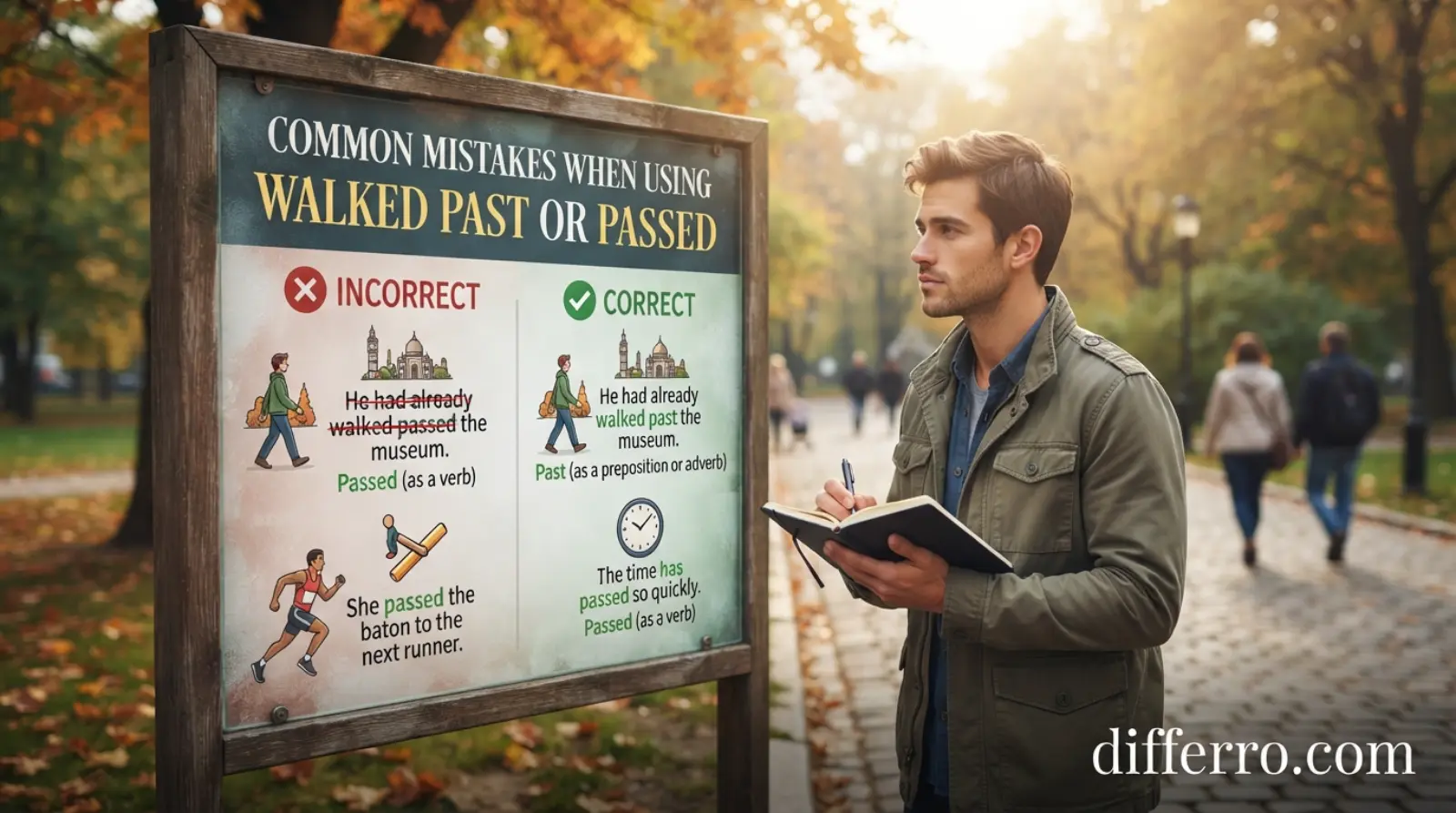
⚠️ Common Mistakes When Using Walked Past or Passed
Mistake 1: Using Walked Past for Exam Results
Incorrect: I walked past my mathematics exam.
Correct: I passed my mathematics exam.
Explanation: Use “passed” when you mean that you succeeded in an examination.
Mistake 2: Confusing Past With Passed
Incorrect: I walked passed the school.
Correct: I walked past the school.
Explanation: “Past” acts as a preposition describing movement beyond something. “Passed” is a verb.
Mistake 3: Assuming Passed Always Means Walking
Incorrect: The driver passed the road on foot.
Correct: The driver passed the road in his car.
Explanation: “Passed” can describe movement using different forms of transport.
Mistake 4: Using Walked Past for Transferring Objects
Incorrect: She walked past me the book.
Correct: She passed me the book.
Explanation: Use “passed” when someone gives or transfers an object.
Mistake 5: Confusing Past and Passed in Writing
Incorrect: Five minutes past before he arrived.
Correct: Five minutes passed before he arrived.
Explanation: Use “passed” as the verb describing time moving forward.
Mistake 6: Adding Unnecessary Words
Incorrect: I walked past by the grocery store.
Correct: I walked past the grocery store.
Explanation: “Past” already expresses movement beyond the location. You do not need another “by.”
🧠 Easy Trick to Remember
Remember this simple difference:
- Walked past = Walking + Beyond. Someone moves on foot beyond a person or place.
- Passed = Action or Result. Someone moves beyond something, succeeds in an exam, or transfers an object.
Memory trick: If your sentence specifically describes walking, consider “walked past.” If it describes success, transfer, or another action, use “passed.”
Examples:
- I walked past the school.
- I passed my examination.
🌍 Everyday-Life Examples: Walked Past or Passed
1. Walking Past a Friend
I walked past my friend at the market yesterday. I was in a hurry and could not stop to talk.
Primary keyword: Walked past.
Secondary keyword: Passed.
2. Passing a Driving Test
My sister passed her driving test last month. She practiced regularly before taking the examination.
Primary keyword: Passed.
Secondary keyword: Walked past.
3. Walking Past a Grocery Store
We walked past the grocery store on our evening walk. We decided to buy groceries on our way back.
Primary keyword: Walked past.
Secondary keyword: Passed.
4. Passing a Ball During a Game
The football player passed the ball to his teammate. His teammate scored a goal shortly afterward.
Primary keyword: Passed.
Secondary keyword: Walked past.
5. Passing Someone on the Road
A cyclist passed our car while we waited at a traffic signal. Later, we walked past the same cyclist near a park.
Primary keyword: Passed.
Secondary keyword: Walked past.
🌍 Google Trends and Usage Insights: USA, UK, Australia, India, and Pakistan
Google Trends measures relative search interest rather than exact search volume. The following observations are general expectations, not verified live rankings.
- USA: Searchers may look for past versus passed grammar explanations and everyday examples.
- UK: Both expressions appear in common British English writing and conversations.
- Australia: Users may search for grammar differences and correct sentence construction.
- India: English learners may focus on past, passed, and walked past sentence examples.
- Pakistan: Students and English learners may search for simple explanations and practical grammar rules.
SEO insight: Compare “walked past or passed,” “walked passed or walked past,” and “past vs passed” separately in Google Trends. Use the same date range and country filters. This helps identify actual regional search interest without inventing search-volume figures.
Comparison Table: Keyword Variations
| Keyword variation | Search intent | Suggested content placement |
|---|---|---|
| Walked past or passed | Direct grammar comparison | Title and introduction |
| Walked past vs passed | Meaning comparison | Key differences |
| Walked passed or walked past | Common spelling confusion | Common mistakes |
| Walk past or passed | Grammar clarification | FAQ section |
| Past vs passed | Word confusion | Related keywords |
| Passed or past grammar | Grammar learning | Meaning section |
| Walked by or passed by | Similar expressions | Origin and examples |
❓ Frequently Asked Questions
1. Is “walked past or passed” grammatically correct?
Yes, both expressions are grammatically correct. “Walked past” describes walking beyond something, while “passed” has several meanings. The correct choice depends on your intended meaning.
2. What is the difference between walked past and passed?
“Walked past” describes moving on foot beyond someone or something. “Passed” can describe movement, passing an examination, transferring an object, or time moving forward.
3. Which expression is more common, walked past or passed?
Both expressions are common in everyday English. However, “passed” has broader usage because it serves several grammatical and descriptive purposes.
4. Is walked past or passed more appropriate for formal writing?
Both expressions work in formal writing. Use “walked past” for specific walking actions and “passed” for exams, movement, transfers, and other meanings.
5. Why do people confuse walked past and passed?
People confuse these expressions because both can describe movement beyond something. Their similar sounds also contribute to mistakes. However, “past” and “passed” perform different grammatical roles.
🏆 Final Verdict: Walked Past or Passed?
Both “walked past” and “passed” are correct English expressions. However, they are not interchangeable in every sentence.
Use “walked past” when someone physically walks beyond a person, building, or object. Use “passed” when describing movement, exam success, transferring something, or the passage of time.
Remember that “past” describes position or movement beyond something, while “passed” is a verb form.
For example, “I walked past the school” describes a walking action. “I passed my examination” describes success.
Understanding this simple difference will improve your grammar and writing. Always choose the expression that matches your sentence’s meaning.
Conclusion
Walked past or passed? Both Walked Past or Passed expressions are correct, but their meanings and grammatical roles differ. “Walked past” describes someone moving on foot beyond a person, building, or object. “Passed” is the past tense and past participle of “pass.” It can describe movement, examination success, transferring objects, and time moving forward.
The easiest way to remember the difference is to connect “walked past” with physical walking. Use “passed” for other actions that involve passing or completing something. Avoid confusing “past” with “passed” because they serve different grammatical purposes. Learning these simple rules will help you write clearer sentences and avoid common English mistakes.

Imran Lodhra is a comparison-focused content writer at Differro.com.
He specializes in creating clear, simple, and informative comparison articles.
His work helps readers understand key differences, pros and cons, and important details.
Imran focuses on accurate, practical, and easy-to-read content for everyday readers.
2 thoughts on “Walked Past or Passed: Which Is Correct?”