
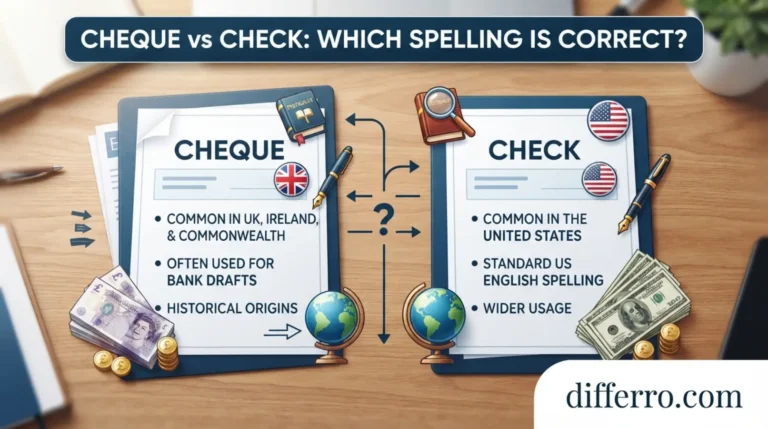
Cheque vs Check? Both Cheque vs Check spellings are correct, but their meanings and uses depend on the context. The main difference comes from British and American English. British English uses “cheque” for a written Payment order. American English uses “check” for the same banking document.
However, “check” has several other meanings in both varieties of English. It can mean examining something, confirming information, or marking a box. It can also describe controlling something or stopping its progress. These different meanings often confuse English learners and writers.
Choosing the correct spelling becomes easier when you know your audience and purpose. If you write for British, Australian, or many South Asian readers, “cheque” usually fits banking contexts. For American readers, “check” is the standard spelling. This guide explains their meanings, origins, differences, and everyday uses with simple examples.
⭐ Quick Answer
Cheque is the British English spelling for a banking document used to make payments. Check is the American English spelling for the same document. However, “check” also means to inspect, verify, or control something.
Example: “I wrote a cheque” is standard British English, while “I wrote a check” is standard American English.
📘 Meaning of Cheque
A cheque is a written instruction that tells a bank to pay a specific amount from someone’s account to another person or organization.
British English uses this spelling in banking and financial contexts. Countries such as the United Kingdom, Australia, and Pakistan commonly use “cheque” for this payment document.
A cheque usually includes the date, recipient’s name, amount, and account holder’s signature. Banks follow their applicable rules when processing it.
Examples of Cheque
Example 1: Sarah wrote a cheque to pay her electricity bill.
Example 2: The school received a cheque from a local donor.
When Does Cheque Apply?
Use “cheque” when discussing a bank payment document in British English or another region that follows this spelling.
Common phrases include:
- Bank cheque
- Cheque book
- Cheque payment
- Cheque deposit
- Bounced cheque
- Cheque account
Remember: “Cheque” refers to the payment document, not the general act of examining or verifying something.
📗 Meaning of Check
The word check has several meanings. American English uses it for a banking document, while British English uses it for many other purposes.
As a verb, “check” means to inspect, examine, or verify something. As a noun, it can mean an inspection, a restriction, or a marked symbol.
Examples of Check
Example 1: Please check your email before leaving the office.
Example 2: The waiter brought us the check after dinner.
The second example uses the American English word for a restaurant bill. British English commonly uses “bill” in this situation.
Common Meanings of Check
- Inspect: Check the door before leaving.
- Verify: Check whether the information is correct.
- Confirm: Check your appointment time.
- Control: The new rules help check rising costs.
- Payment document: He wrote a check to pay the rent.
- Restaurant bill: Could we have the check, please?
The intended meaning depends on the sentence and its context.
🔍 Cheque vs Check: Key Differences
The main difference concerns spelling conventions and meaning. Both words are correct, but they do not always serve the same purpose.
| Feature | Cheque | Check |
|---|---|---|
| Main banking meaning | Written bank payment instruction | Written bank payment instruction in American English |
| British English banking use | Standard | Not standard for the banking document |
| American English banking use | Not standard | Standard |
| General meaning | Usually refers to a payment document | Inspect, verify, control, or mark |
| Tone | Neutral and formal in banking | Neutral in everyday and formal writing |
| Common regions | UK, Australia, Pakistan, and other British English contexts | USA and general English usage for non-banking meanings |
| Example | I deposited a cheque. | I checked the account. |
Important: “Cheque” and “check” are interchangeable only when referring to the banking document across the two spelling systems. The word “check” has additional meanings that “cheque” does not share.
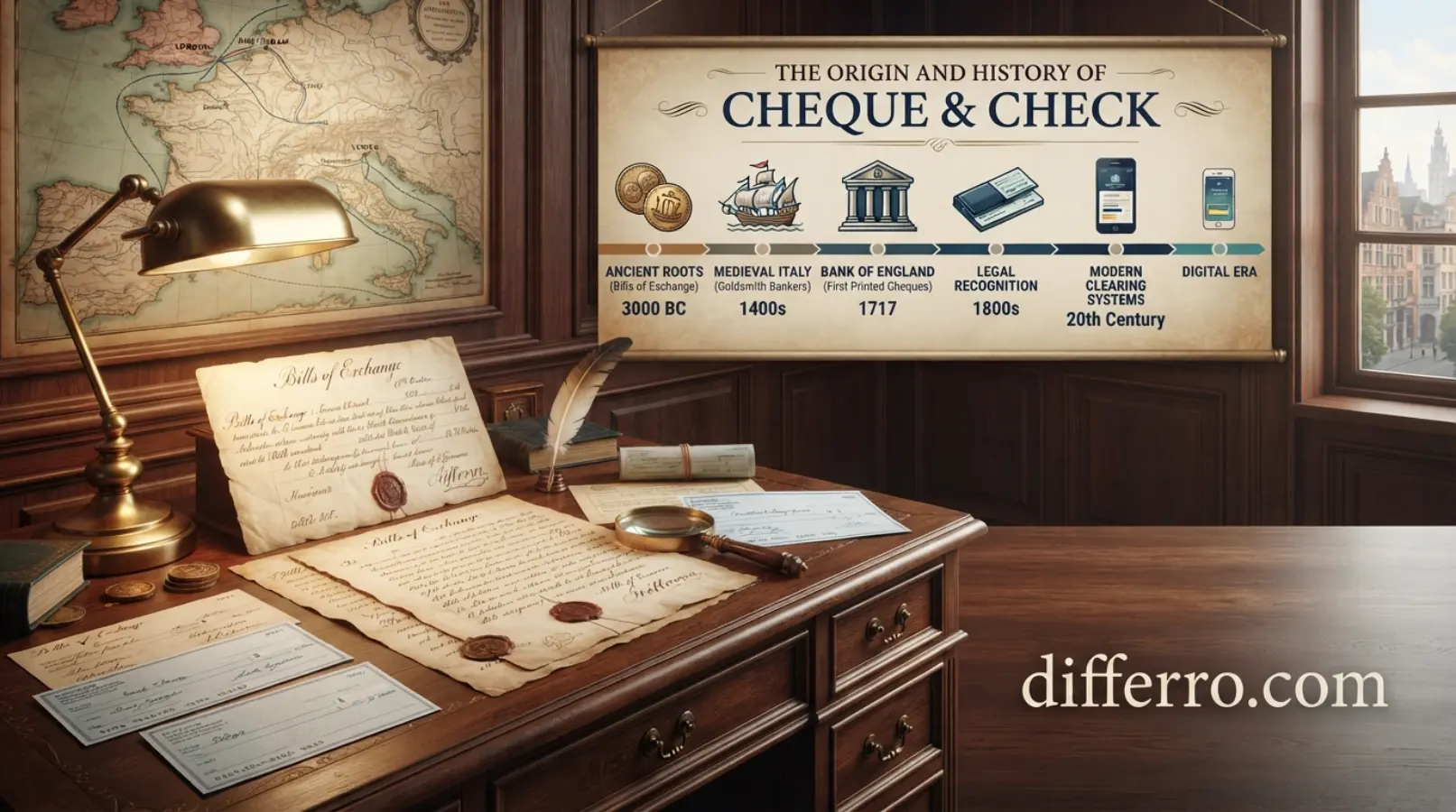
🕰️ Origin and History of Cheque and Check
The two spellings developed through different historical influences.
“Check” entered English through French and related historical forms. It developed several meanings, including examining, restraining, and verifying something.
“Cheque” emerged as a spelling for the banking document in British English. The spelling helped distinguish the financial meaning from other uses of “check.”
American English generally retained “check” for banking, while British English adopted “cheque.”
Similar British and American Spelling Differences
English contains several words with different spellings across regions. These differences usually do not change the basic meaning.
Examples include:
- Colour / Color: British and American spellings for the same word.
- Centre / Center: Different spellings for the same place or point.
- Cheque / Check: Different banking spellings.
- Travelling / Traveling: Different spelling conventions for the same activity.
- Defence / Defense: Different spellings for protection against attack.
🇬🇧 British English vs American English Spelling
British English uses “cheque” for a banking payment document. American English uses “check” for the same document.
Both varieties use “check” for actions such as inspecting, verifying, or confirming something.
Australian English and Pakistani English generally follow the British banking spelling, “cheque.”
British vs American English Comparison Table
| Situation | British English | American English |
|---|---|---|
| Bank payment document | Cheque | Check |
| Inspect something | Check | Check |
| Verify information | Check | Check |
| Restaurant payment request | Bill | Check |
| Payment document example | I wrote a cheque. | I wrote a check. |
| Verification example | Please check the figures. | Please check the figures. |
✍️ When to Use Cheque
Use “cheque” when writing about a banking document in British English or a region that follows British spelling.
1. When Making a Bank Payment
Use “cheque” when someone writes a payment instruction for a bank.
Example: The company issued a cheque to its supplier.
2. When Discussing Banking Services
Use “cheque” in financial documents, banking instructions, and payment records.
Example: Please bring your cheque book to the bank.
3. When Writing for British English Readers
Use “cheque” when your audience expects British spelling.
Example: The customer paid the outstanding amount by cheque.
4. When Writing for Pakistani or Australian Readers
“Cheque” is the standard spelling for the banking document in these English varieties.
Example: The office received a cheque for the approved amount.
✍️ When to Use Check
Use “check” for examining, verifying, confirming, or controlling something. This spelling works in both British and American English.
1. When Inspecting Something
Use “check” when you need to examine an object or situation.
Example: Please check the lock before leaving home.
2. When Verifying Information
Use “check” to confirm whether information is correct.
Example: I will check the figures before submitting the report.
3. When Marking a Box
Use “check” when marking a box on a form or list.
Example: Check the appropriate box on the application form.
4. When Requesting a Restaurant Bill
American English commonly uses “check” for the bill at a restaurant.
Example: Could we have the check, please?
In British English, “bill” is more common in this situation.
5. When Writing for an American Audience
Use “check” when referring to a banking document in American English.
Example: The landlord received the rent check yesterday.
⚠️ Common Mistakes With Cheque and Check
Understanding the difference helps you avoid spelling errors and regional confusion.
Mistake 1: Using Check for a British Banking Document
Incorrect: I sent a check to the British supplier.
Correct: I sent a cheque to the British supplier.
Explanation: Use “cheque” when following British banking spelling conventions.
Mistake 2: Using Cheque as a Verb
Incorrect: Please cheque the figures before submitting the report.
Correct: Please check the figures before submitting the report.
Explanation: “Check” means inspect or verify in both British and American English.
Mistake 3: Using Cheque for a Restaurant Bill
Incorrect: Could we have the cheque, please?
Correct in American English: Could we have the check, please?
Common British alternative: Could we have the bill, please?
Explanation: “Cheque” refers to a banking document, not a restaurant bill.
Mistake 4: Assuming Cheque Is Incorrect American English
Incorrect: “Cheque” is a misspelled word in every situation.
Correct: “Cheque” is standard British English for a banking document.
Explanation: Regional spelling conventions determine which form you should use.
Mistake 5: Using Check for Every Financial Context Without Considering Audience
Incorrect for standard British banking usage: I paid the supplier by check.
Correct: I paid the supplier by cheque.
Explanation: Match the spelling to your intended audience and regional convention.
🧠 Easy Trick to Remember
Use this simple memory trick:
- Cheque = British banking document.
- Check = American banking document.
- Check = inspect or verify in both varieties of English.
Remember the “que” in “cheque” as a clue that the word belongs to British-style banking terminology.
For everyday actions, such as checking a phone or checking information, always use “check.”
🌍 Everyday-Life Examples: Cheque or Check
1. Paying a School Fee
A parent writes a banking document to pay a child’s school fee.
British English: The parent paid the school fee by cheque.
American English: The parent paid the school fee by check.
Keyword usage: Both spellings are correct for their respective regional banking conventions.
2. Checking a Bank Statement
A customer wants to confirm a recent transaction.
British English: Please check your bank statement.
American English: Please check your bank statement.
Keyword usage: “Check” is correct in both varieties because it means verify.
3. Paying a Business Supplier
A business owner pays an invoice using a banking document.
British English: The business owner sent a cheque to the supplier.
American English: The business owner sent a check to the supplier.
Keyword usage: Choose “cheque or check” according to your audience’s spelling convention.
4. Requesting Payment at a Restaurant
A customer finishes a meal and asks to pay.
British English: Could we have the bill, please?
American English: Could we have the check, please?
Keyword usage: Use “bill” in common British restaurant usage and “check” in American English.
5. Completing an Application Form
A student selects an option on a school application.
British English: Check the box beside your preferred subject.
American English: Check the box beside your preferred subject.
Keyword usage: “Check” works in both varieties because it describes marking or selecting an option.
🌎 Google Trends and Usage Insights: USA, UK, Australia, India, and Pakistan
Google Trends measures relative search interest, not exact search volume. The following observations describe likely regional usage patterns, not verified live rankings.
- USA: “Check” is the standard spelling for banking documents and everyday verification.
- UK: “Cheque” is standard for banking documents, while “check” remains common for inspection.
- Australia: “Cheque” is the standard banking spelling, following British English conventions.
- India: “Cheque” is commonly used in banking, although search behavior varies by audience and context.
- Pakistan: “Cheque” is standard in banking and financial writing, while “check” remains common as a verb.
SEO insight: Compare “cheque or check,” “cheque vs check,” and “check spelling” separately in Google Trends. Select each country and the same date range for a fair comparison. Do not claim exact search volumes or country rankings without current data.
Comparison Table: Keyword Variations
| Keyword variation | Search intent | Recommended use |
|---|---|---|
| Cheque vs check | Spelling comparison | Main title and introduction |
| Cheque vs check | Direct comparison | Key differences section |
| Check or cheque spelling | Spelling clarification | Common mistakes section |
| Cheque meaning | Definition | Meaning section |
| Check meaning in English | Vocabulary learning | Definition section |
| British vs American cheque spelling | Regional spelling | British and American comparison |
| How to spell cheque in the USA | Regional spelling question | FAQ section |
❓ Frequently Asked Questions
1. Is “cheque or check” correct?
Yes. Both spellings are correct, but their use depends on the meaning and regional English convention. “Cheque” is standard British banking spelling, while “check” is standard American banking spelling.
2. What is the difference between cheque and check?
“Cheque” refers to a banking payment document in British English. “Check” refers to the same document in American English and also means inspect, verify, or control something.
3. Which spelling is more common?
The answer depends on the country and context. “Check” is standard for banking documents in the United States. “Cheque” is standard in the United Kingdom, Australia, and Pakistan.
4. Is cheque or check more formal?
Both are appropriate in formal writing when you follow the correct regional spelling. Use “cheque” for British-style banking documents and “check” for American banking documents.
5. Why do people confuse cheque and check?
Both spellings refer to the same banking document in different English varieties. However, “check” has additional meanings, including inspecting information and marking a box. These overlapping uses often confuse English learners.
🏆 Final Verdict: Cheque vs Check?
Neither spelling is universally better. The correct choice depends on your audience and the meaning you intend.
Use “cheque” when discussing a banking document in British English, Australian English, or Pakistani English. Use “check” for the same document when writing in American English.
For meanings such as inspect, verify, confirm, or mark a box, use “check” in both British and American English.
If you write for an international audience, choose one English style and use it consistently. This approach improves clarity and keeps your writing professional.
Conclusion
Cheque vs check is a common spelling question because British and American English follow different banking conventions. Both words are correct, but they serve different purposes depending on context.
Use “cheque” for a banking document in British English and other regions that follow its spelling. Use “check” for the same document in American English. Remember that “check” also means inspect, verify, or mark something in both varieties.
The easiest way to avoid mistakes is to identify your audience before writing. Follow one spelling style throughout your article, business document, or website. This keeps your writing clear and consistent. Once you understand the difference, choosing between cheque and check becomes simple.

Imran Lodhra is a comparison-focused content writer at Differro.com.
He specializes in creating clear, simple, and informative comparison articles.
His work helps readers understand key differences, pros and cons, and important details.
Imran focuses on accurate, practical, and easy-to-read content for everyday readers.
1 thought on “Cheque vs Check: Which Spelling Is Correct?”