
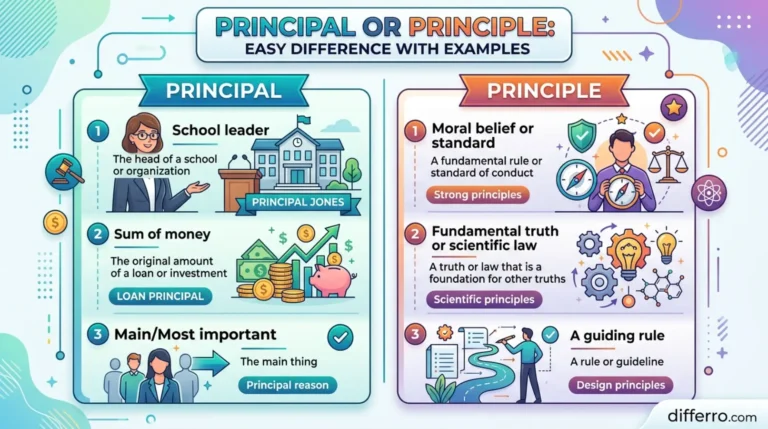
Principal vs Principle confuses many English learners because both words sound exactly alike. However, they have different spellings, meanings, and uses. Principal usually refers to a person in authority, something most important, or a financial amount. Principle refers to a rule, belief, standard, or basic truth. These words are homophones, so pronunciation cannot help you choose the correct spelling.
The good news is that the difference becomes simple when you focus on meaning. If you mean a school leader, main reason, or loan amount, use principal. If you mean a moral rule, scientific idea, or personal belief, use principle. This guide explains the difference with clear examples, common mistakes, memory tricks, and everyday sentences.
⭐ Quick Answer
Principal means a school leader, main person, main thing, or loan amount. Principle means a rule, belief, moral standard, or basic truth.
Example: The school principal follows strong moral principles.
📘 Meaning of Principal
Principal can work as both a noun and an adjective.
As a noun, it can mean a person in charge, especially a school leader. It can also mean the original amount of money borrowed or invested.
As an adjective, principal means main, primary, or most important.
Examples of Principal
- The principal welcomed the students on their first day.
- The principal reason for leaving was the long journey.
Another financial example is:
- I paid part of the principal on my home loan.
📗 Meaning of Principle
Principle is a noun. It refers to a rule, belief, standard, law, or fundamental truth.
People often use it when discussing morals, ethics, science, law, or personal values.
Examples of Principle
- Honesty is an important principle in our family.
- Scientists study the basic principles of physics.
You can also use it in common expressions.
- She refused the offer on principle.
- We agree in principle, but details remain.
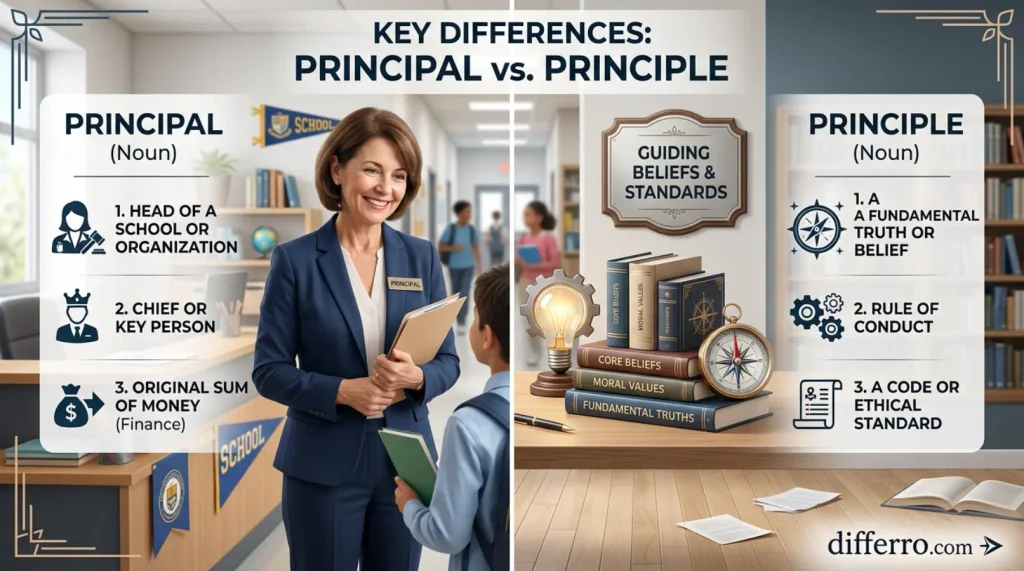
📊 Key Differences: Principal vs Principle
| Feature | Principal | Principle |
|---|---|---|
| Meaning | Main, leading, person in charge, or loan amount | Rule, belief, standard, or basic truth |
| Tone | Neutral and professional | Neutral, ethical, academic, or formal |
| Usage | Schools, business, finance, importance | Ethics, science, law, beliefs, rules |
| Popularity | Very common in everyday writing | Very common in formal and general writing |
| Part of speech | Noun and adjective | Mainly a noun |
| Example | The school principal arrived. | Honesty is a principle. |
Both words are correct. The choice depends entirely on the meaning of your sentence.
📚 Origin & History
Principal comes from Latin roots connected with the ideas of “first” and “chief.” It developed meanings connected with leadership and importance.
Principle comes from Latin roots connected with beginnings, foundations, and basic ideas. Its modern meaning developed around rules, truths, and guiding standards.
The two words look similar because they share related historical roots. Their modern meanings, however, became different.
Similar Word Examples
English contains many confusing word pairs with similar sounds or spellings.
- Affect vs effect
- Advice vs advise
- Compliment vs complement
- Stationary vs stationery
- Their vs there
- Accept vs except
Like these pairs, principal and principle require attention to meaning.
🇬🇧 British English vs American English Spelling
The spelling principal and principle stays the same in British and American English.
The main regional difference concerns school terminology. American English commonly uses principal, while British English commonly uses headteacher for a school leader.
There is no separate American spelling rule that changes principal into principle.
British vs American English Comparison
| Point | British English | American English |
|---|---|---|
| School leader | Usually headteacher | Usually principal |
| Main or most important | Principal | Principal |
| Rule or belief | Principle | Principle |
| Loan amount | Principal | Principal |
| Spelling difference | None | None |
🏫 When to Use Principal
♥︎Use principal when you mean a person with authority.
- The school principal spoke to the parents.
- The company principal approved the agreement.
Use principal when you mean something main or most important.
- Safety is our principal concern.
- The principal cause was poor planning.
♥︎Use principal for the original amount of a loan or investment.
- She paid $2,000 toward the loan principal.
- Interest applies to the remaining principal balance.
📜 When to Use Principle
♥︎Use principle when you mean a rule or belief.
- Respect is an important principle.
- The organization follows strict ethical principles.
Use principle for a basic scientific or general truth.
- The machine works according to a simple principle.
- Students learned the basic principles of chemistry.
♥︎Use principle in common phrases.
- In principle, I agree with your idea.
- He refused to compromise on principle.
- It became a matter of principle.
The expression “in principal” is incorrect when you mean “in theory.”
⚠️ Common Mistakes
Mistake 1: Writing “school principle”
❌ The school principle welcomed the students.
✅ The school principal welcomed the students.
A school leader is a principal.
Mistake 2: Writing “principle reason”
❌ Cost was the principle reason for the change.
✅ Cost was the principal reason for the change.
Here, principal means “main.”
Mistake 3: Writing “in principal”
❌ We agree in principal with the proposal.
✅ We agree in principle with the proposal.
The correct expression is in principle.
Mistake 4: Writing “principle amount”
❌ I paid part of the principle amount.
✅ I paid part of the principal amount.
A loan’s original amount is the principal.
Mistake 5: Writing “moral principal”
❌ Honesty is an important moral principal.
✅ Honesty is an important moral principle.
A moral rule or belief is a principle.
🧠 Easy Trick to Remember
Use this simple memory trick:
Principal = PAL
The word principal ends with pal.
Think:
“The principal is my pal.”
This trick works especially well for remembering a school principal.
For the other word, think:
Principle = Rule
A principle is often a rule, belief, or standard.
You can also use this three-word test:
- Person → Principal
- Main → Principal
- Rule → Principle
For finance, remember:
Money borrowed → Principal
These shortcuts make the difference much easier to remember.
🌟 Everyday Life Examples
1. At School
The principal announced the new school schedule.
The word principal refers to the person leading the school.
Primary keyword: principal vs principle
Secondary keyword: school principal
2. At Work
Customer safety is the principal concern of the company.
Here, principal means the most important concern.
Primary keyword: principal vs principle
Secondary keyword: principal meaning
3. In Personal Life
She follows the principle of treating everyone fairly.
Here, principle means a personal moral rule.
Primary keyword: principal vs principle
Secondary keyword: principle meaning
4. In Finance
The bank calculated the interest on the remaining principal.
Here, principal means the original loan amount.
Primary keyword: principal vs principle
Secondary keyword: principal amount
5. In Science
Students learned the basic principles of electricity.
Here, principles means fundamental rules or ideas.
Primary keyword: principal vs principle
Secondary keyword: principles definition
🔎 Related Keywords
- principal vs principle difference
- principal or principle
- principal and principle examples
- principal meaning
- principle meaning
- principal spelling
- principle spelling
🏆 Final Verdict
Both principal and principle are correct words.
Choose principal for a school leader, person in authority, main idea, important factor, or loan amount.
Choose principle for a rule, belief, moral value, standard, or fundamental truth.
The easiest test is to ask what you mean.
If you mean person, main, or money, choose principal.
If you mean rule, belief, or basic truth, choose principle.
Remembering this distinction will help you avoid one of English’s most common spelling confusions.
📈 Google Trends & Usage Data
Google Trends does not provide a permanent, text-based ranking that confirms one spelling’s exact popularity across all five countries. Search interest can also change by topic and time. However, principal has broad everyday uses in education, importance, business, and finance. Principle appears strongly in discussions about ethics, science, law, and beliefs.
Across the USA, UK, Australia, India, and Pakistan, both terms remain established English words. School terminology creates especially strong usage for principal in American English, while British English commonly uses headteacher for the school role.
For SEO, searches around principal vs principle, principal or principle, and principal vs principle difference match clear comparison intent. These variations serve readers who need a quick spelling and meaning answer.
Country Usage Insight
| Country | Principal Usage | Principle Usage | Key Insight |
|---|---|---|---|
| USA | Very common | Very common | “School principal” is standard |
| UK | Common | Very common | “Headteacher” often replaces school principal |
| Australia | Common | Very common | Both appear in education and formal writing |
| India | Very common | Very common | “School principal” is widely used |
| Pakistan | Very common | Very common | Both appear in education and academic writing |
Keyword Variations Comparison
| Keyword Variation | Search Intent | Best Content Focus |
|---|---|---|
| Principal vs Principle | Comparison | Complete difference |
| Principal or Principle | Spelling confusion | Which word is correct |
| Principal vs Principle Difference | Informational | Meaning and examples |
| Principal Meaning | Definition | Uses of principal |
| Principle Meaning | Definition | Rules and beliefs |
| Principal and Principle Examples | Learning | Sentence examples |
| In Principle vs In Principal | Grammar | Correct expression |
❓ FAQ
Is “principal” correct?
Yes. Principal is correct when you mean a school leader, main thing, person in authority, or loan amount.
What is the difference between principal and principle?
Principal means main, leading, a person in charge, or a financial amount. Principle means a rule, belief, standard, or basic truth.
Which word is more common, principal or principle?
Both are common. Principal has several everyday meanings, while principle appears widely in ethical, scientific, legal, and academic contexts.
Is principal more formal than principle?
Neither word is automatically more formal. Their meanings determine their use. Both work in formal and everyday English.
Why do people confuse principal and principle?
They confuse them because both words have nearly identical spelling and the same pronunciation. Their meanings and grammatical roles differ.
✍️ Conclusion
Principal vs Principle becomes easy once you understand what each word means. Principal refers to a school leader, person in authority, main thing, or loan amount. Principle refers to a rule, belief, standard, or basic truth. Both words sound alike, but their spellings and meanings differ. Use principal when you mean “main,” “leader,” or “money.” Use principle when you mean “rule,” “belief,” or “fundamental idea.” Remember the simple trick: the principal is your pal, while a principle is a rule. These shortcuts can help you choose the correct spelling quickly. With regular practice, you can use both words confidently in school, work, finance, and everyday writing.

Imran Lodhra is a comparison-focused content writer at Differro.com.
He specializes in creating clear, simple, and informative comparison articles.
His work helps readers understand key differences, pros and cons, and important details.
Imran focuses on accurate, practical, and easy-to-read content for everyday readers.