
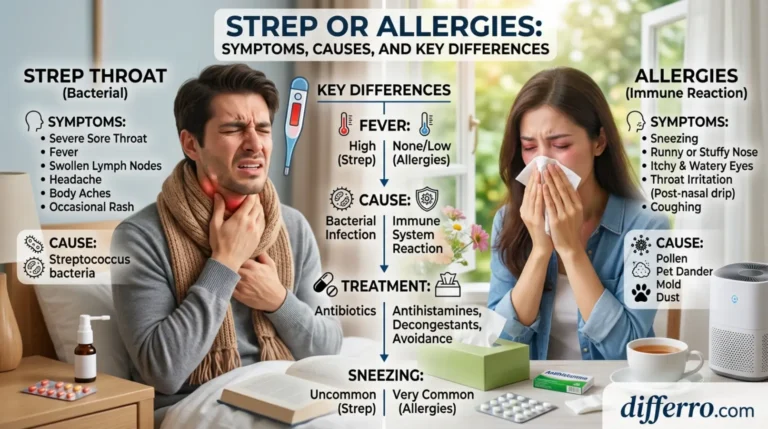
Strep Or Allergies can be difficult to distinguish when you have a sore or irritated throat. Both conditions can cause throat discomfort, but they have different causes and symptoms. Strep throat is a bacterial infection caused by group A Streptococcus, while allergies happen when the immune system reacts to allergens. (CDC)
Allergies often cause sneezing, an itchy nose, watery eyes, congestion, and a mild scratchy throat. Strep throat more often causes sudden throat pain, painful swallowing, fever, and swollen neck glands. Cough and runny nose are less typical of strep. (Cleveland Clinic)
Knowing these differences can help you understand your symptoms. Still, symptoms alone cannot always confirm strep. A healthcare professional may use a rapid strep test or throat culture. (Johns Hopkins Medicine)
⚡ Quick Answer
Strep Or Allergies usually differ by symptom pattern. Strep often causes sudden severe throat pain, fever, and painful swallowing. Allergies commonly cause sneezing, itchy or watery eyes, congestion, and a scratchy throat.
Example: Fever with sudden throat pain and no cough may suggest strep. Sneezing with itchy eyes and a clear runny nose points more toward allergies.
🔎 Meaning of Strep Throat
Strep throat is a bacterial infection caused by group A Streptococcus. It commonly affects the throat and tonsils. (Mayo Clinic)
Common symptoms can include:
- Sudden sore throat
- Pain when swallowing
- Fever
- Swollen neck glands
- Red or swollen tonsils
- Sometimes white patches on the tonsils
- Headache
- Stomach pain or nausea in some children
Example 1:
“Sarah developed a sudden sore throat and fever, so her doctor tested her for strep.”
Example 2:
“Tom had painful swallowing and swollen neck glands without a cough.”
🌿 Meaning of Allergies
Allergies happen when your immune system reacts to substances called allergens. Common triggers include pollen, dust, mold, and pet dander. (Mayo Clinic)
Allergies may cause:
- Sneezing
- Itchy eyes
- Watery eyes
- Clear runny nose
- Nasal congestion
- Itchy or scratchy throat
- Postnasal drip
- Mild coughing
Example 1:
“Maria gets a scratchy throat and watery eyes when pollen levels rise.”
Example 2:
“Ali sneezes frequently after exposure to dust and pet dander.”
📊 Strep Or Allergies: Key Differences
| Feature | Strep Throat | Allergies |
|---|---|---|
| Meaning | Bacterial throat infection | Immune reaction to allergens |
| Main cause | Group A Streptococcus bacteria | Pollen, dust, mold, pet dander, and other allergens |
| Throat pain | Often sudden and stronger | Usually mild or scratchy |
| Fever | Common | Usually absent |
| Sneezing | Usually absent | Common |
| Runny nose | Usually absent | Common |
| Itchy eyes | Uncommon | Common |
| Cough | Usually absent | Can occur |
| Swollen glands | Can occur | Less typical |
| White tonsil patches | Can occur | Not typical |
| Contagious | Yes | No |
| Diagnosis | Often requires testing | Usually based on symptoms and history |
These patterns can provide clues, but they do not replace medical testing. (CDC)
📚 Origin & History
The word strep comes from Streptococcus, the name of a group of bacteria. The term comes from Greek roots associated with twisted or chain-like forms.
Allergy comes from Greek roots meaning an altered or different reaction. The modern medical term describes an immune response to substances that are usually harmless.
Similar medical terms include:
- Strep throat
- Streptococcal infection
- Allergic rhinitis
- Seasonal allergies
- Hay fever
- Sore throat
Strep throat has a specific bacterial cause. Allergies have environmental or immune triggers.
🇬🇧 British English vs American English Spelling
Strep and allergies are spelled the same in British and American English.
The main difference may appear in related words, such as tonsilitis versus the American spelling tonsillitis.
The terms strep throat and allergies remain widely understood in both varieties of English.
British vs American English Comparison
| Term | British English | American English |
|---|---|---|
| Strep throat | Strep throat | Strep throat |
| Allergies | Allergies | Allergies |
| Allergy | Allergy | Allergy |
| Sore throat | Sore throat | Sore throat |
| Tonsils | Tonsils | Tonsils |
🦠 When to Use “Strep Throat”
Use strep throat when discussing a suspected or confirmed bacterial throat infection.
Examples:
- “The doctor tested her for strep throat.”
- “He had a fever and severe throat pain from strep throat.”
- “A positive strep test can help confirm the infection.”
A healthcare professional should confirm suspected strep before antibiotic treatment. Rapid tests and throat cultures can help diagnose the infection. (Johns Hopkins Medicine)
🌼 When to Use “Allergies”
Use allergies when symptoms result from exposure to allergens.
Examples:
- “My allergies become worse during pollen season.”
- “Her allergies cause sneezing and itchy eyes.”
- “Dust can trigger his allergies.”
Allergy symptoms commonly include sneezing, nasal congestion, clear discharge, and itchy or watery eyes. (Valley Health Link)
❌ Common Mistakes
1. Calling Every Sore Throat Strep
Incorrect:
“Every sore throat means I have strep.”
Correct:
“A sore throat can have many causes, including viruses, allergies, and strep.”
Most sore throats are caused by viruses rather than strep bacteria. (CDC)
2. Assuming Allergies Cause Fever
Incorrect:
“My fever must be from seasonal allergies.”
Correct:
“Fever is more suggestive of an infection than typical allergies.”
3. Thinking a Cough Means Strep
Incorrect:
“I have a cough, so I probably have strep.”
Correct:
“A cough is less typical of strep and can point toward another cause.”
4. Using Antibiotics for Allergies
Incorrect:
“I should take antibiotics for my allergies.”
Correct:
“Antibiotics do not treat allergies.”
Antibiotics are used for appropriate bacterial infections, not allergic reactions or viral illnesses. (CDC)
5. Diagnosing Strep From Symptoms Alone
Incorrect:
“My throat hurts, so I know it is strep.”
Correct:
“A healthcare professional may need a strep test to confirm the diagnosis.”
🧠 Easy Trick to Remember
Remember this simple rule:
“Fever and fast throat pain? Think strep. Sneezing and itching? Think allergies.”
Another quick memory tip is:
- Strep = Severe throat + Fever
- Allergies = Itching + Sneezing
These clues are helpful, but they cannot guarantee a diagnosis.
🏠 Everyday Life Examples
1. Waking Up With a Scratchy Throat
You wake up with a mild scratchy throat, stuffy nose, and sneezing.
Likely clue: Allergies may be involved.
This pattern fits strep or allergies symptoms better on the allergy side.
2. Sudden Throat Pain at School
A child suddenly develops severe throat pain and fever.
Likely clue: Strep throat should be considered.
A healthcare professional may recommend a strep test.
3. Springtime Sneezing
You experience sneezing, itchy eyes, and a clear runny nose every spring.
Likely clue: Seasonal allergies are more likely.
This is a common allergies vs strep throat comparison.
4. Painful Swallowing With Fever
Your throat becomes painful quickly, and swallowing hurts.
Likely clue: Strep may be possible.
A test can help determine the cause.
5. Itchy Eyes and Postnasal Drip
Your eyes feel itchy while mucus drains into your throat.
Likely clue: Allergies may be causing throat irritation.
Postnasal drip can make an allergy-related sore throat worse. (Mayo Clinic)
📈 Google Trends & Usage Insight: USA, UK, Australia, India, Pakistan
Search interest around strep throat, allergies, and related symptom comparisons tends to rise when people experience seasonal respiratory symptoms. Interest can vary by season and local allergy patterns.
In the USA and Canada-like northern climates, allergy-related searches often increase during major pollen seasons. The UK and Australia can show different seasonal patterns because their seasons occur at opposite times.
In India and Pakistan, searches can also rise during periods of changing weather, dust exposure, and respiratory illness. These patterns are best viewed as seasonal signals rather than proof of a diagnosis.
Google Trends does not establish medical prevalence. Search volume also changes with news, outbreaks, weather, and public awareness.
📊 Keyword Variations Comparison
| Keyword Variation | Search Intent | Main Topic |
|---|---|---|
| Strep Or Allergies | Comparison | Identify likely cause |
| Strep Throat vs Allergies | Comparison | Compare symptoms |
| Allergies vs Strep Throat | Comparison | Compare symptoms |
| Is It Strep or Allergies | Question | Symptom identification |
| Strep or Allergies Symptoms | Informational | Symptoms |
| Strep Throat Symptoms | Informational | Strep |
| Allergy Symptoms | Informational | Allergies |
🚨 When Should You Seek Medical Advice?
Contact a healthcare professional when you have a severe or persistent sore throat, especially with fever or painful swallowing.
Testing is important when strep is suspected because symptoms can overlap with other illnesses. (Johns Hopkins Medicine)
Seek urgent medical help for serious symptoms such as:
- Trouble breathing
- Severe difficulty swallowing
- Signs of dehydration
- Rapidly worsening symptoms
- Severe swelling
Do not start antibiotics simply because you have a sore throat. The correct treatment depends on the cause.
❓ Frequently Asked Questions
Is it correct to say “strep or allergies”?
Yes. “Strep or allergies” is a natural phrase when comparing possible causes of throat symptoms.
What is the difference between strep and allergies?
Strep is a bacterial infection. Allergies are immune reactions to allergens. Strep often causes sudden throat pain and fever, while allergies commonly cause sneezing, itching, and watery eyes. (CDC)
Which is more common, strep or allergies?
Both are common health concerns, but they are different conditions. Most sore throats are caused by viruses, while allergies are another common cause of throat irritation. (CDC)
Is “strep or allergies” formal usage?
It is understandable and common in everyday health searches. Medical writing usually uses more specific terms such as strep throat, streptococcal infection, or allergic rhinitis.
Why does confusion between strep and allergies exist?
Both conditions can cause throat discomfort. However, their other symptoms often differ. Sneezing and itchy eyes favor allergies, while sudden severe throat pain and fever can suggest strep. (Cleveland Clinic)
⚖️ Final Verdict
Strep Or Allergies are not the same condition.
Choose strep throat when discussing a bacterial throat infection caused by group A Streptococcus. Choose allergies when symptoms result from allergens such as pollen, dust, mold, or pet dander.
A sudden severe sore throat with fever may make strep more likely. Sneezing, itchy eyes, congestion, and a scratchy throat point more toward allergies. However, symptoms can overlap, so suspected strep may require testing. (CDC)
📝 Conclusion
Strep Or Allergies can look similar at first, especially when throat irritation is the main symptom. The Strep throat is a bacterial infection, while allergies are an immune response to allergens. Strep often brings sudden throat pain, painful swallowing, fever, and swollen neck glands. Allergies more often cause sneezing, congestion, itchy eyes, and a scratchy throat. (Cleveland Clinic)
The most useful clue is the overall symptom pattern. A fever with sudden severe throat pain deserves medical attention. Itchy eyes and repeated sneezing often fit allergies. Still, you should not diagnose strep from symptoms alone. A rapid test or throat culture may be needed. When symptoms are severe, worsening, or unclear, speak with a healthcare professional.

Imran Lodhra is a comparison-focused content writer at Differro.com.
He specializes in creating clear, simple, and informative comparison articles.
His work helps readers understand key differences, pros and cons, and important details.
Imran focuses on accurate, practical, and easy-to-read content for everyday readers.
1 thought on “Strep Or Allergies: Symptoms, Causes, and Key Differences”