
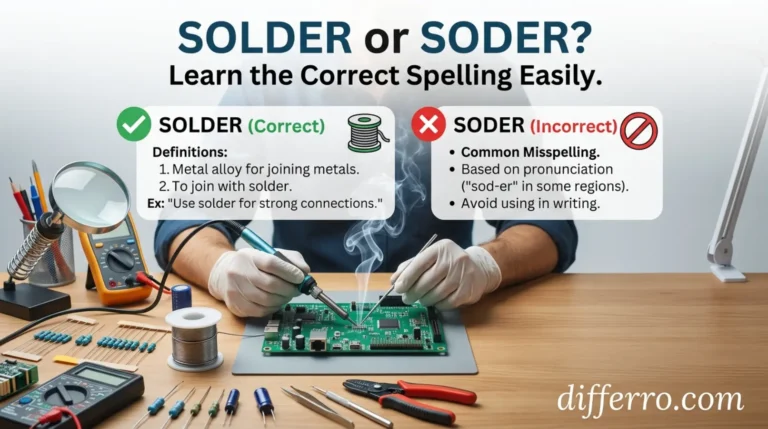
Soder or Solder can cause confusion because both spellings may sound similar in everyday speech. The correct modern English spelling is solder. It refers to a metal alloy used to join wires, electronic parts, pipes, and other metal surfaces. It also works as a verb meaning to join something with solder.
The confusion mainly comes from pronunciation. In American English, the l in solder usually does not sound clearly. This can make the word seem like “soder” when spoken. However, pronunciation does not change the standard spelling. Solder remains the correct choice in modern English writing. The spelling soder exists in older English sources, but modern writers should normally use solder.
⭐ Quick Answer
Solder is the correct and standard modern spelling. Soder is mainly an obsolete historical spelling and should not replace solder in modern writing.
Example:
✅ I need to solder these wires together.
❌ I need to soder these wires together.
Meaning of Solder
Solder is a metal or mixture of metals that melts and joins metal surfaces when it cools. It commonly appears in electronics, jewelry making, plumbing, and repair work.
As a verb, solder means to join metal parts using solder.
Examples:
- The technician used solder to repair the circuit.
- She learned how to solder two wires together.
The word can also appear in related forms such as soldered, soldering, and solderer.
Meaning of Soder
Soder has historical evidence as an older form of solder. Older dictionaries recorded soder as a noun and verb. Modern dictionaries classify it as an obsolete form.
Examples from historical usage:
- The craftsman used soder to join metal pieces.
- The metal parts were sodered together.
These examples reflect historical spelling. Modern writers should use solder instead.
🔎 Soder or Solder: Key Differences
| Feature | Soder | Solder |
|---|---|---|
| Meaning | Historical form of solder | Metal alloy or joining process |
| Tone | Obsolete or historical | Modern and standard |
| Usage | Rare in modern English | Common in technical writing |
| Popularity | Very low | Much more common |
| Modern writing | Usually avoid | Recommended |
| Electronics | Not standard | Standard |
| Verb form | Historical | Modern |
📜 Origin and History
The history of solder goes back to Middle English. It developed through Old French forms and ultimately connects with the Latin solidare, meaning “to make solid” or “fasten together.”
Merriam-Webster records solder as a noun from the 14th century and as a verb from the 15th century.
Older English also used spellings such as soder. Historical dictionaries show soder as a spelling connected with the same meaning.
Similar historical spelling changes appear in many English words. Examples include colour/color, theatre/theater, and older forms that changed over time.
🇬🇧 British English vs American English Spelling
British and American English use solder as the standard spelling.
The main difference appears in pronunciation rather than spelling.
American speakers commonly pronounce the word without a clearly heard l, which helps explain the soder confusion.
British vs American English Comparison
| Feature | British English | American English |
|---|---|---|
| Standard spelling | solder | solder |
| Common pronunciation | Often includes an audible l | Usually no clearly heard l |
| Soder as modern spelling | Not standard | Not standard |
| Recommended writing | solder | solder |
✍️ When to Use Solder
Use solder when you mean the material used to join metal parts.
Examples:
- The electrician bought a roll of solder.
- This solder melts at a low temperature.
- The repair requires lead-free solder.
Use solder as a verb when describing the joining process.
Examples:
- I need to solder the loose wire.
- The technician will solder the connection.
- She can solder small electronic components.
📖 When to Use Soder
Use soder only when discussing historical spelling or quoting an older source.
Examples:
- The old dictionary listed soder as a word.
- The historical document uses soder instead of solder.
For modern schoolwork, websites, emails, manuals, and technical documents, choose solder.
⚠️ Common Mistakes
1. Writing Soder Because It Sounds Right
❌ I need to soder the wire.
✅ I need to solder the wire.
Pronunciation does not always reveal English spelling.
2. Removing the L From Soldered
❌ The wire was sodered to the board.
✅ The wire was soldered to the board.
The standard spelling keeps the l.
3. Writing Sodering
❌ He is sodering the circuit.
✅ He is soldering the circuit.
The correct form comes from solder + ing.
4. Treating Soder and Solder as Equal Modern Choices
❌ You can use either spelling in formal writing.
✅ Use solder in modern standard English.
Soder has historical usage, but it is not the normal modern spelling.
5. Changing Solder to Soder in Technical Content
❌ The technician used soder on the circuit board.
✅ The technician used solder on the circuit board.
Technical writing should use the recognized modern form.
🧠 Easy Trick to Remember
Think of the word solid.
SOLDER → SOLID → JOIN
Solder helps join metal parts and creates a solid connection.
The connection between solder and Latin solidare also makes this memory trick useful.
Remember this simple rule:
The L stays in solder, even when you cannot clearly hear it.
🔧 Soder or Solder in Everyday Life
1. Repairing a Circuit Board
A technician may solder tiny components onto a circuit board.
The correct spelling is solder, not soder.
2. Fixing Loose Wires
A loose wire may need solder to create a strong connection.
You can also say, “I need to solder the wire.”
3. Making Jewelry
Jewelry makers use solder to join small metal pieces.
The process requires careful heating and controlled application.
4. Working With Electronics
DIY electronics projects often require soldering tools and materials.
A beginner may learn to solder wires and components.
5. Writing Technical Instructions
Technical manuals should use solder, soldered, and soldering.
Avoid soder, sodered, and sodering in modern instructions.
📊 Google Trends & Usage Data
Google Trends comparisons can change by country and time period. A directional comparison shows a clear advantage for solder across the USA, UK, Australia, India, and Pakistan.
Solder also appears consistently in modern dictionaries and technical usage. Soder mainly appears in historical references or as a spelling based on pronunciation.
For SEO, solder should be the primary keyword. Soder or solder works well as a comparison keyword because users search the phrase when checking the spelling.
Keyword Variations Comparison
| Keyword Variation | Modern Status | SEO Intent |
|---|---|---|
| solder | Standard | Definition and usage |
| soder | Historical/incorrect in modern usage | Spelling confusion |
| soder or solder | Comparison phrase | Spelling question |
| solder vs soder | Comparison phrase | Difference search |
| how to spell solder | Standard spelling | Spelling intent |
| is soder a word | Historical curiosity | Word validity |
| solder meaning | Standard | Definition intent |
🌎 Country Usage Insight
| Country | Preferred Modern Spelling | Main Search Intent |
|---|---|---|
| 🇺🇸 USA | solder | Spelling and technical use |
| 🇬🇧 UK | solder | Spelling and pronunciation |
| 🇦🇺 Australia | solder | Technical and educational use |
| 🇮🇳 India | solder | Electronics and spelling |
| 🇵🇰 Pakistan | solder | Electronics and English usage |
The strongest SEO opportunity comes from targeting soder or solder as the comparison phrase. The article should then establish solder as the correct modern spelling.
🏆 Final Verdict
Solder is the correct spelling for modern English.
Use solder for electronics, plumbing, jewelry, repairs, technical writing, schoolwork, and professional communication.
Soder has historical dictionary evidence, but it is now obsolete in ordinary modern English.
The confusion mainly comes from pronunciation. American English often does not clearly pronounce the l in solder.
Best choice:
✅ solder = modern standard spelling
⚠️ soder = historical or obsolete form
❓ Frequently Asked Questions
Is “soder” correct?
Soder is an old spelling of solder, but it is not the standard modern spelling. Use solder in current writing.
What is the difference between soder and solder?
Solder is the standard modern spelling. Soder is mainly an obsolete historical spelling. Both forms have referred to joining metal with a metallic substance.
Which is more common, soder or solder?
Solder is far more common in modern English. It is the established spelling used in dictionaries and technical writing.
Is solder formal or informal?
Solder works in both everyday and formal contexts. It is especially common in technical, engineering, electronics, manufacturing, and repair writing.
Why does soder cause confusion?
The confusion comes mainly from pronunciation. American English commonly pronounces solder without a clearly audible l. This can make the spelling look like soder.
📝 Conclusion
Soder or solder is a spelling question with a simple answer: solder is the correct modern spelling. It refers to a metal alloy used to join metal surfaces and also works as a verb for the joining process. The spelling soder appeared in older English sources, but it is now considered obsolete in normal modern usage. The unusual spelling of solder often causes confusion because its pronunciation can hide the l, especially in American English. For school assignments, websites, emails, technical documents, electronics guides, and professional writing, always choose solder. Remember the easy trick: solder helps make a solid connection. That connection can help you remember the correct spelling every time.

Imran Lodhra is a comparison-focused content writer at Differro.com.
He specializes in creating clear, simple, and informative comparison articles.
His work helps readers understand key differences, pros and cons, and important details.
Imran focuses on accurate, practical, and easy-to-read content for everyday readers.
1 thought on “Solder or Soder : Learn the Correct Spelling Easily”