
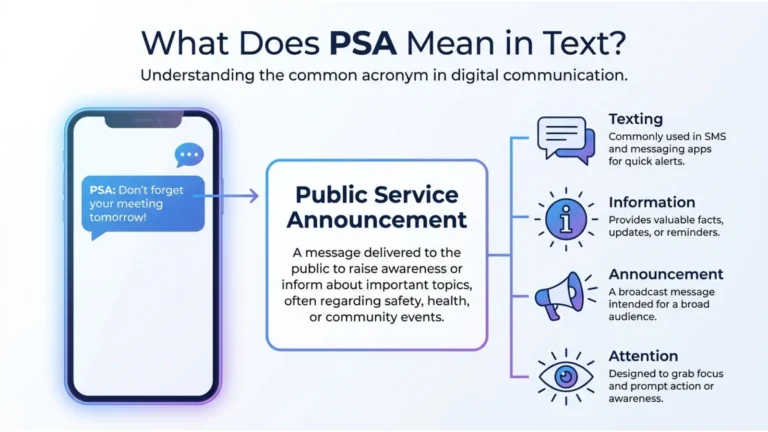
PSA meaning slang is something people often search for after seeing “PSA” in a text, TikTok caption, Instagram post, group chat, or online comment.
While PSA may look like a complicated abbreviation, its meaning is usually simple. In everyday online communication, people use it to introduce information they think others should know. It can sound serious, helpful, funny, or slightly dramatic depending on the situation.
You may see someone write “PSA: Don’t forget your umbrella” or “PSA, this restaurant is amazing!” In most cases, the person is making a quick announcement or drawing attention to an important point. Understanding the context helps you know exactly how the abbreviation is being used.
Quick Answer
PSA meaning slang is usually “Public Service Announcement.” In texts and social media, people use PSA to introduce a helpful, important, or attention-grabbing message.
Example: “PSA: The deadline is tomorrow, so submit your form today.”
What Does PSA Mean in Text?
In texting and online conversations, PSA most commonly stands for “Public Service Announcement.”
Traditionally, a public service announcement is a message designed to inform the public about something important, such as safety, health, or community information.
Online, however, PSA has become much more casual.
Someone may type “PSA:” before sharing:
- A helpful tip
- An important reminder
- A warning
- A personal opinion
- A funny observation
- News their friends should know
- A recommendation
For example:
“PSA: Bring a jacket tonight. It’s freezing outside.”
Here, the person is not making an official announcement. They are simply using PSA to make their message stand out.
PSA Full Form and Definition
The most common PSA full form in texting is:
PSA = Public Service Announcement
A public service announcement traditionally provides information intended to benefit or educate the public.
On social media and in chats, the phrase is often used in a playful or informal way.
What Does PSA Stand For?
If you’re wondering “what does PSA stand for?”, the answer depends on context.
In everyday texting:
PSA = Public Service Announcement
In other fields, PSA can have completely different meanings. For example, in medicine, PSA can refer to prostate-specific antigen. That meaning is unrelated to internet slang.
Therefore, always look at the surrounding words before deciding what PSA means.
PSA Meaning in Different Contexts
The meaning and tone of PSA can change depending on where you see it.
1. PSA in Text Messages
In a private text, PSA usually introduces a reminder or piece of information.
Example:
“PSA: We’re meeting at 7, not 8.”
The sender is simply making sure everyone knows the correct time.
2. PSA on Social Media
On platforms such as Instagram, TikTok, Facebook, or X, PSA is commonly used before a public-facing message.
Example:
“PSA: Stop leaving your phone charger at home.”
The statement may be serious, humorous, or exaggerated.
3. PSA in Group Chats
Friends often use PSA to get everyone’s attention.
Example:
“PSA: The movie starts in 20 minutes!”
It makes an ordinary reminder sound like an important announcement.
4. PSA in a Funny or Sarcastic Way
People also use PSA jokingly.
Example:
“PSA: Pizza tastes better when someone else pays for it.”
This isn’t a real public announcement. The writer is using the familiar format for humor.
Is PSA Rude, Offensive, or Neutral?
PSA is generally neutral and not offensive.
The abbreviation itself does not contain an insult or offensive meaning.
However, the message following PSA can affect how the entire statement feels.
For example:
- “PSA: Drink some water.” — Friendly
- “PSA: Read the instructions before asking questions.” — Could sound annoyed
- “PSA: You really need to stop doing that.” — Potentially critical
So, PSA is usually safe, but tone depends on the words around it.
Where Is PSA Commonly Used?
You may encounter PSA in many forms of digital communication, including:
- Text messages
- Group chats
- Instagram captions
- TikTok captions
- Facebook posts
- X posts
- Reddit discussions
- Discord conversations
- Online forums
- Comments and memes
- Workplace chats
It is especially common when someone wants their message to get attention quickly.
Real-Life PSA Conversation Examples
Friendly Example
Alex: “PSA: The café closes early today.”
Sam: “Thanks for letting me know!”
Here, PSA introduces a useful reminder.
Casual Example
Mia: “PSA: The new episode is finally out!”
Liam: “Watching it right now 😂”
The abbreviation makes the announcement sound energetic and informal.
Argumentative Example
Person 1: “PSA: Please read the group rules before posting.”
Person 2: “I already read them.”
Here, PSA can sound slightly passive-aggressive depending on the conversation.
Humorous Example
Jamie: “PSA: Never go grocery shopping when you’re hungry.”
The person is presenting a common-life observation as though it were an official announcement.
Helpful Example
Teacher: “PSA: Tomorrow’s assignment must be submitted before noon.”
This usage is direct and informative.
Emotional and Psychological Meaning of PSA
PSA does not have a specific psychological meaning. However, using it can influence how a message feels.
When someone starts with “PSA:”, they may be trying to:
- Get attention
- Emphasize an important point
- Help others
- Warn people
- Make a reminder memorable
- Add humor
- Make an opinion sound more authoritative
The abbreviation can create the feeling that the following information deserves attention.
In casual conversations, it may also make a simple statement sound more dramatic than it really is.
Origin and Background of PSA
PSA comes from the phrase “public service announcement.”
The term has traditionally been associated with messages intended to inform the public about matters such as safety, health, education, or community concerns.
As internet communication became more casual, people began borrowing the format for everyday conversations.
Instead of an official announcement, someone might write:
“PSA: Wear sunscreen.”
Or:
“PSA: This is the best coffee I’ve ever had.”
This informal use helped PSA become a familiar abbreviation in online communication.
PSA vs. Similar Internet Expressions
PSA is related to several expressions people use to introduce information, but they are not exactly the same.
| Term | Meaning | Typical Use | Tone |
|---|---|---|---|
| PSA | Public Service Announcement | Sharing important or useful information | Informal / attention-grabbing |
| FYI | For Your Information | Giving someone information | Neutral |
| BTW | By The Way | Adding extra information | Casual |
| Heads up | A warning or advance notice | Alerting someone | Friendly / casual |
| Reminder | Something to help someone remember | Giving a notice | Neutral |
For example, FYI simply gives information, while PSA often makes the information feel more like an announcement.
When Should You Use PSA?
PSA works best in informal or semi-formal communication.
Use it when you want to:
- Grab someone’s attention
- Share a useful reminder
- Give a quick warning
- Announce something casually
- Add humor to a statement
- Highlight information in a social media post
For example:
“PSA: Check the weather before leaving.”
This sounds natural in a group chat or social post.
When Should You Avoid Using PSA?
Although PSA is widely understood, it may not be appropriate in every situation.
Avoid it when writing:
- Formal business letters
- Academic papers
- Legal documents
- Official reports
- Highly professional announcements
- Formal applications
Instead, write the message directly.
For example, instead of:
“PSA: The meeting has been moved to Friday.”
A formal workplace message could say:
“Please note that the meeting has been moved to Friday.”
Polite Alternatives to PSA
PSA itself isn’t offensive, so you don’t usually need to replace it for politeness.
However, if you want a softer or more professional tone, you can use:
- “Just a reminder…”
- “Please note…”
- “For your information…”
- “A quick heads-up…”
- “I wanted to let you know…”
- “Just letting everyone know…”
These alternatives can sound more natural in professional conversations.
Why Do People Use PSA?
People use PSA because it is short, recognizable, and attention-grabbing.
Instead of writing:
“I want everyone to know something important.”
They can simply write:
“PSA:”
The abbreviation saves space while giving the following message extra emphasis.
It is also useful for social media because short phrases can quickly capture attention.
Another reason is humor. Turning an ordinary thought into a “public announcement” can make the statement more entertaining.
Impact of Using PSA in Communication
PSA can change the way a message is perceived.
It may make a statement feel:
- More important
- More urgent
- More noticeable
- More humorous
- More authoritative
But this can work both ways.
If someone repeatedly uses PSA for trivial complaints, others may see the style as dramatic or attention-seeking.
Therefore, context matters.
Is PSA Safe for Social Media?
Yes. PSA is generally safe and normal to use on social media.
It is not inherently vulgar, offensive, or inappropriate.
However, what you say after “PSA” still matters. A harmless abbreviation can introduce content that is offensive, misleading, or controversial.
For normal posts, captions, comments, and reminders, PSA is generally perfectly acceptable.
Common Misunderstandings About PSA
One common misunderstanding is assuming that PSA always refers to slang.
Technically, Public Service Announcement is the original phrase, while its use in texting and social media is an informal abbreviation.
Another misunderstanding happens because PSA has meanings in other fields.
For example, someone discussing medicine may use PSA to refer to prostate-specific antigen, not “public service announcement.”
Therefore, don’t automatically interpret PSA as slang when you see it.
Variations and Types of PSA Usage
You may see PSA written in several ways:
- PSA: The most common format
- PSA! More energetic or dramatic
- PSA everyone: Directly addressing a group
- Quick PSA: A short announcement
- Public service announcement: The complete phrase
- PSA, please: An informal attention-getter
Examples:
“Quick PSA: Save your work before closing the app.”
“PSA! The tickets are almost sold out.”
These variations have the same basic idea: draw attention to information.
How to Respond When Someone Uses PSA
Usually, you don’t need a special response to “PSA.”
Simply respond to the information.
For example:
Friend: “PSA: The store closes at 6.”
You: “Thanks for the heads-up!”
Or:
Friend: “PSA: This song is incredible.”
You: “Agreed!”
If the PSA is a warning, you can acknowledge it:
“Got it, thanks for letting me know.”
Regional and Cultural Usage
PSA is especially recognizable in English-speaking internet culture, including social media and online communities.
Its basic meaning remains “Public Service Announcement,” but the style can vary.
In some communities, PSA is used seriously for safety or awareness information. In others, it is mainly used as a humorous way to introduce an opinion or everyday observation.
Because online slang changes quickly, the exact tone depends heavily on the platform, audience, and surrounding message.
Frequently Asked Questions
What does PSA mean in texting?
In texting, PSA usually means “Public Service Announcement.” It is commonly used to introduce important, useful, funny, or attention-grabbing information.
What does PSA stand for in slang?
The PSA full form is Public Service Announcement. Online, it is often used informally rather than for an official announcement.
Is PSA a slang word?
PSA is better described as an abbreviation or initialism that has an informal internet use. People commonly use it as casual shorthand in texts and social media.
Is PSA rude?
No. PSA is normally neutral. However, the message following it can sound friendly, sarcastic, critical, or argumentative depending on the wording.
What does PSA mean on social media?
On social media, PSA usually introduces information the writer wants other people to notice. It can be serious, helpful, humorous, or sarcastic.
Can PSA have another meaning?
Yes. PSA can mean different things in different fields. For example, in medicine, PSA can refer to prostate-specific antigen. Context determines the intended meaning.
Conclusion
Understanding PSA meaning slang is simple once you know the context. In texts, chats, and social media, PSA usually means “Public Service Announcement.” People use it to introduce a reminder, warning, helpful tip, announcement, opinion, or joke.
The expression is generally neutral and not offensive. Its tone depends on what comes after “PSA” and the relationship between the people communicating.
If you see “PSA:” at the beginning of a social media post or text, think of it as “Here’s something I want you to know.” In formal writing, however, a clearer phrase such as “Please note” or “For your information” is usually more appropriate.

Ali Raza is an M.Phil. scholar and English language expert specializing in English grammar, slang meanings, vocabulary, and everyday expressions. He writes clear, practical, and easy-to-understand content that helps readers master confusing English words, phrases, spelling, and modern slang. His goal is to make English learning simple, useful, and accessible for students, beginners, and everyday readers.
1 thought on “PSA Meaning Slang What Does PSA Mean in Text”