

Whiff or Wiff is a common spelling confusion because both forms sound almost identical. The correct standard English spelling is whiff. It can mean a brief smell, a small puff of air, or a slight hint of something. In sports, whiff can also mean missing a ball or striking out. Cambridge lists the same spelling and pronunciation in British and American English. (Cambridge Dictionary)
Wiff can appear in names, informal writing, historical sources, or specialized contexts. However, it should not replace whiff in normal English writing. The confusion mainly comes from the silent-looking h, since the word is pronounced /wɪf/. (Merriam-Webster)
⭐ Quick Answer
Whiff is the correct standard English spelling. Wiff is usually a misspelling when you mean a brief smell, slight hint, or missed attempt.
Example: I caught a whiff of fresh coffee.
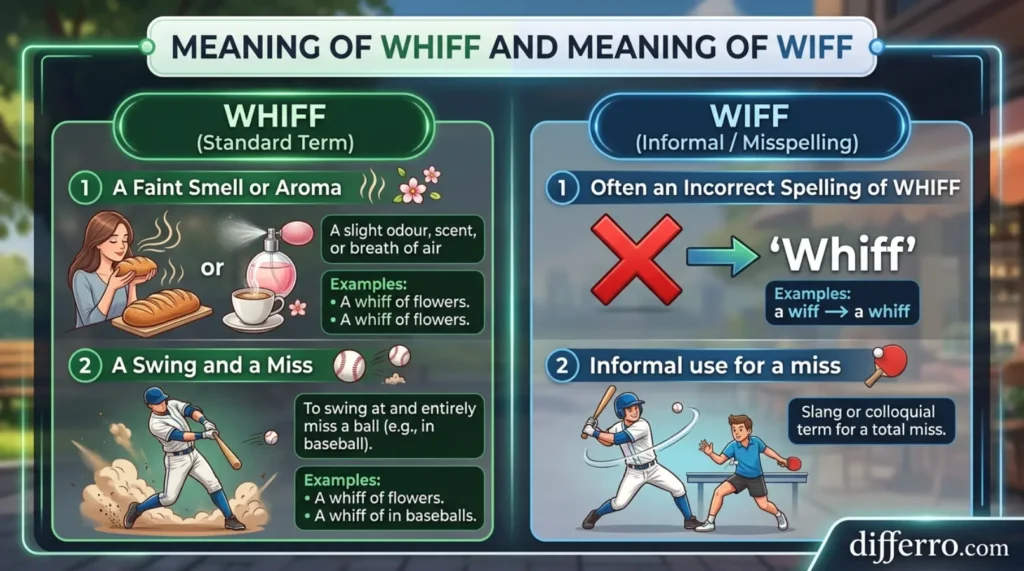
📖 Meaning of Whiff
Whiff is a standard English word used as a noun and verb. It commonly describes a brief smell or small amount of air, smoke, or gas. It can also mean a slight indication of something. (Merriam-Webster)
Examples:
- I caught a whiff of fresh bread.
- There was a whiff of smoke in the room.
In sports, whiff can mean missing a ball completely. Cambridge also records a US slang use meaning to fail at something. (Cambridge Dictionary)
Examples:
- The batter whiffed at the fastball.
- I completely whiffed that shot.
📖 Meaning of Wiff
Wiff is not the standard modern spelling for the common meanings of whiff.
It may still appear in:
- Proper names
- Usernames
- Informal slang
- Specialized terms
- Historical or dialectal writing
For normal English, choose whiff.
Examples:
- ❌ I caught a wiff of perfume.
- ✅ I caught a whiff of perfume.
- ❌ The batter wiffed at the pitch.
- ✅ The batter whiffed at the pitch.
🔍 Whiff or Wiff: Key Differences
| Feature | Whiff | Wiff |
|---|---|---|
| Standard English | ✅ Yes | ❌ Usually no |
| Meaning | Smell, puff, hint, miss | Usually a nonstandard spelling |
| Tone | Normal | Informal or specialized |
| Everyday usage | Common | Limited |
| Professional writing | Recommended | Avoid |
| Sports usage | Yes | Not standard |
| Pronunciation | /wɪf/ | Often intended as /wɪf/ |
Merriam-Webster lists whiff as a noun and verb with meanings involving smells, traces, air, and strikeouts. (Merriam-Webster)
📜 Origin & History
The word whiff has a long history in English. Merriam-Webster records its first known use as 1591. Its origin is described as imitative, reflecting a sound or action associated with air or blowing. (Merriam-Webster)
The word later developed several related meanings. These include a small puff, a smell, a slight trace, and a sports miss.
Similar words include:
- whiffle — to blow lightly or unsteadily
- whistle — a high sound made by air
- puff — a short burst of air
- sniff — to breathe in through the nose
- waft — to move gently through the air
The spelling whiff became the established modern form.
🇬🇧 British English vs American English Spelling
There is no British-American spelling difference for this word.
British English uses whiff.
American English also uses whiff.
Cambridge gives /wɪf/ for both UK and US pronunciation. (Cambridge Dictionary)
Comparison Table: British vs American English
| Feature | British English | American English |
|---|---|---|
| Correct spelling | Whiff | Whiff |
| Pronunciation | /wɪf/ | /wɪf/ |
| Smell meaning | Yes | Yes |
| Sports meaning | Yes | Yes |
| Wiff as standard spelling | No | No |

✍️ When to Use Whiff
Use whiff when you mean a brief smell, small puff, slight hint, or missed attempt.
✮For Smells
- I caught a whiff of roses.
- A whiff of smoke entered the room.
For Hints
- There was a whiff of suspicion.
- His statement carried a whiff of doubt.
✮For Sports
- The batter whiffed at the pitch.
- The golfer whiffed the shot.
For Failures
- I completely whiffed that question.
- The team whiffed on a great opportunity.
Cambridge recognizes these smell, sports, and failure-related uses. (Cambridge Dictionary)
✍️ When to Use Wiff
Use wiff only when the spelling belongs to a specific name, specialized term, or intentional informal usage.
For ordinary English writing, avoid it.
Examples
- ❌ I smelled a wiff of smoke.
- ✅ I smelled a whiff of smoke.
- ❌ She wiffed the ball.
- ✅ She whiffed the ball.
A proper name can follow its own spelling rules. The same applies to usernames and brand names.
⚠️ Common Mistakes
1. Writing Wiff for a Smell
❌ I caught a wiff of coffee.
✅ I caught a whiff of coffee.
2. Removing the H
❌ There was a wiff of smoke.
✅ There was a whiff of smoke.
The h remains part of the standard spelling.
3. Using Wiffed in Sports
❌ The batter wiffed at the ball.
✅ The batter whiffed at the ball.
4. Writing Wiff in Formal Work
❌ The report mentioned a wiff of corruption.
✅ The report mentioned a whiff of corruption.
5. Assuming Sound Determines Spelling
❌ It sounds like “wiff,” so wiff must be correct.
✅ English spelling does not always match pronunciation perfectly.
🧠 Easy Trick to Remember
Remember this:
WHIFF = What Hits Your Face as a Smell
Think of these phrases:
- whiff of coffee
- whiff of perfume
- whiff of smoke
- whiff of suspicion
- whiffed the ball
If you mean the normal English word, remember the WH and double FF.
🌎 Everyday Life Examples
1. In the Kitchen
I caught a whiff of freshly baked bread.
2. At Home
A strange whiff of smoke came from the kitchen.
3. In a Garden
She noticed a pleasant whiff of roses.
4. During a Game
The batter swung hard but whiffed at the ball.
5. In Conversation
There was a whiff of doubt in his response.
These examples show how whiff works naturally with smells, sports, and figurative meanings. (Merriam-Webster)
📊 Google Trends & Usage Data
Search visibility for whiff is much stronger because it is the established English word. Current web usage also shows wiff appearing mainly in spelling questions, names, informal contexts, and specialized uses. (Compairfy)
USA: Whiff is strongly associated with everyday English and sports usage.
UK: Whiff is the standard spelling and has no British spelling variant.
Australia: Whiff remains the conventional English spelling.
India: Spelling-confusion searches can arise because pronunciation makes the silent h easy to miss.
Pakistan: English learners may encounter the same spelling confusion, especially in written communication.
SEO insight: Treat “Whiff or Wiff” as a spelling-intent keyword. Build supporting content around whiff meaning, whiffed vs wiffed, and correct spelling of whiff.
Note: Google Trends does not provide reliable public numeric data for every low-volume spelling comparison. The regional points above are directional usage insights, not exact search-volume figures.
Comparison Table: Keyword Variations
| Keyword Variation | Search Intent | Best Answer |
|---|---|---|
| Whiff or Wiff | Spelling | Whiff |
| Wiff or Whiff | Spelling | Whiff |
| Whiff meaning | Definition | Brief smell or hint |
| Wiff meaning | Confusion | Usually nonstandard |
| Whiffed or Wiffed | Grammar | Whiffed |
| Is Whiff a Word? | Definition | Yes |
| Correct spelling of Whiff | Spelling | Whiff |
⚖️ Final Verdict
Whiff is the correct choice for standard modern English.
Use whiff for:
- A brief smell
- A small puff
- A slight hint
- A missed sports shot
- A failed attempt
Wiff should not normally replace whiff in school, business, academic, or professional writing.
The easiest rule is:
If you mean the standard English word, choose WHIFF.
❓ Frequently Asked Questions
Is “whiff” or “wiff” correct?
Whiff is the standard spelling. It can describe a brief smell, small puff, slight hint, or missed attempt. (Merriam-Webster)
What is the difference between whiff and wiff?
Whiff is the established standard English word. Wiff is usually a nonstandard spelling when people intend whiff.
Which is more common, whiff or wiff?
Whiff is much more common in standard English. It appears in dictionaries and normal writing. (Merriam-Webster)
Is whiff formal or informal?
Whiff works in both everyday and formal writing. Its figurative use also appears in journalism and professional writing.
Why does the confusion between whiff and wiff exist?
The main reason is pronunciation. The word is pronounced /wɪf/, so writers may omit the h when spelling it from sound. Cambridge confirms the UK and US pronunciation. (Cambridge Dictionary)
📝 Conclusion
When choosing between Whiff or Wiff, use whiff in standard English. The word can describe a brief smell, a small puff of air, or a slight hint of something. It can also describe a missed shot or failed attempt in sports and informal American usage. (Merriam-Webster)
The confusion comes mainly from pronunciation. Whiff sounds like the spelling could be wiff, but English spelling does not always follow sound. British and American English both use whiff, so you do not need a regional spelling. (Cambridge Dictionary)
For schoolwork, websites, emails, business documents, and professional writing, choose whiff. Wiff may appear in names or specialized contexts, but it is not the normal spelling of this English word.

Imran Lodhra is a comparison-focused content writer at Differro.com.
He specializes in creating clear, simple, and informative comparison articles.
His work helps readers understand key differences, pros and cons, and important details.
Imran focuses on accurate, practical, and easy-to-read content for everyday readers.