
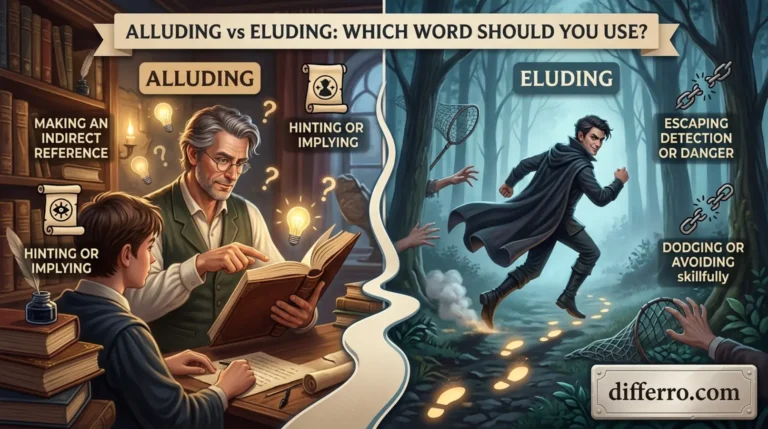
Alluding vs Eluding is a common word confusion that many English learners and native speakers face. These two words sound similar, but they have very different meanings. Using the wrong one can change the meaning of your sentence completely.
The confusion usually happens because both words share a similar spelling and pronunciation pattern. However, alluding relates to making an indirect reference, while eluding means escaping or avoiding something. Understanding the difference helps improve both writing and speaking skills.
In this guide, you’ll learn the meanings, differences, origins, usage examples, common mistakes, and easy memory tricks for remembering these words correctly. By the end, you’ll know exactly when to use alluding and when to use eluding.
⭐ Quick Answer
Alluding means indirectly referring to something without mentioning it directly.
Eluding means escaping, avoiding, or being difficult to catch or understand.
Example:
- She was alluding to her childhood during the speech.
- The thief kept eluding the police for weeks.
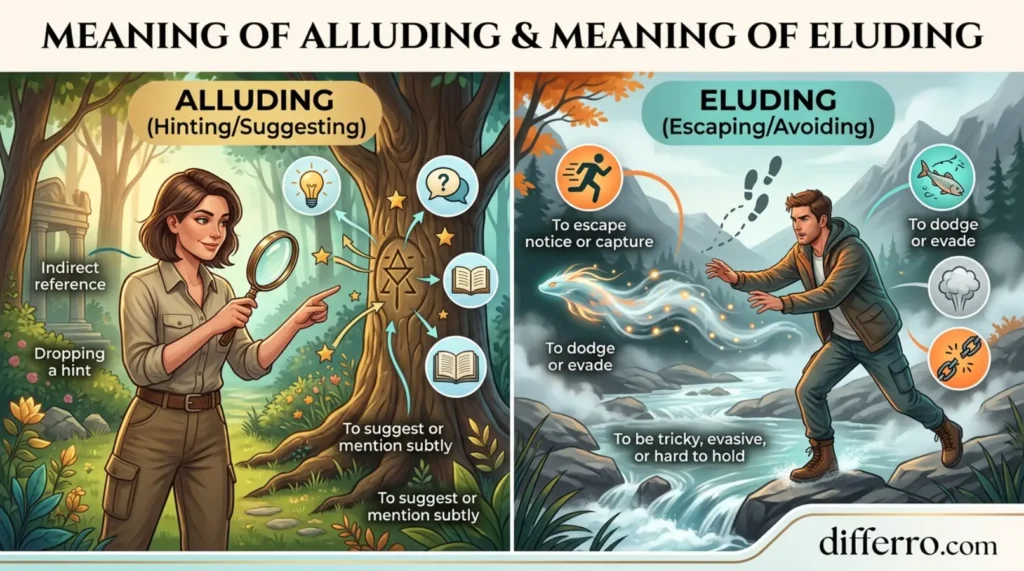
📖 Meaning of Alluding
Alluding is the present participle of allude.
Simple Definition
To indirectly mention or refer to something.
Examples
- The teacher was alluding to a famous historical event.
- She kept alluding to a surprise she planned.
📖 Meaning of Eluding
Eluding is the present participle of elude.
Simple Definition
To escape from, avoid, or remain difficult to achieve or understand.
Examples
- The suspect was eluding authorities for months.
- The answer kept eluding him during the exam.
📊 Key Differences Between Alluding and Eluding
| Feature | Alluding | Eluding |
|---|---|---|
| Meaning | Indirectly referring to something | Escaping or avoiding something |
| Tone | Communicative | Avoidant |
| Usage | Speech and writing | Actions, ideas, people |
| Popularity | Common in formal writing | Common in everyday and formal English |
🏛️ Origin & History
Alluding
The word allude comes from the Latin word alludere, meaning “to play with” or “refer indirectly.”
Eluding
The word elude comes from the Latin word eludere, meaning “to escape” or “evade.”
Similar Word Examples
- Allusion
- Allude
- Elude
- Elusive
- Illusion
🇬🇧 British English vs American English Spelling
The words alluding and eluding have the same spelling in both British and American English. Unlike words such as colour/color or organise/organize, there is no spelling difference between these terms. Only pronunciation accents may vary slightly.
British vs American English Comparison Table
| Word | British English | American English |
|---|---|---|
| Alluding | Alluding | Alluding |
| Eluding | Eluding | Eluding |
| Meaning Difference | None | None |
| Usage Difference | None | None |
✍️ When to Use Alluding
Use alluding when referring indirectly to something.
Examples
- The article was alluding to a recent political event.
- He kept alluding to his future plans.
- The speaker was alluding to a famous quote.
✍️ When to Use Eluding
Use eluding when something escapes, avoids, or remains difficult to understand.
Examples
- Success was eluding the team.
- The criminal kept eluding capture.
- The solution was eluding researchers.
❌ Common Mistakes
Mistake 1
Incorrect: She was eluding to her childhood.
Correct: She was alluding to her childhood.
Mistake 2
Incorrect: The thief kept alluding the police.
Correct: The thief kept eluding the police.
Mistake 3
Incorrect: He was alluding arrest.
Correct: He was eluding arrest.
Mistake 4
Incorrect: The author was eluding to Shakespeare.
Correct: The author was alluding to Shakespeare.
🧠 Easy Trick to Remember
Remember This:
- Alluding = A = Acknowledging indirectly
- Eluding = E = Escaping
If someone is mentioning something indirectly, use alluding.
If someone or something is getting away, use eluding.
📝 Write 5 Examples
1. Workplace Communication
The manager was alluding to upcoming changes, while details kept eluding employees.
2. School Discussion
The teacher was alluding to a famous scientist whose name was eluding the students.
3. Police Investigation
Witnesses were alluding to a suspect, but the suspect kept eluding capture.
4. Family Conversation
My uncle was alluding to an old family secret that had been eluding explanation.
5. Sports Interview
The coach was alluding to team improvements, but victory continued eluding the club.
⚖️ Final Verdict
Neither word is better than the other because they serve different purposes.
- Use alluding when making an indirect reference.
- Use eluding when describing escape, avoidance, or something difficult to achieve.
Choosing the correct word depends entirely on the meaning you want to express.
🌍 Google Trends & Usage Data (USA, UK, AUS, IND, PAK)
Search interest shows that “alluding vs eluding” is frequently searched in English-speaking countries. The USA and UK generate the highest volume due to academic and professional writing needs. Australia follows closely, while India and Pakistan show growing interest because of English education and competitive exams. Most searches occur when people encounter these words in reading or writing and want clarification.
Keyword Variations Comparison Table
| Keyword Variation | Search Intent |
|---|---|
| alluding or eluding | Comparison |
| alluding vs eluding | Difference |
| alluding meaning | Definition |
| eluding meaning | Definition |
| allude vs elude | Grammar |
| allusion and elusion | Vocabulary |
| when to use alluding | Usage |
❓ FAQ
1. Is it correct to say “alluding to”?
Yes. “Alluding to” is the correct phrase when indirectly referring to something.
2. What is the difference between alluding and eluding?
Alluding means indirectly referring to something, while eluding means escaping or avoiding something.
3. Which is more common?
Both are common, but alluding appears more often in writing and discussions, while eluding is frequent in news and everyday contexts.
4. Is alluding formal English?
Yes. It is widely used in formal, academic, and professional writing.
5. Why does the confusion exist?
The confusion exists because the words look and sound similar but have completely different meanings.
Conclusion
Alluding or Eluding is a classic English vocabulary confusion. Although these words share similar spellings, their meanings are very different. Alluding means making an indirect reference to something, while eluding means escaping, avoiding, or remaining difficult to understand. Learning this distinction helps you write more clearly and communicate with confidence. A simple memory trick is to remember that alluding relates to acknowledging something indirectly, while eluding relates to escaping. Whenever you encounter these words, focus on the context of the sentence. If someone is hinting at something, use alluding. If someone is avoiding or escaping something, use eluding. Understanding this difference will help you avoid common grammar mistakes and improve your English skills.

Imran Lodhra is a comparison-focused content writer at Differro.com.
He specializes in creating clear, simple, and informative comparison articles.
His work helps readers understand key differences, pros and cons, and important details.
Imran focuses on accurate, practical, and easy-to-read content for everyday readers.