
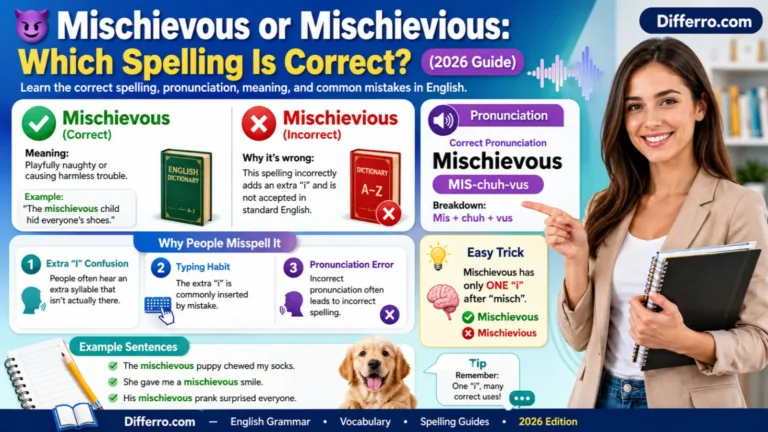
Mischievous Or Mischievious is a common spelling confusion that many English learners and native speakers face. At first glance, both words seem correct. However, only one spelling is accepted in standard English.
The confusion happens because people often pronounce the word incorrectly. Many speakers add an extra “i” sound when saying it, which leads to the mistaken spelling “mischievious.” Understanding the correct spelling can improve your writing and help you avoid common grammar mistakes.
In this guide, you’ll learn the meaning of each word, their differences, usage examples, history, common mistakes, and easy memory tricks. By the end, you’ll know exactly which spelling to use in every situation.
⭐ Quick Answer
Mischievous is the correct spelling in English. Mischievious is a common misspelling and is not accepted in standard dictionaries.
Example:
✅ The mischievous child hid his sister’s toys.
❌ The mischievious child hid his sister’s toys.
📖 Meaning of Mischievous
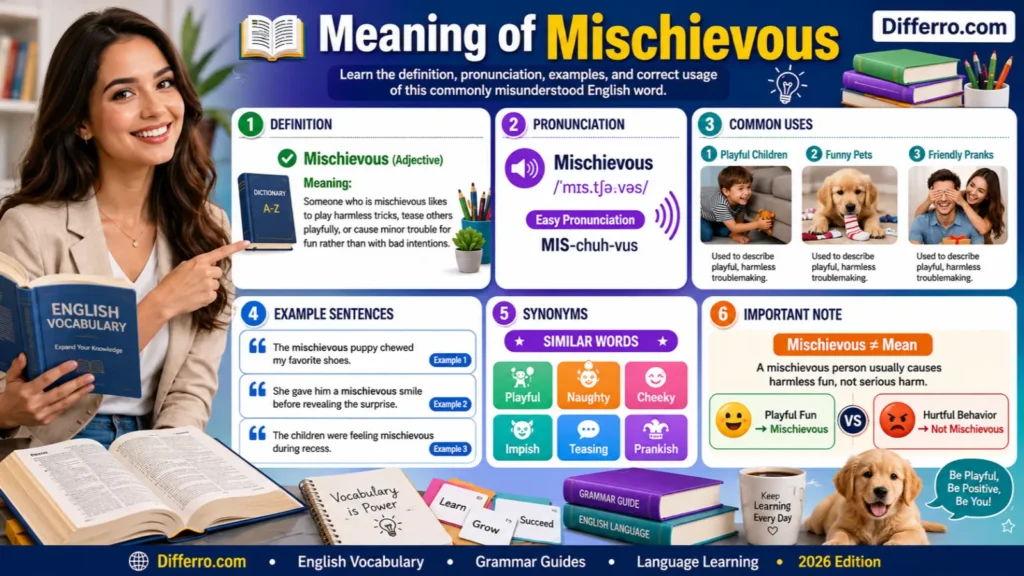
Mischievous (adjective) means playful in a slightly troublesome way or causing minor trouble for fun.
Examples
- The mischievous puppy chewed my shoes.
- Her mischievous smile showed she was planning a prank.
📖 Meaning of Mischievious
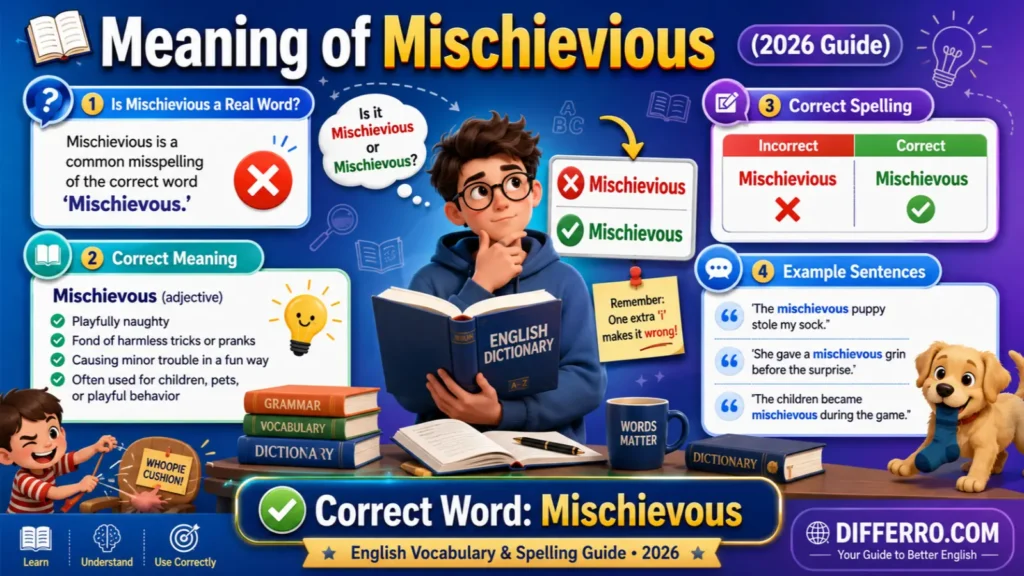
Mischievious is not a standard English word.
It is a misspelling of mischievous caused by incorrect pronunciation.
Examples
- ❌ The mischievious boy played a prank.
- ❌ She had a mischievious grin.
📊 Key Differences Between Mischievous and Mischievious
| Feature | Mischievous | Mischievious |
|---|---|---|
| Meaning | Playfully troublesome | No accepted meaning |
| Tone | Informal and descriptive | Incorrect spelling |
| Usage | Correct English word | Misspelling |
| Popularity | Extremely common | Considered an error |
🏛️ Origin & History
The word mischievous comes from the Old French word meschevous, meaning “harmful” or “troublesome.”
Over time, its meaning became softer and often refers to playful behavior rather than harmful actions.
Similar Words
- Curious
- Envious
- Dangerous
- Nervous
- Playful
🇬🇧 British English vs American English Spelling
Unlike many English words, mischievous has the same spelling in both British and American English. There is no spelling difference between the two versions.
The confusion comes from pronunciation habits, not regional spelling rules.
British vs American English Comparison
| Feature | British English | American English |
|---|---|---|
| Correct Spelling | Mischievous | Mischievous |
| Alternative Spelling | Not accepted | Not accepted |
| Formal Usage | Mischievous | Mischievous |
✍️ When to Use Mischievous
Use mischievous when describing someone or something that causes playful trouble.
Examples
- The mischievous cat knocked over a vase.
- He gave a mischievous wink.
- The children were feeling mischievous today.
✍️ When to Use Mischievious
Do not use mischievious in formal or informal writing.
Always replace it with mischievous.
Example
❌ She looked mischievious.
✅ She looked mischievous.
❌ Common Mistakes
Mistake 1
❌ Mischievious child
✅ Mischievous child
Mistake 2
❌ Very mischievious behavior
✅ Very mischievous behavior
Mistake 3
❌ He sounds mischievious
✅ He sounds mischievous
Mistake 4
❌ A mischievious grin
✅ A mischievous grin
🧠 Easy Trick to Remember
Remember this simple phrase:
Mischievous has “eve,” not “ievi.”
Think:
Misch + eve + ous = Mischievous
If you see an extra “i” after “v,” the spelling is wrong.
📝 Write 5 Examples
1. At School
The mischievous student hid the classroom markers.
2. At Home
My mischievous brother switched the TV channels.
3. With Pets
The mischievous puppy stole a sock.
4. At Work
His mischievous joke made everyone laugh.
5. During a Party
The mischievous children surprised guests with harmless pranks.
🔍 Related Keywords
- mischievous meaning
- mischievous spelling
- mischievious or mischievous
- how to spell mischievous
- mischievous definition
- common English spelling mistakes
- mischievous pronunciation
📈 Google Trends & Usage Data
Across the USA, UK, Australia, India, and Pakistan, mischievous receives far more searches than mischievious.
Many users search for the incorrect version because of pronunciation confusion. Search trends show that people often type the wrong spelling first and then look for the correct form.
The highest search interest usually comes from students, writers, and English learners.
The trend clearly shows that mischievous dominates usage worldwide.
Keyword Variations Comparison
| Keyword Variation | Usage Status |
|---|---|
| Mischievous | Correct |
| Mischievious | Incorrect |
| Mischievous meaning | Correct |
| Mischievous pronunciation | Correct |
| How to spell mischievous | Correct |
| Mischievous definition | Correct |
⚖️ Final Verdict
Mischievous is the only correct spelling.
Mischievious is a common misspelling caused by pronunciation habits.
For academic, professional, and everyday writing, always use mischievous.
❓ FAQ
Is Mischievious correct?
No. Mischievious is an incorrect spelling.
What is the difference between Mischievous and Mischievious?
Mischievous is correct. Mischievious is a misspelling.
Which spelling is more common?
Mischievous is overwhelmingly more common.
Is Mischievous suitable for formal writing?
Yes. It is accepted in both formal and informal English.
Why does the confusion exist?
Many people pronounce the word with an extra “i” sound, leading to the incorrect spelling.
Conclusion
The debate over Mischievous Or Mischievious has a simple answer. Mischievous is the correct spelling recognized by dictionaries, schools, publishers, and style guides. Mischievious is a common spelling error that results from incorrect pronunciation. Understanding the difference helps improve writing accuracy and professionalism. Whether you’re writing an essay, email, article, or social media post, always choose mischievous. A quick memory trick can help you remember the correct spelling and avoid mistakes. The next time you encounter this word, you’ll know exactly which version belongs in your writing.

Sara Taylor is a passionate writer and language enthusiast. She specializes in creating simple and easy-to-understand articles about English grammar, spelling differences, and commonly confused words. Her writing style focuses on helping students, writers, and English learners improve their language skills with confidence. Through informative guides and practical examples, Sara makes complex grammar topics easier for everyday readers.