

Silicon Or Silicone is a common confusing keyword in English. Many people mix these two words in writing and speech.
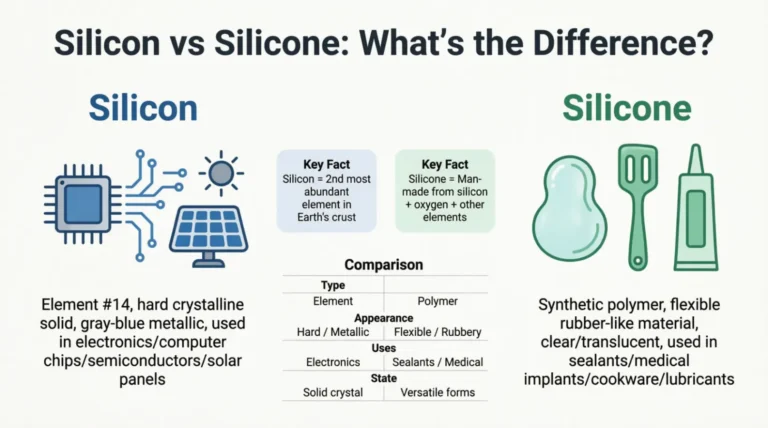
They look similar but have totally different meanings and uses. Silicon is a natural chemical element. Silicone is a man-made material used in daily products.
This confusion happens in science, health, beauty, and tech content. Even students and writers often use the wrong word.
In this article, you will clearly understand the difference. You will also learn meanings, examples, usage rules, and easy memory tricks. This guide will help you avoid mistakes and improve your writing accuracy. Let’s make this simple and clear.
⭐ Quick Answer
Silicon Or Silicone are not the same.
Silicon is a natural chemical element used in electronics. Silicone is a synthetic material used in kitchen tools, implants, and sealants.
👉 Example:
- Silicon is used in computer chips
- Silicone is used in baking molds and medical devices
4. Meaning Section
🔹 Meaning of Silicon
Silicon is a chemical element found in sand and rocks.
It is widely used in electronics and computer chips.
Examples:
- Silicon is used in microprocessors.
- Solar panels are made using silicon.
🔹 Meaning of Silicone
Silicone is a synthetic polymer made from silicon, oxygen, carbon, and hydrogen.
It is flexible, heat-resistant, and waterproof.
Examples:
- Silicone is used in kitchen baking mats.
- Silicone is used in medical implants.
5. Key Differences Table
| Feature | Silicon | Silicone |
|---|---|---|
| Meaning | Natural chemical element | Synthetic polymer material |
| Tone | Scientific / technical | Industrial / everyday use |
| Usage | Electronics, chips, solar cells | Kitchenware, medical tools |
| Popularity | High in tech industries | High in consumer products |
6. Origin & History
Silicon was discovered in the early 1800s by chemists studying minerals.
It became important during the computer revolution.
Silicone was developed in the 20th century for industrial use.
It was designed for heat resistance and flexibility.
Similar word examples:
- Carbon vs Carbon fiber
- Aluminum vs Alloy materials
🇬🇧 British English vs American English Spelling
There is no spelling difference between British and American English for silicon or silicone.
The difference lies only in usage context, not spelling.
Both regions use the same scientific terms globally.
Comparison Table: British vs American English
| Word | British English | American English |
|---|---|---|
| Silicon | Silicon | Silicon |
| Silicone | Silicone | Silicone |
7. When to Use Each Word
🔹 Use Silicon When:
- Talking about electronics
- Discussing science or chemistry
- Referring to computer chips
Example:
Silicon is used in smartphones and laptops.
🔹 Use Silicone When:
- Talking about kitchen products
- Medical or cosmetic items
- Industrial sealing materials
Example:
Silicone is used in baby bottle nipples.
8. Common Mistakes
❌ Mistake 1: Silicon baking tray
✔ Correct: Silicone baking tray
❌ Mistake 2: Silicone chips in computers
✔ Correct: Silicon chips in computers
❌ Mistake 3: Silicon breast implants
✔ Correct: Silicone breast implants
❌ Mistake 4: Silicone sand in electronics
✔ Correct: Silicon from sand in electronics
9. Easy Trick to Remember
Think like this:
- Silicon = Tech (chips, computers)
- Silicone = Soft (rubber-like, flexible items)
👉 Tech = Silicon
👉 Soft products = Silicone
10. Everyday Life Examples
💻 1. Smartphones
Silicon is used in smartphone processors.
🍰 2. Baking Tools
Silicone molds are used in ovens.
🏥 3. Medical Implants
Silicone is used in safe medical implants.
🔆 4. Solar Panels
Silicon helps convert sunlight into energy.
🧴 5. Beauty Products
Silicone is used in skincare and cosmetics.
11. Related Keywords
- Silicon vs Silicone difference
- Silicon meaning in science
- Silicone material uses
- Silicon chip explanation
- Silicone products list
- Silicon vs silicone examples
- Silicone vs rubber material
12. Final Verdict
Silicon and Silicone are completely different.
Silicon belongs to science and electronics.
Silicone belongs to flexible industrial and consumer products.
If you are talking about computers or chips, use silicon.
If you are talking about soft, rubber-like products, use silicone.
📊 Google Trends & Usage Insight (5 Countries)
In the USA and UK, both terms are widely searched in tech and health content.
Australia shows steady interest in silicone due to home products.
India and Pakistan show higher confusion between both words in education searches.
Overall, “silicone” is more common in daily life, while “silicon” dominates tech searches.
Comparison Table: Keyword Variations
| Variation | Usage Area |
|---|---|
| Silicon vs Silicone | Education |
| Silicon meaning | Science |
| Silicone uses | Consumer goods |
| Silicon chips | Technology |
| Silicone products | Lifestyle |
❓ FAQ Section
1. Is it correct to say silicon and silicone?
Yes, both are correct but used in different contexts.
2. What is the main difference?
Silicon is a natural element, silicone is a synthetic material.
3. Which is more common?
Silicone is more common in daily life products.
4. Is silicon formal?
Yes, silicon is a formal scientific term.
5. Why is there confusion?
Because both words sound similar and look alike.
🧠 Conclusion
Silicon Or Silicone confusion is very common in English writing.
Both words look similar but serve different purposes.
Silicon is a natural element used in electronics, solar panels, and computer chips.
Silicone is a man-made material used in kitchen tools, medical devices, and industrial products.
Understanding this difference improves your writing accuracy and communication skills.
It also helps in science, education, and daily usage.
Always remember the simple rule: silicon belongs to technology, and silicone belongs to flexible products.
With practice, you will never confuse these two words again.
This knowledge is useful for students, writers, and professionals in many fields.

