
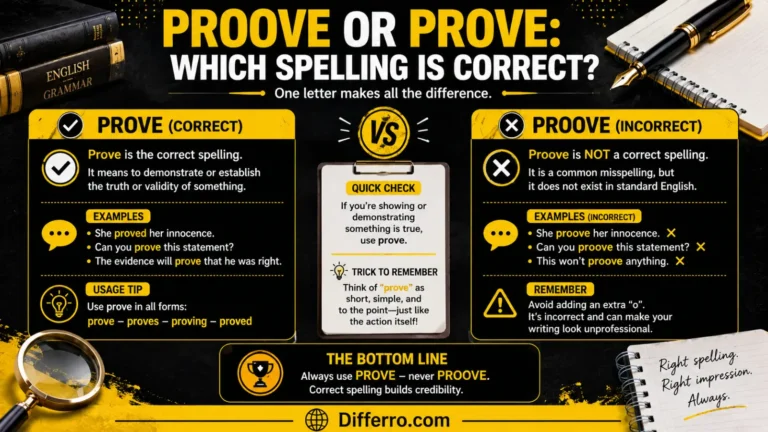
Proove or Prove is a common spelling confusion in English. Many people accidentally write “proove” because it sounds similar to words like “choose” or “improve.” However, only one spelling is correct in standard English.
This mistake appears in emails, school assignments, blog posts, and even business writing. English spelling rules can feel confusing because some words do not follow predictable patterns.
The good news is simple: “prove” is the correct spelling, while “proove” is considered a misspelling. Learning the difference helps you write more clearly and professionally.
In this guide, you will learn the meaning, usage, history, common mistakes, and easy memory tricks for “prove” and “proove.” You will also see examples, usage trends, and SEO-friendly comparisons to fully understand the topic.
⭐ Quick Answer
“Prove” is the correct English spelling.
“Proove” is incorrect and not accepted in modern English dictionaries.
✅ Correct: I can prove my point.
❌ Incorrect: I can proove my point.
📖 Meaning of Proove
Meaning of “Proove”
“Proove” has no accepted meaning in modern English. It is simply a spelling mistake of “prove.”
Examples
❌ She will proove her skills tomorrow.
❌ Can you proove this fact?
📖 Meaning of Prove
Meaning of “Prove”
“Prove” means to show that something is true using evidence, facts, or actions.
Examples
✅ He can prove his innocence.
✅ This test will prove the theory.
📊 Key Differences Between Proove and Prove
| Feature | Proove | Prove |
|---|---|---|
| Correct Spelling | ❌ No | ✅ Yes |
| Meaning | None | Show truth with evidence |
| Usage | Misspelling | Standard English word |
| Tone | Incorrect | Formal and informal |
| Popularity | Rare | Extremely common |
| Dictionary Status | Not accepted | Accepted worldwide |
🕰️ Origin & History
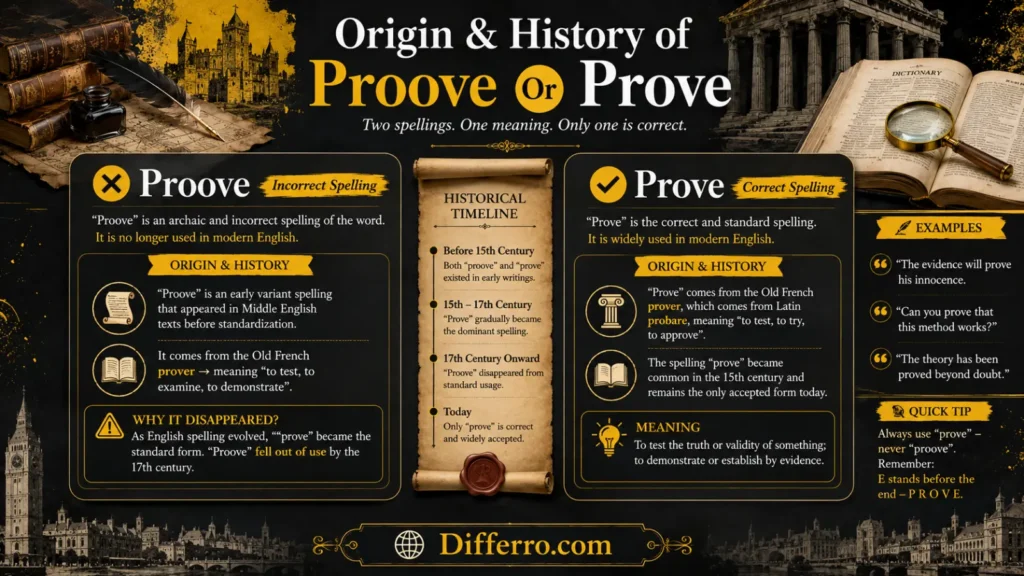
The word “prove” comes from the Old French word prover. It later entered Middle English and became part of modern English vocabulary.
English has many confusing spellings because words came from different languages.
Similar Word Examples
- Move
- Improve
- Approve
- Groove
These words may cause people to wrongly spell “prove” as “proove.”
🇬🇧 British English vs American English Spelling
Both British English and American English use the spelling “prove.” There is no regional spelling difference for this word.
“Proove” is incorrect in both language styles.
Comparison Table: British vs American English
| Language Style | Correct Form |
|---|---|
| British English | Prove |
| American English | Prove |
| Australian English | Prove |
| Canadian English | Prove |
✍️ When to Use Each Word
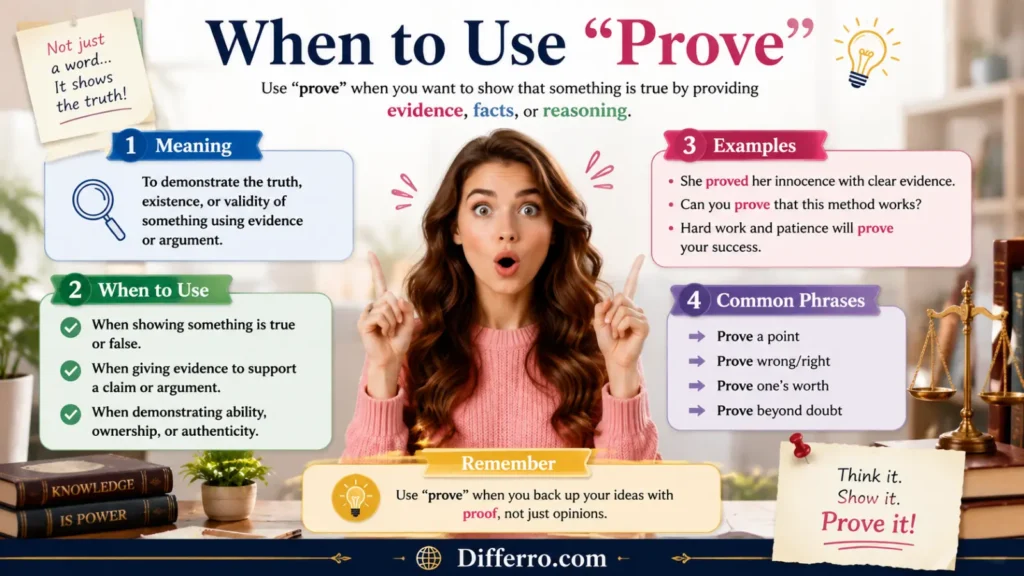
When to Use “Prove”
Use “prove” when showing facts, truth, evidence, or results.
Examples
- Can you prove your claim?
- The teacher proved the answer.
- This document proves ownership.
When to Use “Proove”
Do not use “proove” in formal or informal writing because it is incorrect.
Incorrect Examples
- ❌ I will proove it tomorrow.
- ❌ They prooved the point.
❌ Common Mistakes
| Incorrect Usage | Correct Usage |
|---|---|
| Proove | Prove |
| Prooved | Proved |
| Prooving | Proving |
| Can you proove it? | Can you prove it? |
🧠 Easy Trick to Remember
Think of this sentence:
👉 “You prove truth with one ‘o’.”
The correct spelling only has one “o.”
📝 write 5 examples
1. School Assignment Example
The student used facts to prove the answer was correct.
2. Workplace Example
Employees must prove their skills during training.
3. Courtroom Example
Lawyers try to prove innocence using evidence.
4. Science Example
Experiments help scientists prove theories.
5. Everyday Conversation Example
You do not need to prove everything to everyone.
🔍 Related Keywords
- Prove meaning
- Proove vs prove
- Correct spelling of prove
- How to spell prove
- Prove definition
- Prove in English
- Common spelling mistakes
🌍 Google Trends & Usage Data
Search data shows that “prove” is overwhelmingly more popular than “proove” worldwide. Most searches for “proove” come from spelling confusion.
Countries like the USA, UK, Australia, India, and Pakistan all show strong preference for “prove.” English learners often search both spellings to verify correctness.
The misspelled version appears mostly in casual typing or beginner writing.
📈 Comparison Table: Keyword Variations
| Country | “Prove” Popularity | “Proove” Popularity |
|---|---|---|
| USA | Very High | Very Low |
| UK | Very High | Very Low |
| Australia | High | Low |
| India | High | Moderate |
| Pakistan | High | Moderate |
⚖️ Final Verdict
✅ “Prove” is the only correct spelling.
❌ “Proove” is a spelling mistake.
Use “prove” in:
- Academic writing
- Emails
- Business communication
- Everyday English
Avoid “proove” completely in professional writing.
FAQs ;
1. Is “proove” correct?
No. “Proove” is incorrect in modern English.
2. What is the difference between prove and proove?
“Prove” is correct. “Proove” is a misspelling.
3. Which is more common, prove or proove?
“Prove” is far more common worldwide.
4. Is “prove” formal or informal?
“Prove” works in both formal and informal writing.
5. Why does this confusion exist?
People often confuse the spelling because of words like “improve” and “approve.”
📝 Conclusion
The confusion between proove and prove is very common, especially among English learners. Still, the answer is simple. “Prove” is the correct spelling used in dictionaries, schools, workplaces, and everyday communication.
“Proove” is not accepted in standard English and should be avoided in all writing. Understanding the correct form helps improve grammar, spelling, and professionalism.
A simple memory trick can help you remember it forever: “prove has one o.”
Whenever you want to show truth, evidence, or facts, always choose prove.
Discover More Post ;
Axle Or Axel: Which Spelling Is Correct?
Roster Or Roaster: What’s the Real Difference?
While Or Whilst: What’s the Real Difference?

Sara Taylor is a passionate writer and language enthusiast. She specializes in creating simple and easy-to-understand articles about English grammar, spelling differences, and commonly confused words. Her writing style focuses on helping students, writers, and English learners improve their language skills with confidence. Through informative guides and practical examples, Sara makes complex grammar topics easier for everyday readers.